
Dark Command (1940 film)
1940 American Western directed by Raoul Walsh, adapted from W. R. Burnett, starring John Wayne and Claire Trevor; produced by Republic Pictures and nominated for two Academy Awards.
Overview
Dark Command is a 1940 American Western film directed by Raoul Walsh and adapted from a work by W. R. Burnett. Released by Republic Pictures, it features a leading cast that includes John Wayne and Claire Trevor, with supporting appearances by Walter Pidgeon, Roy Rogers, Marjorie Main and others. The film blends action, romance and period conflict common to studio Westerns of the era.
Image gallery
1 Image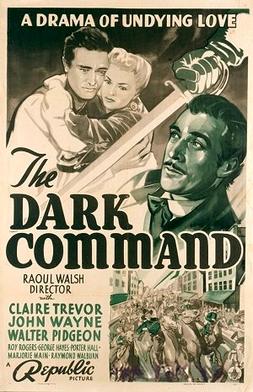
Setting and themes
Rather than a simple frontier adventure, the story unfolds against regional tensions of the late 19th-century United States and incorporates themes of loyalty, law and disorder. The narrative emphasizes the clash between personal ambition and communal stability, showing how local violence can be tied to larger political and economic pressures during the period.
Production and cast
Produced by Republic Pictures, a studio known for efficient genre filmmaking, Dark Command benefited from higher production values than many poverty-row Westerns. Director Raoul Walsh brought experience in action cinema, and the casting combined a rising star in John Wayne with established character actors. The supporting ensemble gave the picture a mix of comic and dramatic textures that was typical of studio-era Westerns.
Awards and reception
The film received recognition from the Academy of Motion Picture Arts and Sciences with two nominations at the 1941 Academy Awards: one for Best Original Score and one for Best Art Direction (crediting John Victor Mackay). Contemporary reviews noted the film's production polish and star power, while later commentators have placed it within John Wayne's early career surge after his breakout in the late 1930s.
Principal cast
- John Wayne — leading role
- Claire Trevor — leading lady
- Walter Pidgeon — supporting
- Roy Rogers — supporting appearance
- George "Gabby" Hayes — character sidekick
- Marjorie Main — supporting
Legacy and significance
Dark Command occupies a place in the transition of the Hollywood Western from B-picture routine toward more ambitious studio presentations. Its Oscar nominations highlighted technical aspects of the production at a studio not usually associated with prestige filmmaking. For students of the genre and of John Wayne's career, the film is often cited as an example of how star vehicles and studio craftsmanship were combined to broaden popular appeal.
Author
AlegsaOnline.com Dark Command (1940 film) Leandro Alegsa
URL: https://en.alegsaonline.com/art/137264