
Big Momma's House 2
2006 crime-comedy sequel starring Martin Lawrence as an undercover FBI agent in disguise; directed by John Whitesell and released by 20th Century Fox as the second film in the Big Momma trilogy.
Big Momma's House 2 is a 2006 American crime comedy that continues the fish-out-of-water premise of the original film. Directed by John Whitesell, it follows FBI agent Malcolm Turner as he again adopts the persona of "Big Momma" to solve a case while juggling family situations and broad physical comedy. The picture blends slapstick, disguise-based gags and light crime plotting, and it serves as the middle entry of a three-film series.
Image gallery
1 Image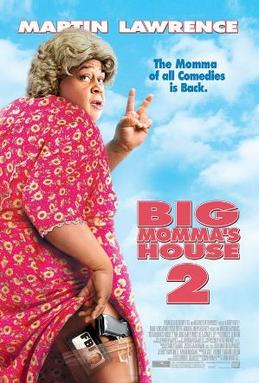
Plot overview
In this sequel Malcolm goes undercover in his Big Momma disguise to protect a friend and to gather evidence against suspects involved in a theft and other misdeeds. Alongside the investigation, the movie explores domestic and parental themes through humorous misunderstandings, mistaken identities and the challenges of keeping a deep-cover persona from being exposed. The tone is comedic and relies heavily on Martin Lawrence's performance and the situations created by the disguise.
Cast and characters
- Martin Lawrence as FBI agent Malcolm Turner / Big Momma
- Nia Long in a supporting role
- Zachary Levi among the younger adult cast
- Mark Moses in a law-enforcement or antagonist role
- Emily Procter appears in a supporting capacity
- Kat Dennings in an early-career appearance
- Chloë Grace Moretz appears as a child actor in the ensemble
Production and release
The film was produced and distributed by 20th Century Fox and released in 2006. It was developed as a direct sequel to the 2000 original and aimed to continue the franchise's commercial appeal rather than to reinvent the premise. John Whitesell directed, working with returning creative elements that emphasized broad comedy and family-oriented content. The movie was marketed to fans of the first film and to a general audience seeking light entertainment.
Reception and legacy
Critics were mixed on the sequel: responses tended to note its reliance on familiar gags and the central cross-dressing disguise, while some viewers appreciated its comedic moments and family-friendly approach. Commercially the film performed well enough to keep the franchise alive and later led to a third installment. Today the movie is most often discussed in the context of franchise comedies of the 2000s and Martin Lawrence's recurring role as Big Momma.
Notable points include the film's placement in an early-21st-century wave of comic action family films, its role in the careers of younger cast members, and its continuation of a formula—costume, mistaken identity and domestic comedy—that defined the series.
Author
AlegsaOnline.com Big Momma's House 2 Leandro Alegsa
URL: https://en.alegsaonline.com/art/135315