
Airline Deregulation Act (1978)
A 1978 U.S. federal law that removed government control over fares, routes, and market entry in commercial aviation, reshaping competition, fares, networks, and the industry structure.
Overview
The Airline Deregulation Act is a United States federal law enacted in 1978 that substantially reduced federal control over the commercial airline industry. Prior to the law, a federal agency set fares, approved routes, and controlled which carriers could enter particular markets. The act shifted many of those decisions from regulators to market participants and consumers, creating a regulatory environment oriented toward free-market competition.
Image gallery
1 Image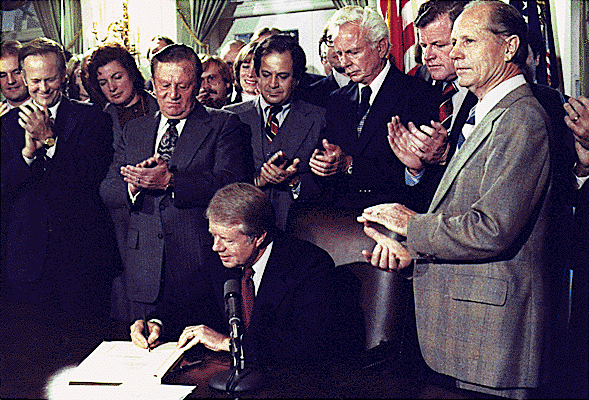
Main provisions and characteristics
Key elements of the law removed federal oversight of ticket prices, route authorizations and entry and exit of carriers. It also led to the gradual elimination of the Civil Aeronautics Board's licensing and economic regulation functions, while safety regulation and aircraft certification remained under the Federal Aviation Administration. The statute included provisions intended to ease the transition for smaller communities and to address potential market failures.
Historical background and enactment
The act followed decades of tightly regulated airline economics dating from the 1930s. In the 1970s policymakers, economists and consumer advocates argued regulation kept fares high and stifled innovation. Congress passed the law to open markets and encourage competition. The implementation of deregulation was phased so that carriers, employees and the traveling public could adjust to the new environment.
Effects and impacts
Deregulation produced a complex mix of outcomes. Consumers generally benefited from lower average fares, a large increase in available flights, and new service options. New and low-cost carriers entered the market, while established airlines adopted new pricing strategies such as yield management and frequent-flyer programs. However, the period also saw industry consolidation, periods of financial instability for some carriers, and changes in service to smaller communities.
- More competition on major routes and emergence of low-cost carriers.
- Development of hub-and-spoke route networks by many legacy airlines.
- Declines in service or higher subsidies for some rural routes; programs were created to mitigate these effects.
- Waves of mergers and restructuring that increased market concentration in some regions.
Notable distinctions and legacy
The act is often credited with transforming U.S. aviation into a more price-competitive, innovative market, while critics point to consolidation and uneven service outcomes. Safety oversight remained a federal responsibility, and subsequent policy debates have focused on competition policy, consumer protections, labor impacts and how best to ensure air service connectivity for smaller communities. For more contextual information on the law and its economic rationale see federal regulation resources and analyses.
Contemporary relevance
Even decades after enactment, the Airline Deregulation Act shapes airline strategy, fare structures and government oversight. Discussions about airline competition, merger policy, and rural air service continue to reference the act’s effects as policymakers balance market efficiency with public-interest goals.
Author
AlegsaOnline.com Airline Deregulation Act (1978) Leandro Alegsa
URL: https://en.alegsaonline.com/art/134169