
Abdul Halim Khaddam: Syrian statesman, vice president and exile (1932–2020)
Long-serving Syrian diplomat and vice president who served briefly as interim president in 2000, later broke with the Assad regime and lived in exile until his death in 2020.
Abdul Halim Khaddam (Arabic: عبد الحليم خدام; 15 September 1932 – 31 March 2020) was a senior Syrian politician and diplomat who played a central role in the government from the 1970s until the mid-2000s. A Sunni Muslim who rose to prominence within an Alawite-dominated leadership, Khaddam was long seen as a close ally of President Hafez al-Assad and later became a notable critic of the administration led by Hafez's son, Bashar al-Assad.

Image gallery
5 Images


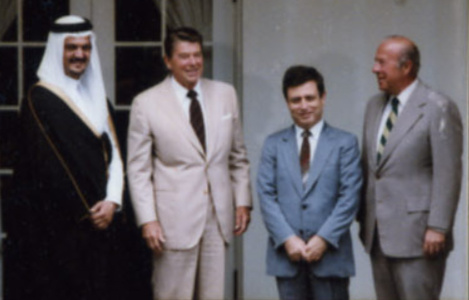
Early career and rise
Khaddam entered public life as a member of the ruling Ba'ath Party and served in diplomatic and ministerial posts that raised his national profile. During the 1970s he emerged as one of Syria's key foreign-policy figures, representing the country abroad and handling sensitive regional relationships. His background and Sunni identity made him a political bridge in a state where the highest offices were dominated by members of other sectarian groups.
Foreign minister and vice presidency
From the early 1970s until the mid-1980s Khaddam was Syria's chief diplomat, serving as Minister of Foreign Affairs and leading many international delegations. In 1984 he was elevated to the vice presidency, a position he retained for more than two decades. As vice president he was entrusted with a range of responsibilities, including diplomatic missions, liaison with key regional actors, and representation of Syrian interests in multilateral forums. Observers credited him with considerable influence in shaping the state's external posture during periods of tension in the Middle East.
Interim presidency and the 2000 transition
When President Hafez al-Assad died in June 2000, Khaddam served as the acting head of state during the formal transition period that preceded the inauguration of Hafez's son. He occupied the interim role from 10 June 2000 until the new leadership consolidated the succession, a short but symbolically important interval in which he supervised constitutional and procedural arrangements for the transfer of authority.
Resignation, exile and public dissent
In 2005 Khaddam resigned from his official posts and left Syria. He settled in France, where he lived in exile and gradually adopted a more critical public stance toward the Damascus leadership. In interviews and statements from abroad he challenged aspects of government policy and raised questions about events that had damaged Syria's relations with neighbouring countries. His departure and vocal criticism represented a rare break by a high-ranking former insider, and it attracted sustained media and diplomatic attention.
Involvement in regional controversies
Throughout and after his time in office Khaddam was associated in public discussion with Syria's complex role in Lebanon and other regional affairs. He was frequently referenced in reporting and analysis of Syrian-Lebanese ties, and commentators noted that his knowledge of both domestic and regional networks made his commentary particularly consequential. Accounts of his later remarks and activities varied; some observers treated his claims as significant testimony from a former insider, while others advised caution and highlighted the contentious political context in which he spoke.
Legacy and assessments
Khaddam's legacy is multifaceted. Supporters and some analysts remembered him as a seasoned diplomat and pragmatic statesman who helped manage Syria's external relations and maintain internal stability for many years. Critics and opponents pointed to his long tenure within an authoritarian system and later contested statements. His status as one of the few Sunnis to reach the highest ranks of an Alawite-led administration has been cited in discussions of sectarian balance and elite politics in Syria.
After years in exile, Khaddam died on 31 March 2020 in France. His death was widely reported and prompted retrospectives on his role in Syrian political life, including assessments of the transition following Hafez al-Assad's death and the period of political realignment that followed. For additional contemporary reporting and analysis on his career and public statements see major news archives and specialized studies of Syrian and Levantine politics (interim presidency, regional context), and accounts of his later residence and activities in France (exile and residence).
Khaddam remains a notable example of a long-serving regime insider whose later public dissent illustrates broader tensions within Syrian governance over succession, sectarian representation, and regional policy. His career is often discussed in works on Syrian governance, diplomacy, and the politics of the Levant during the late 20th and early 21st centuries.
Author
AlegsaOnline.com Abdul Halim Khaddam: Syrian statesman, vice president and exile (1932–2020) Leandro Alegsa
URL: https://en.alegsaonline.com/art/134052