
Wilhelm Ostwald (1853–1932)
Wilhelm Ostwald was a Baltic German chemist who helped found physical chemistry; he won the 1909 Nobel Prize for work on catalysis, chemical equilibria, and reaction rates.
Wilhelm Ostwald (23 September 1853 – 4 April 1932) was a chemist and thinker who is regarded as one of the founders of modern physical chemistry. He was born in Riga, then part of the Russian Empire and today the capital of Latvia. Ostwald combined experimental work with theoretical insight to clarify how chemical reactions proceed and how rates and equilibria can be understood in physical terms. In 1909 he received the Nobel Prize in Chemistry (1909) in recognition of his research on catalysis, chemical equilibria and reaction rates.
Image gallery
10 Images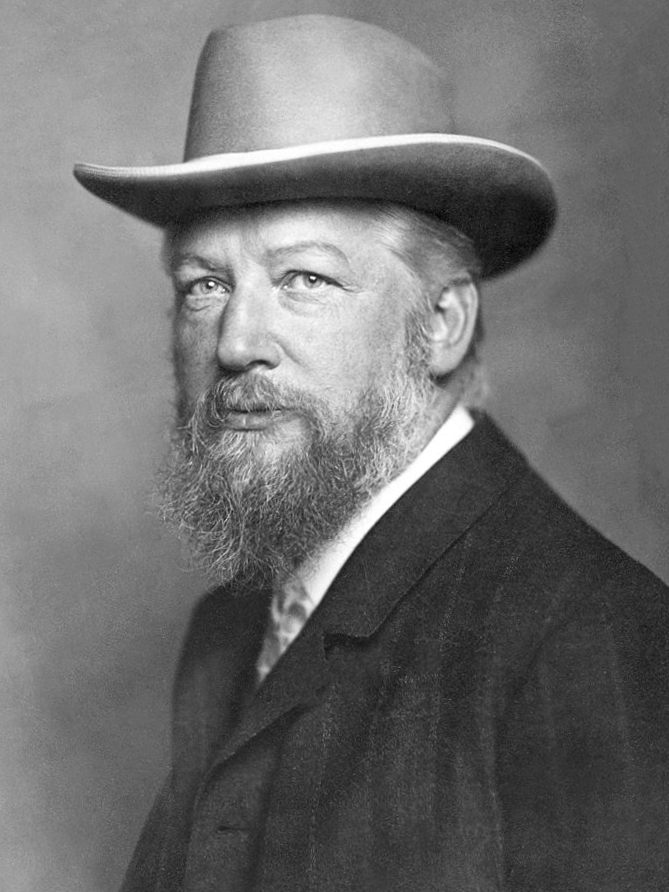


Key contributions
- Catalysis: Ostwald carried out systematic studies of catalytic reactions and their effects on reaction rates, helping to establish catalysis as a central topic in chemistry.
- Reaction rates and equilibria: He investigated how concentrations and physical conditions influence chemical equilibria and kinetics, providing practical laws and approximations used in physical chemistry.
- Ostwald's dilution law and ripening: He is associated with rules and empirical relations—most famously Ostwald's dilution law for weak electrolytes and the concept of Ostwald ripening in phase separation and materials science.
- Laboratory apparatus and methods: Devices such as the Ostwald viscometer and approaches to standardizing measurements reflect his emphasis on precise experimental technique.
- Color theory and popular science: Outside core chemistry he developed a systematic color notation (the Ostwald color system) and worked on making scientific ideas more accessible to broader audiences.
Ostwald trained and worked in several German-speaking universities and laboratories and became a prominent professor whose lectures and textbooks shaped generations of chemists. He founded and edited scientific journals that promoted the new discipline of physical chemistry and helped create a professional network linking experimentalists and theoreticians. His writing ranged from technical research papers to essays on scientific method and education.
His influence extended beyond laboratory results. Ostwald advocated for clearer measurement standards, interdisciplinary exchange, and the practical application of chemical knowledge in industry and technology. He also took an active interest in communicating science to the public and in broader intellectual movements of his time.
Although commonly described in national terms because of his birthplace, Ostwald was a Baltic German whose career was centered in German-speaking academia; his Nobel Prize is frequently noted in histories of chemistry and is sometimes mentioned in cultural accounts of the Baltic region because he was born in what is now Latvia. His family included scientists such as his son Wolfgang Ostwald, who continued work on colloids and related topics.
Ostwald's legacy is visible in textbooks, laboratory methods, and concepts that remain in use: catalytic principles, kinetic analysis, and the descriptions of phase transformation processes all trace part of their development to his work. His combination of theory, careful experiment and public engagement helped establish physical chemistry as a distinct and enduring scientific discipline.
Author
AlegsaOnline.com Wilhelm Ostwald (1853–1932) Leandro Alegsa
URL: https://en.alegsaonline.com/art/132864