
Qi Baishi
Qi Baishi (1864–1957) was a leading Chinese painter, calligrapher and seal carver whose lively ink-and-wash works and folk-influenced style reshaped modern Chinese painting.
Overview
Qi Baishi (1864–1957) was a prominent Chinese painter, calligrapher and seal carver best known for his expressive ink-and-wash paintings. Rising from a modest rural background, he developed a distinctive, direct style that blended popular motifs with classical literati techniques. His work played a significant role in 20th-century Chinese art and brought renewed attention to the xieyi (freehand) approach.
Image gallery
3 Images

Style and subjects
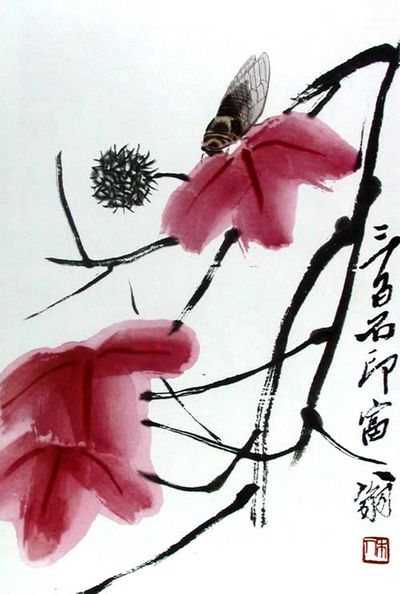
Qi favored simple subjects—shrimp, fish, crabs, insects, birds, flowers, fruit and vegetables—rendered with economical brushstrokes and a lively sense of movement. He combined spare ink washes with bright color accents, using contrast and rhythm to suggest texture and life rather than elaborate detail. His shrimp paintings, admired for their translucency and energetic brushwork, are among the most celebrated examples of his technique.
Life and career
Born in Xiangtan, Hunan province, Qi worked early on as a carpenter and taught himself painting and seal carving. Over decades he refined his craft, producing paintings, calligraphy and carved seals. In 1953 he was elected president of the China Artists Association, a recognition of his influence on contemporary Chinese visual culture. He spent his later years in Beijing and died there in 1957.
Legacy and influence
Qi Baishi is remembered for revitalizing traditional Chinese ink painting by integrating folk sensibilities with scholarly practices. He elevated everyday subjects, showing how brief, confident strokes could convey personality and poetry. His career inspired many later artists and helped shape institutional support for modern Chinese art.
Notable facts
- He was also an accomplished seal carver; his seals and inscriptions often accompany his paintings.
- Qi’s xieyi approach emphasizes expressive gesture and spontaneity over meticulous detail.
- His works remain widely studied and exhibited as models of twentieth-century Chinese painting.
Author
AlegsaOnline.com Qi Baishi Leandro Alegsa
URL: https://en.alegsaonline.com/art/129058