
Adolf Eichmann — Nazi SS official and organizer of deportations (1906–1962)
German SS officer who coordinated mass deportations during the Holocaust, escaped to Argentina, captured by Israel in 1960, tried in Jerusalem (1961) for crimes against humanity and executed in 1962.
Overview
Otto Adolf Eichmann (born 19 March 1906 in Solingen) was a German official in the security services of Nazi Germany. He served in the SS and rose to the rank often described as SS-Obersturmbannführer (commonly compared with a lieutenant-colonel; see rank explanation). Eichmann is widely known for his role in organizing the identification, deportation and forced removal of Jews from occupied Europe during the period commonly called the Holocaust.
Image gallery
10 Images



Early life and rise
Eichmann was born in Germany and became involved with nationalist and völkisch movements in the interwar period before joining the Nazi Party and the SS. He worked in security and administrative posts and by the late 1930s had moved into positions responsible for Jewish affairs and emigration. Over time he became head of Referat IV B4 within the Reich Main Security Office (RSHA), the department that dealt with Jewish questions and related deportation logistics.
Role in deportations and administration
As head of Referat IV B4, Eichmann oversaw the practical arrangements for rounding up, registering and transporting millions of people to ghettos, forced-labour sites and extermination camps. His office coordinated with local police, occupying authorities and railway administrations to schedule transports that carried victims to camps such as Auschwitz. While larger policy decisions were made by senior Nazi leaders, historians identify Eichmann as a key administrator whose bureaucratic work helped make systematic mass deportation and murder possible.
Implementation and logistics
Eichmann's work was largely organizational: compiling lists, issuing orders, arranging trains and negotiating with civilian agencies to move large populations. His approach illustrates how ordinary administrative procedures and paperwork could be transformed into tools for mass atrocity. Documents and testimony from the period show his frequent involvement in the details of deportation practice across occupied Europe.
Flight, concealment and capture
After the defeat of Nazi Germany, Eichmann went into hiding and eventually fled to South America. By the 1950s he had settled in Argentina under an assumed identity. In 1960 Israeli intelligence located him and agents of the Mossad carried out an operation to seize him and bring him to Israel. The operation — described by some as an abduction and by others as a justified capture of a mass murderer — raised questions about state conduct and sovereignty because it took place on Argentine soil; debates about legality and morality have continued among scholars and legal experts.
Trial in Jerusalem
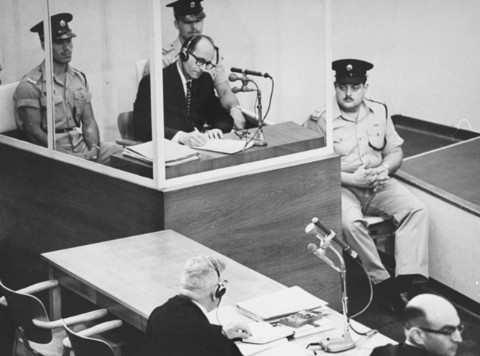
Eichmann was tried in Jerusalem in 1961 on charges that included crimes against the Jewish people, crimes against humanity and war crimes, summarized under the legal category of crimes against humanity. The proceedings were public and widely covered by international media; many survivors gave testimony describing the processes of deportation, imprisonment and extermination. The trial focused on both Eichmann's direct actions and his role within the broader Nazi system.
Conviction, execution and aftermath
He was convicted and sentenced to death. Eichmann was executed in 1962; his body was cremated and the ashes were dispersed at sea. The trial and its outcome were significant for victims, survivors and the international community: the Jerusalem proceedings became a major moment in public Holocaust memory, bringing extensive eyewitness testimony into court record and public awareness.
Legacy and controversies
The Eichmann case had several lasting effects. It intensified global awareness of the Holocaust and shifted some memory work from private testimony to documented legal record. The trial prompted discussion of individual responsibility within bureaucracies, famously debated in Hannah Arendt's phrase describing Eichmann's demeanor as the "banality of evil". That phrase, and subsequent scholarship, generated controversy about obedience, moral choice and the nature of complicity.
The abduction and trial also influenced international law and the prosecution of mass crimes, informing later approaches to jurisdiction, extradition and universal accountability for crimes against humanity. At the same time, historians and legal analysts continue to weigh the moral urgency of bringing Eichmann to justice against the diplomatic and legal irregularities of the method used to capture him.
Memory and historiography
Scholars have used the Eichmann case to study Nazi administration, the mechanics of genocide and postwar processes of justice and remembrance. The trial gave many survivors a public platform to testify, shaping collective memory and education about the Holocaust for subsequent generations. Museums, legal studies and historical research still refer to the case when discussing how modern states, institutions and individuals can become implicated in large-scale crimes.
Key facts
- Born 19 March 1906 in Solingen.
- SS officer and head of Referat IV B4 within the RSHA (SS, rank often compared to lieutenant-colonel).
- Responsible for organizing deportations to extermination camps during the Holocaust, including transports to sites such as Auschwitz.
- Fled Europe and lived in Argentina under an assumed identity; located in 1960 and taken by agents of the Mossad in an operation some called an abduction.
- Public trial in Jerusalem in 1961 for crimes against humanity; convicted and executed in 1962.
Because of its legal, moral and historical implications, the Eichmann case remains central to discussions about accountability, memory and how ordinary bureaucratic systems can be mobilized to commit atrocity.
Related articles
Author
AlegsaOnline.com Adolf Eichmann — Nazi SS official and organizer of deportations (1906–1962) Leandro Alegsa
URL: https://en.alegsaonline.com/art/1041