
Two-Minute Warning (1976 film)
1976 ensemble disaster film about a sniper at a packed Los Angeles football stadium, starring Charlton Heston, Jack Klugman and Martin Balsam; nominated for the Academy Award for Best Film Editing.
Overview
Two-Minute Warning is a 1976 ensemble disaster film directed by Larry Peerce. The story follows the mounting crisis when a sniper opens fire at a crowded Los Angeles football stadium during a high-profile game, transforming a sporting event into a public-safety emergency. The movie is notable for its large cast and interwoven perspectives of spectators, police, and officials.
Image gallery
1 Image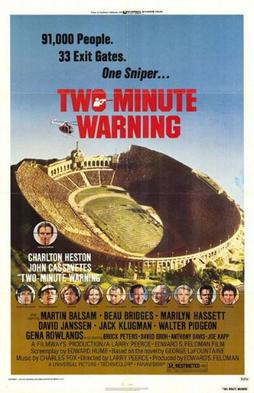
Cast and characters
The picture features lead performances and supporting roles from established screen actors. Principal names associated with the production include Charlton Heston, Jack Klugman, and Martin Balsam. These players portray a mix of law-enforcement figures, stadium staff, desperate relatives, and panicked fans, typical of the disaster-film ensemble approach.
Plot themes and structure
Rather than focusing on a single protagonist, the film alternates between multiple viewpoints to build tension: the authorities attempting containment, the medical teams preparing for casualties, journalists covering events in real time, and ordinary spectators caught in the danger. Themes include crowd psychology, the stresses of crisis response, and the media's role in public emergencies.
Production and release
The film was produced and released in the mid-1970s, a period when large-scale disaster pictures were popular in American cinema. It used a mix of staged set pieces and crowd scenes to convey scale and urgency. The editing and pacing were important to sustaining suspense across the parallel storylines.
Reception and legacy
At the time of release, critics offered mixed reactions: some praised the tense set pieces and performances, while others criticized the blending of melodrama with sensational subject matter. The film received recognition from the film industry when it was nominated for an Academy Award; the nomination was for Best Film Editing (Academy Awards), highlighting the importance of cutting in creating the film's momentum.
Notable facts
- The film exemplifies the ensemble disaster genre that was prominent in the 1970s.
- It examines how institutions respond under pressure and the human stories within a public crisis.
- Its editing nomination underlines the technical craft used to intercut multiple crises and perspectives.
Related articles
Author
AlegsaOnline.com Two-Minute Warning (1976 film) Leandro Alegsa
URL: https://en.alegsaonline.com/art/102286