
Timeline of Burgundian and Habsburg acquisitions in the Low Countries
Chronological overview of how the medieval Low Countries passed into Burgundian hands and then into Habsburg rule, with political background, key events, and long-term consequences.
Overview
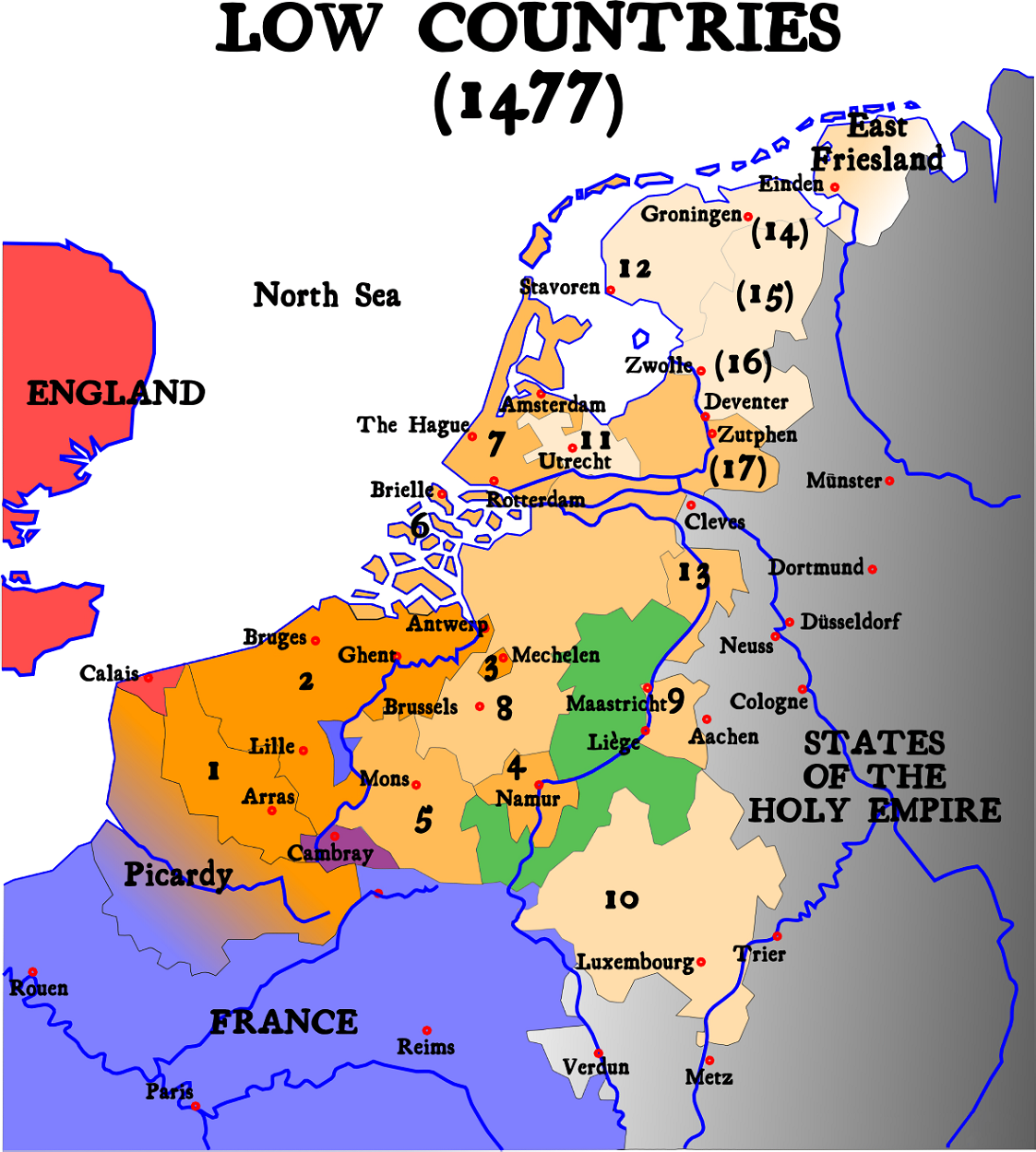
The Low Countries (roughly modern Belgium, the Netherlands and Luxembourg) were a patchwork of counties, duchies and semi‑autonomous towns in the late Middle Ages. Wealthy commercial cities—notably Bruges, Ypres and Ghent—exerted strong economic and political influence, often negotiating privileges and arranging dynastic marriages that shaped regional politics. During the 14th and 15th centuries a sequence of inheritances, purchases and political maneuvers brought many of these polities into a single dynastic orbit, known as the Burgundian domains, and later passed them to the Habsburgs.
Image gallery
6 Images




Political context and characteristics
Several features made the Low Countries attractive to expanding dynasties: prosperous textile production and international trade, strategic North Sea ports, and relatively sophisticated municipal institutions. Local rulers often lacked the manpower to impose direct rule, so they relied on negotiated authority, charters and privileges. A dynastic union therefore meant combining a number of distinct legal entities under one sovereign while frequently preserving provincial rights.
Key events and a working timeline
- 1369: A pivotal dynastic marriage linked the County of Flanders to the ducal house of Burgundy. This marriage is widely seen as the opening move that brought Flemish territories into Burgundian influence.
- Late 14th century: When Louis II of Flanders died without a surviving male heir, the Burgundian claims strengthened through inheritance, bringing Flanders and associated counties into the Burgundian sphere.
- Early to mid‑15th century: Burgundian rulers steadily expanded their control by inheritance, purchase and diplomacy. Over decades they added territories such as Artois, Namur, Brabant and parts of the coastal counties, creating a contiguous collection of provinces in the Low Countries.
- 1430s: Through negotiated settlements and the decline of rival local dynasties, the Burgundian dukes obtained important northern counties and duchies, further consolidating their holdings.
- 1477–1482: The death of Charles the Bold of Burgundy without a male heir led to a dynastic marriage that transferred Burgundian possessions into the Habsburg sphere when his daughter Mary married Maximilian of Habsburg—an event viewed as the decisive shift toward Habsburg rule.
- 16th century: Under Habsburg rulers (notably Charles V), the provinces were progressively integrated into a more centralized administration. Legal and fiscal reforms, together with declarations such as the mid‑16th century measures that organized the Seventeen Provinces, gave the Habsburgs a stronger claim to hereditary sovereignty.
Consequences and significance
The Burgundian and subsequent Habsburg consolidation had lasting effects. It created a large, comparatively cohesive political unit in northwestern Europe that fostered economic growth, cultural exchange and courtly patronage. At the same time, the retention of local privileges and the patchwork nature of jurisdictions contributed to tensions over taxation, religion and governance. These frictions were among the long‑term causes of the later Dutch Revolt and the eventual political division between northern and southern provinces.
Distinctions and notable facts
It is important to distinguish between personal or dynastic union and full administrative unification: the Burgundian and Habsburg rulers often governed by combining personal rule with recognition of provincial laws, rather than by imposing a uniform state. The process stretched across more than a century and involved marriages, inheritances, purchases and treaties rather than a single conquest, so the composition and legal status of the territories changed repeatedly. For further reading on individual cities and institutions see entries for Bruges, Ypres, Ghent and the broader Burgundian domains.
Questions and answers
Q: What is the timeline of Burgundian and Habsburg acquisitions in the Low Countries?
A: The Burgundian and Habsburg acquisitions in the Low Countries occurred around the 13th and early 14th century.
Q: What was the role of Dutch cities in the political and economical affairs of their fiefs?
A: Dutch cities played a major role in the political and economical affairs of their fiefs.
Q: What powers did Flemish cities gain over their county?
A: Flemish cities gained powers over their county.
Q: What happened when Louis II, Count of Flanders, died without a male heir?
A: When Louis II, Count of Flanders, died without a male heir, events were set in motion that led to the Burgundian and, in 1478, the Habsburg Netherlands.
Q: Which cities arranged a marriage between Louis II, Count of Flanders' daughter and the Duke of Burgundy?
A: Bruges, Ypres, and Ghent arranged a marriage between Louis II, Count of Flanders' daughter and the Duke of Burgundy.
Q: What was the outcome of the events that were set in motion by Louis II, Count of Flanders' death?
A: The events that were set in motion by Louis II, Count of Flanders' death led to the Burgundian and, in 1478, the Habsburg Netherlands.
Q: When did the Burgundian Netherlands and the Habsburg Netherlands come into being?
A: The Burgundian Netherlands and the Habsburg Netherlands came into being in the 15th century.
Related articles
Author
AlegsaOnline.com Timeline of Burgundian and Habsburg acquisitions in the Low Countries Leandro Alegsa
URL: https://en.alegsaonline.com/art/99953
Sources
- metmuseum.org : "Low Countries, 1000–1400 A.D."