
Time in Pakistan
Summary of Pakistan Standard Time (UTC+05:00), brief history of daylight saving experiments (2002, 2008, 2009), effects on daily life, cross‑border relations and practical considerations.
Overview
Pakistan observes a single national time standard known as Pakistan Standard Time (PST), which is five hours ahead of Coordinated Universal Time (UTC+05:00). The IANA time zone database lists the country under the zone name Asia/Karachi. Civil time in Pakistan governs government offices, schools, transport timetables, television and radio schedules, and other public services. For general information about the country, see Pakistan.
Image gallery
1 Image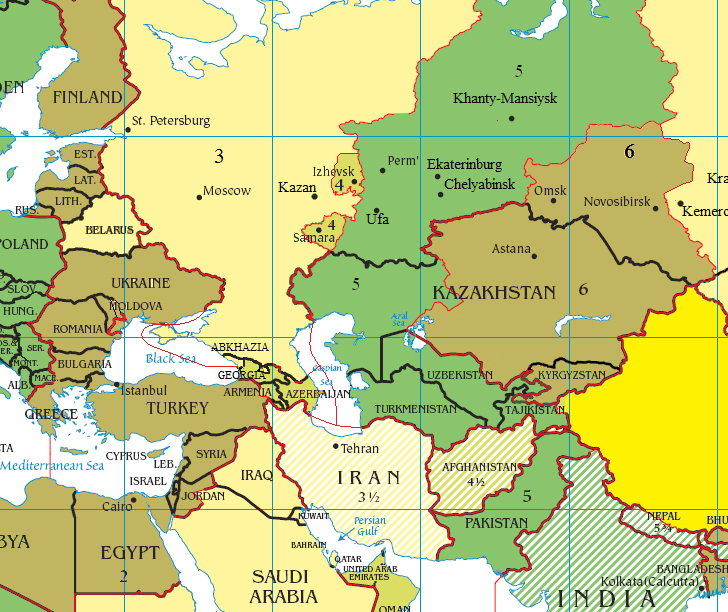
Daylight saving experiments (2002, 2008, 2009)
On several occasions in the early 21st century the Pakistani government temporarily advanced clocks by one hour during summer months in an attempt to reduce peak electricity demand and extend evening daylight. These adjustments moved local time to UTC+06:00 while in effect. Major instances included:
- 2002: A government-declared period beginning in April and ending in October was intended to make fuller use of daylight and conserve energy.
- 2008: DST was reintroduced in June to address a large shortfall in electricity generation; the period was later extended into October and overlapped with the Islamic month of Ramadan, which influenced scheduling of daily prayers and fasting-related activities.
- 2009: Another DST period started in April and ran through October as part of continued energy-management efforts.
These changes were enacted by executive decisions rather than by a permanent statutory shift, and after experimentation the government discontinued the practice. Pakistan does not currently observe daylight saving time.
Practical effects and motivations
The principal motivation for temporary daylight saving measures was energy conservation: shifting an hour of daylight into the evening can reduce the need for lighting and lower peak demand. Policymakers also cited potential benefits for commerce and outdoor leisure. In practice, the outcome was mixed. Some sectors reported modest energy savings, while other effects—such as disruption to transport schedules, business coordination, and confusion over prayer times during Ramadan—diminished public support.
Cross-border and regional considerations
Pakistan sits west of India, which observes Indian Standard Time (IST, UTC+05:30). Under Pakistan's normal standard time Pakistan is half an hour behind India; however, when Pakistan briefly adopted UTC+06:00 during DST it became half an hour ahead of India. This counterintuitive result—where a country to the west was ahead of one to the east—highlights how artificial clock shifts can alter expected regional time relationships. For comparison with India, see India.
Timekeeping today and notable facts
Today Pakistan maintains a single, stable time zone (UTC+05:00) for the whole country. Official changes to civil time are announced by the federal government and appear in schedules and public notices when they occur. Internationally, Pakistan's time information is represented by the standard zone identifier Asia/Karachi, which software, airlines and broadcasters commonly use to coordinate cross-border activities.
Although daylight saving time is not currently in use, the episodes of 2002–2009 are often cited in discussions about energy policy and the social impacts of shifting civil time. They demonstrate the trade-offs governments consider when balancing electrical supply constraints, social routines, and the desire for a predictable national schedule.
Questions and answers
Q: Has Pakistan experimented with Daylight Saving Time (DST)?
A: Yes, Pakistan has experimented with DST a number of times since 2002.
Q: What was the purpose of observing DST in Pakistan in 2002?
A: The purpose of observing DST in Pakistan in 2002 was to make maximum use of daylight and to save energy.
Q: Did Pakistan observe DST in 2008?
A: Yes, Pakistan observed DST in 2008.
Q: Why did the government extend the end date of DST in 2008?
A: The government extended the end date of DST in 2008 to October 31, including the holy month of Ramadan (which began in early September), to meet the annual shortfall of 4 gigawatts of electricity instead of enforcing daily power cuts in households and factories.
Q: When was DST observed in Pakistan in 2009?
A: DST was observed in Pakistan from April 15 through October 31 in 2009.
Q: Is DST still observed in Pakistan?
A: No, DST is no longer observed in Pakistan.
Q: Why was Pakistan half an hour ahead of India during the times DST was observed?
A: Pakistan was half an hour ahead of India during the times DST was observed because local time was shifted from UTC+05:00 to UTC+06:00 during those summer periods.
Related articles
Author
AlegsaOnline.com Time in Pakistan Leandro Alegsa
URL: https://en.alegsaonline.com/art/99934
Sources
- timeanddate.com : "Time Zone & Clock Changes in Islamabad, Pakistan"
- rediff.com : "Pakistan goes in for Daylight Saving Time"
- worldtimezone.com : "DST News - Pakistan Daylight Saving Time news"
- app.com.pk : Associated Press Of Pakistan ( Pakistan's Premier NEWS Agency ) - Clocks advanced by an hour
- thenews.com.pk : thenews.com.pk/updates.asp?id=87774
- app.com.pk : app.com.pk/?option=com_content&task=view&id=86748&Itemid=2