
Tiger beetle — fast, colorful predatory beetles
Tiger beetles are a widespread group of predatory beetles known for bright metallic colors, powerful jaws and exceptional running speed. They inhabit open sunny habitats worldwide and are important ecological indicators.
Tiger beetles are a distinctive assemblage of predatory beetles recognized for their speed, vivid coloring and prominent jaws. Often treated as the subfamily Cicindelinae within the ground beetle family Carabidae, they are sometimes treated as a separate family (Cicindelidae) by older sources. Entomologists currently recognize roughly 2,600 species and subspecies, with especially high species richness in the Indo ‑Malayan (Oriental) and Neotropical regions. The common English name reflects their aggressive hunting style rather than any relation to big cats: these beetles are active daytime predators with a rapid pursuit behaviour.
Image gallery
8 Images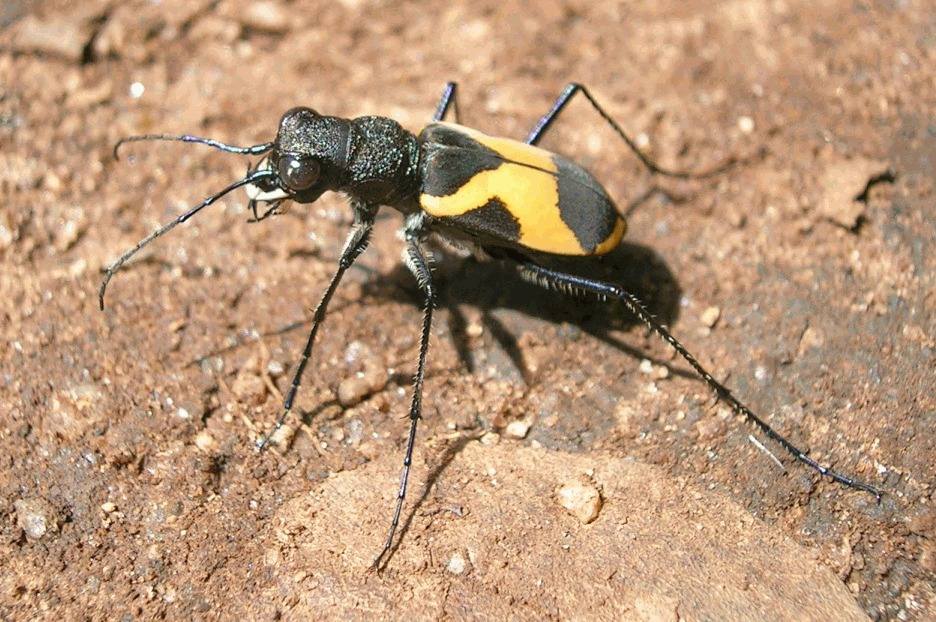


Key characteristics
Tiger beetles share a set of physical and behavioral traits that make them easy to recognize: a streamlined body, very long legs for running, large compound eyes for acute vision, and a proportionally wide head bearing strong, hooked jaws. Their mandibles are used both to seize and macerate prey and in fights over territory or mates. The hard forewings, or elytra, are often glossy, metallic or patterned in contrasting spots or lines, producing the bright appearance that makes many species conspicuous.
- Powerful jaws: Mandibles are heavy and toothed for catching and crushing insect prey.
- Vision and speed: Large eyes and long legs enable fast pursuit; the fastest species exceed 9 km/h.
- Coloration: Iridescent greens, blues, bronze and patterned elytra are common.
Behavior, hunting and life cycle
All tiger beetles are predators at both adult and larval stages. Adults chase down small arthropods on open ground, often on sandy or compacted soils. Their remarkable running speed is coupled with a stop ‑start pattern: at very high speed they momentarily lose visual tracking and pause to reorient. Larvae live in vertical burrows dug into the soil and ambush prey that passes the burrow rim. A typical life cycle includes egg, several larval instars, a pupal stage and the adult; many species have one generation per year but timing varies by climate and habitat.
Distribution and preferred habitats
Tiger beetles are found on every continent except the Antarctic and, in modern times, are absent from Tasmania. Highest diversity occurs in tropical Asia and the Neotropics, and many species are habitat specialists. Typical habitats include sandy beaches and dunes, riverbanks, salt flats, open forest clearings and desert margins. Some species prefer open sun ‑exposed ground while others occupy vegetated slopes or rocky outcrops.
- Coastal and dune specialists, often threatened by development.
- Riverine and lakeshore species that patrol moist sand or silt.
- Interior drylands and forest openings where bare ground is exposed.
Scientific and conservation notes
Tiger beetles are popular study subjects in ecology and evolution because of their conspicuous behaviour, diverse forms and sensitivity to habitat change. Some species serve as bioindicators for the health of sandy or riparian systems. Many have restricted ranges and specialized habitat needs, making them vulnerable to land ‑use change, coastal development and erosion. The group also has a long history in taxonomy and insect collecting; older literature and field guides sometimes use different family placements or names, so care is needed when consulting varied sources. For general introductions and species accounts see sources on regional beetle fauna and entomological guides available online and in print (tiger beetle overview, Neotropical summaries).
Notable facts: when speed is scaled to body length, tiger beetles are among the fastest animals known, and their combination of speed, vision and striking coloration makes them a distinctive component of open terrestrial ecosystems worldwide. Researchers continue to document new species and refine the group's classification as molecular and morphological studies progress (see elytral diversity, see family placement, see mandible form).
Questions and answers
Q: What is the family name of the tiger beetles?
A: The family name of the tiger beetles is Carabidae.
Q: How many species and subspecies of tiger beetles are known?
A: About 2,600 species and subspecies of tiger beetles are known.
Q: Where is the richest diversity of tiger beetles found?
A: The richest diversity of tiger beetles is found in the Oriental (Indo-Malayan) region, followed by the Neotropics.
Q: What is the unique feature of tiger beetles that they are known for?
A: Tiger beetles are known for their aggressive predatory habits and running speed.
Q: What is the maximum speed that the fastest species of tiger beetle can run at?
A: The fastest species of tiger beetle can run at a speed of 9 km/h (5.6 mph), which, relative to its body length, is about 22 times the speed of an Olympic sprinter.
Q: Where in the world do tiger beetles not live?
A: Tiger beetles do not live in the Antarctic and Tasmania.
Q: What are some physical characteristics of tiger beetles?
A: Tiger beetles have powerful jaws called mandibles, long legs, big eyes, and a wide head. They are also known for their colorful and bold markings on their elytra.
Related articles
Author
AlegsaOnline.com Tiger beetle — fast, colorful predatory beetles Leandro Alegsa
URL: https://en.alegsaonline.com/art/99826