
Throw Momma from the Train (1987) — Danny DeVito black comedy
Overview of the 1987 black comedy Throw Momma from the Train directed by and starring Danny DeVito — plot, cast, production, themes, reception, and legacy.
Throw Momma from the Train is a 1987 American black comedy directed by and starring Danny DeVito. The film adapts the central conceit of reciprocal murder from earlier fiction, most directly riffing on Hitchcock's Strangers on a Train, but transforms the premise into a darkly comic story about thwarted ambition, dysfunctional family ties, and the perverse comforts of revenge fantasies. The movie's title plays on the lyric and cadence of the song "Mama From the Train," written by Irving Gordon and popularized by Patti Page; the contrast between the song's homespun tones and the film's violent humor is an explicit part of its comedic strategy (title source).
Image gallery
1 Image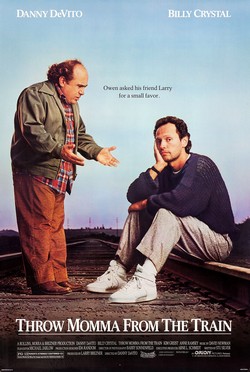
Plot and themes
The narrative follows a timid writing instructor whose life and career have stalled. He becomes entangled with a brash, emotionally unstable former student who proposes a crude exchange of murders: each would eliminate the other's tormentor. Rather than developing into a straight thriller, the film treats the scheme as the basis for farce and satire. Prominent themes include creative frustration, male rivalry, the oppressive dynamics of parent–child relationships, and the social anxieties of the late 1980s. The film repeatedly juxtaposes slapstick with moments of genuine unease, asking how far ordinary people might go when pushed to the limit.
Cast and performances
- Danny DeVito directs and stars, shaping the film's brisk, irreverent tone and steering the mixture of comedy and menace.
- Tom Hanks appears as the quieter, put-upon counterpart whose restrained reactions provide a foil for the chaos around him.
- Anne Ramsey plays the intimidating mother figure whose colorful, abrasive performance was singled out by critics and awards bodies.
- Supporting roles include work by Rob Reiner, Kate Mulgrew, Kim Greist and musician Branford Marsalis; the film also features a brief cameo by Oprah Winfrey.
Production and style
DeVito's direction emphasizes brisk pacing and character-driven set pieces rather than intricate plotting. The visual style and production design reflect an urban and suburban milieu common to many 1980s comedies, while the screenplay blends blackly comic dialogue with physical humor. The film played with audience expectations by openly referencing a famous suspense film and then inverting its tone; critics noted how that intertextuality functioned as both homage and parody.
Reception and awards
On release the film received a mixture of positive and critical notices. Reviewers commonly praised the performances—Anne Ramsey's explosive, memorable turn was widely highlighted—and recognized DeVito's skill at balancing broad comedy with darker undertones. The film proved commercially successful enough to secure a wide audience at the time. Ramsey earned an Academy Award nomination for Best Supporting Actress in recognition of her performance (Oscar nomination).
Legacy and cultural context
In subsequent years the film has been discussed as an example of late-20th-century American black comedy that foregrounds character over plot mechanics. It is often cited when writers and critics examine how mainstream comedies incorporate elements of suspense and crime without becoming full-throttle thrillers. Its mixture of outrageous humor and genuine emotional friction keeps it in discussions of DeVito's early directorial work and of 1980s films that negotiated taste boundaries around violent or unpleasant subject matter. For readers seeking a concise contemporary introduction, consult a general film overview or profiles of the principal cast and crew (DeVito, Hanks, Ramsey) and accounts of the film's intertextual relationship with Strangers on a Train.
Further notes
The film's title, its explicit references to a mid‑century popular song, and its use of cameo appearances reflect a broader trend in 1980s studio comedies toward playful self‑consciousness. While some viewers find the juxtaposition of slapstick and menace uncomfortable, others regard that tension as the film's central strength. For additional cast details and contemporary coverage, consult cast lists and retrospective essays that place the movie within DeVito's career and the era's comedy landscape (supporting cast, cast details, cameo note, title source).
Overall, Throw Momma from the Train remains notable both for the strength of individual performances and for its willingness to push a familiar plot device into broadly comic and sometimes uncomfortable territory. Its place in popular memory rests on the combination of striking characterizations, intertextual humor, and a director's clear interest in blending suspense-derived premises with broad comic payoff.
Questions and answers
Q: What is Throw Momma from the Train?
A: Throw Momma from the Train is a black comedy movie released in 1987.
Q: Was the movie inspired by a novel?
A: No, the movie was inspired by a movie called Strangers on a Train.
Q: What is the significance of the movie's title?
A: The movie's title was taken from the song "Mama From the Train".
Q: Who are some of the actors in the movie?
A: The movie stars Danny DeVito, Tom Hanks, Anne Ramsey, Kim Greist, Rob Reiner, Branford Marsalis, and Kate Mulgrew.
Q: Did the movie receive positive reviews?
A: The movie received mixed to positive reviews.
Q: Was the movie a commercial success?
A: Yes, the movie was a commercial success.
Q: Who received an Academy Award nomination for their performance in the movie?
A: Anne Ramsey was singled out for praise for her portrayal of Mrs. Lift and got an Academy Award nomination for Best Supporting Actress.
Related articles
Author
AlegsaOnline.com Throw Momma from the Train (1987) — Danny DeVito black comedy Leandro Alegsa
URL: https://en.alegsaonline.com/art/99682