
Thomas Robert Malthus: life, ideas and influence
Overview of Thomas Robert Malthus (1766–1834), his population theory, contributions to political economy, key concepts such as preventive and positive checks, and his lasting influence.
Overview
Thomas Robert Malthus (13 February 1766 – 23 December 1834) was an English clergyman and influential economist and social theorist. Best known for his writings on population and scarcity, he combined moral philosophy and political economy to address the social problems of his time. He was elected a Fellow of the Royal Society and served as a professor of history and political economy at the East India Company College.
Image gallery
4 Images
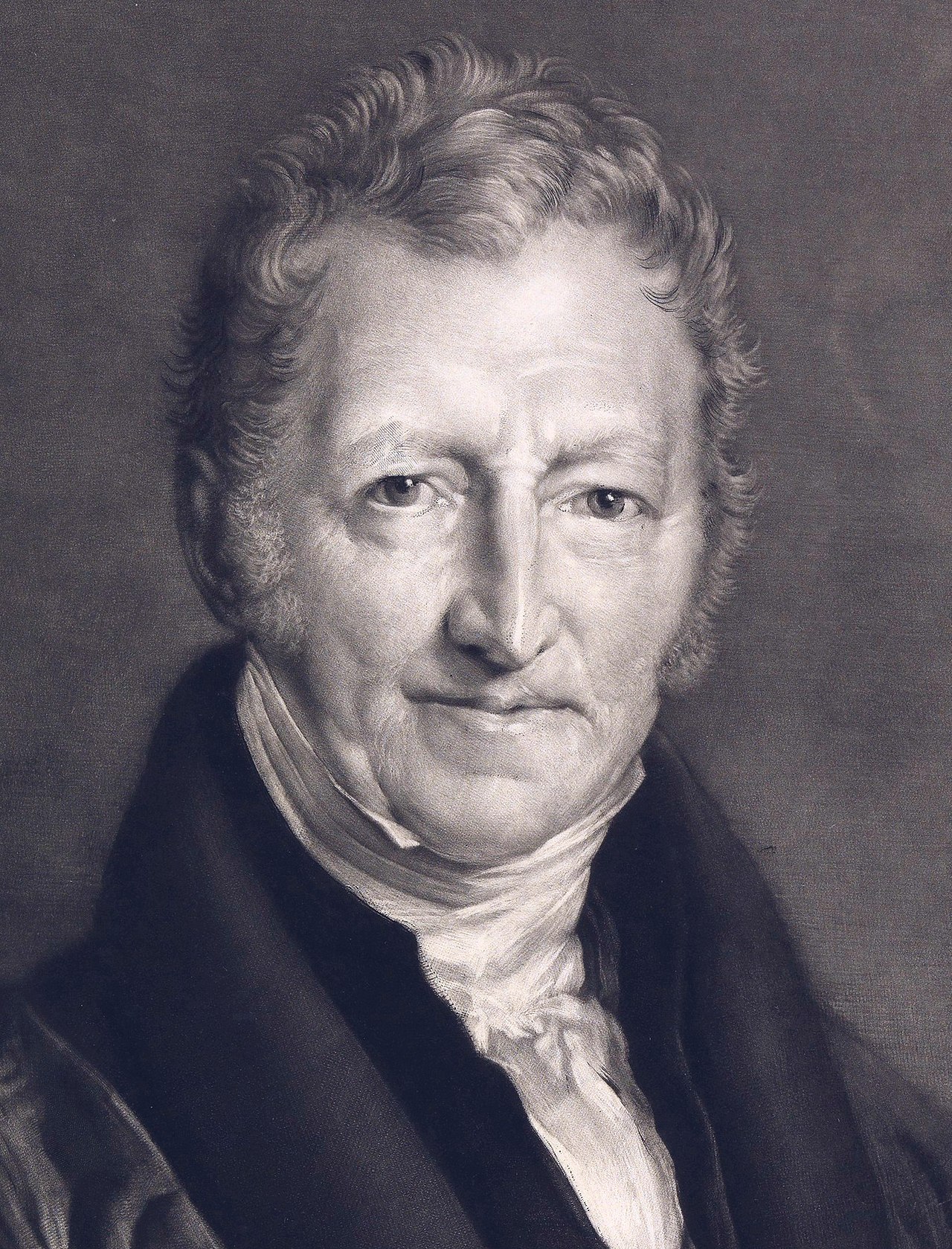


Major work and central argument
His most famous book, An Essay on the Principle of Population, first published anonymously in 1798 and expanded in later editions, argued that human populations tend to grow faster than resources needed for subsistence. Malthus contrasted geometric population increase with arithmetic food supply growth and described mechanisms—what he called "checks"—that keep population and resources in balance.
Malthus distinguished between preventive checks (deliberate actions that reduce birth rates, such as delayed marriage) and positive checks (increases in mortality from famine, disease, or war). His formulation influenced contemporary debates on welfare, land use and public policy.
Contributions to political economy
Beyond population studies, Malthus contributed to discussions of economic rent, distribution, and the role of agricultural limits in prices. He engaged in published debates with other classical economists about value, growth, and the causes of prosperity and poverty, emphasizing scarcity and the constraints it places on living standards.
- Key concepts: preventive vs positive checks.
- Population dynamics: implications for resources and policy (population dynamics).
- Phrase noted: he popularized the expression struggle for existence.
Reception and legacy
Malthus's ideas sparked intense controversy. Critics disputed his assumptions about productivity and social policy, while others used his framework to argue for or against public relief programs. His formulation of population pressure influenced later thinkers in biology and economics; Charles Darwin and Alfred Russel Wallace acknowledged Malthus's role in shaping the concept of natural selection.
Today Malthus is read both as a historical figure who framed early demographic economics and as a touchstone for modern debates about sustainability, resource limits, and economic policy. For summaries and primary texts see biographical resources and editions of his major writings at collected works and general overviews of political economy.
Further reading and reference portals can be found through academic introductions to population studies, histories of classical economics, and research on land and rent theory. General discussions of his influence on evolutionary thought appear alongside citations that mention the "struggle for existence" concept.
Questions and answers
Q: Who was Thomas Robert Malthus?
A: Thomas Robert Malthus was a British writer who wrote on political economy and population.
Q: What was the contribution of Thomas Robert Malthus to economics?
A: Thomas Robert Malthus popularized the economic theory of rent.
Q: When was Thomas Robert Malthus born?
A: Thomas Robert Malthus was born on 13 February 1766.
Q: Which phrase did Thomas Robert Malthus first use?
A: Thomas Robert Malthus was the first to use the phrase 'struggle for existence'.
Q: What was the area of interest of Thomas Robert Malthus?
A: The area of interest of Thomas Robert Malthus was political economy and population.
Q: What was the full name of Thomas Robert Malthus?
A: The full name of Thomas Robert Malthus was The Rev. Thomas Robert Malthus FRS.
Q: When did Thomas Robert Malthus die?
A: Thomas Robert Malthus died on 23 December 1834.
Related articles
Author
AlegsaOnline.com Thomas Robert Malthus: life, ideas and influence Leandro Alegsa
URL: https://en.alegsaonline.com/art/99532
Sources
- retrobibliothek.de : Meyers Konversationslexikon
- homepages.caverock.net.nz : "Biography"
- 1911encyclopedia.org : Britannica