
Thixotropy: time-dependent shear thinning in gels and fluids
Thixotropy is a reversible, time-dependent decrease in viscosity that occurs in some gels and fluids when they are mechanically disturbed, important in paints, foods, cosmetics, and drilling fluids.
Overview
Thixotropy describes a behaviour of certain soft materials that are relatively viscous or gel-like at rest but become noticeably less viscous when they are stirred, shaken, or otherwise stressed. The effect is time-dependent: applying a sustained deformation or shear stress causes the material to thin progressively, and when the stress is removed the structure slowly rebuilds until the original consistency returns. Thixotropy occurs in many everyday and industrial substances, including some gels, suspensions and fluids.
Image gallery
2 Images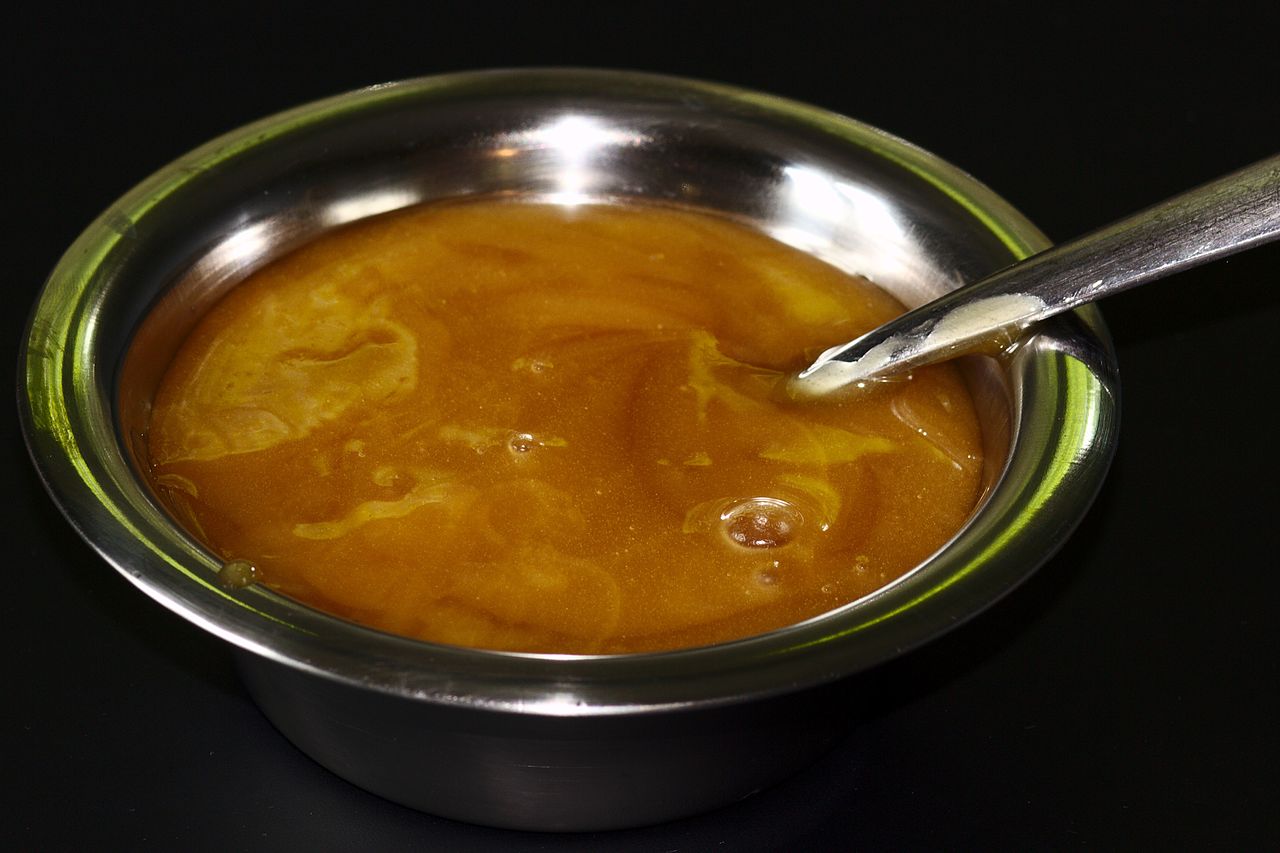

Mechanism and characteristics
The characteristic behaviour arises from a reversible breakdown and recovery of internal microstructure. At rest, particles, polymer networks or aggregates form an interconnected scaffold that resists flow; under sustained shear this network is disrupted, allowing the material to flow more easily and reducing its viscosity. Recovery happens gradually as the components re-associate when motion ceases. Because recovery is not instantaneous, thixotropic materials show a hysteresis in flow behaviour: the measured viscosity depends on the recent history of applied stress or deformation.
Measurement and rheology
Thixotropy is distinguished from purely shear-thinning behaviour (instantaneous, rate-dependent viscosity) by its dependence on time. Rheologists characterize it with protocols such as step shear tests, recovery tests and looped shear-rate ramps that reveal time-dependent decay and rebuilding of structure. In the language of continuum rheology, thixotropic fluids are a subset of Non-Newtonian fluids whose constitutive response includes an internal structural parameter that evolves with time under shear. Practical measurements focus on how long it takes viscosity to fall under a given stress and how long it takes to recover after the stress is removed.
Applications and examples
Thixotropic behaviour is useful in many applications where ease of application under force and stability at rest are both desirable. Examples include:
- Paints and coatings: they brush or spray easily but resist sagging on vertical surfaces.
- Food products: sauces and dressings that pour under stirring but cling to food when stationary.
- Cosmetics and personal care: creams and gels that spread smoothly but hold shape in a jar.
- Drilling muds and cement slurries: flow when pumped but suspend weights and cuttings when static.
- Clays and many colloids: construction and ceramic slips that combine workability with stability.
Distinctions and notable facts
It is important to distinguish thixotropy from closely related phenomena. Shear-thinning refers to an immediate drop in viscosity with increasing shear rate but without a time-dependent recovery; thixotropy adds an explicit time scale for breakdown and rebuild. The opposite effect, where viscosity increases with sustained shear, is called rheopexy or anti-thixotropy and is much rarer. In practice, a material may show a mix of behaviors depending on composition, temperature and concentration.
Understanding thixotropy helps in formulation, quality control and processing: correct additives and particle interactions can tune how quickly a product flows under stress and how rapidly it returns to a rested structure. For more technical introductions and data interpretation see general rheology texts and resources such as those linked here: gels overview, fluid properties, viscosity concepts, non-Newtonian fluids, shear and stress, and colloidal systems.
Questions and answers
Q: What is thixotropy?
A: Thixotropy is the property of certain gels or fluids that are viscous under normal conditions but flow when shaken or agitated.
Q: What are Non-Newtonian fluids?
A: Non-Newtonian fluids are fluids that show a change in viscosity. The longer the fluid undergoes shear stress, the lower its viscosity.
Q: What is a thixotropic fluid?
A: A thixotropic fluid is a fluid that takes a finite time to attain equilibrium viscosity when introduced to a step change in shear rate.
Q: Which materials are examples of thixotropic materials?
A: Many gels and colloids are examples of thixotropic materials, exhibiting a stable form at rest but becoming fluid when agitated.
Q: What are anti-thixotropic fluids?
A: Anti-thixotropic fluids are fluids that show an increase in viscosity or even solidification when constant shear stress is applied.
Q: How can constant shear stress be applied to a fluid?
A: Constant shear stress can be applied to a fluid by shaking or mixing.
Q: Are anti-thixotropic fluids common?
A: No, anti-thixotropic fluids are much less common than thixotropic fluids.
Related articles
Author
AlegsaOnline.com Thixotropy: time-dependent shear thinning in gels and fluids Leandro Alegsa
URL: https://en.alegsaonline.com/art/99462