
Third Servile War (Spartacus: the Gladiator Revolt against Rome)
A major slave uprising in Italy (73–71 BC) led by Spartacus that challenged the late Roman Republic, defeated several Roman detachments, and was suppressed by Marcus Licinius Crassus.
Overview
The Third Servile War (73–71 BC), often called the Gladiator War or the War of Spartacus, was the most serious of the slave revolts that troubled the Roman Republic. What began as an escape by a small group of gladiators from a school in Capua grew into a broad armed rebellion of enslaved people and fugitives that defeated Roman forces on multiple occasions and threatened parts of southern and central Italy. Ancient biographers and historians, including Plutarch, recorded the uprising; modern study combines those accounts with archaeological and literary evidence to reconstruct events.
Image gallery
9 Images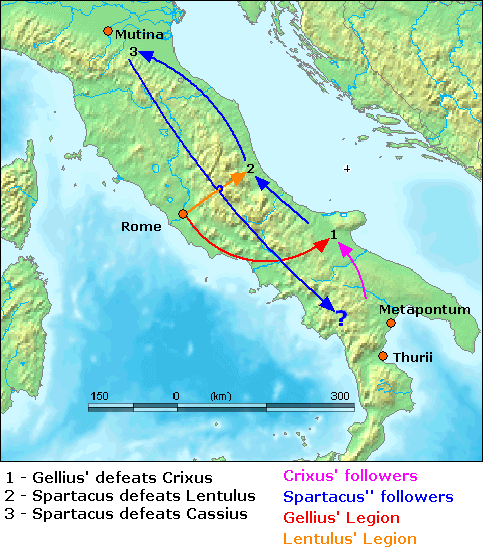




Origins and early successes
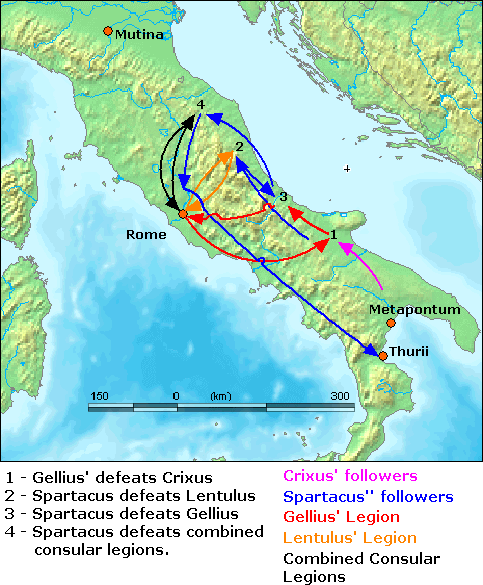
The revolt started in 73 BC when a band of gladiators, reportedly led by a Thracian named Spartacus, escaped confinement and seized weapons. Joined by other fugitives, agricultural labourers and pastoral slaves, the force expanded rapidly. In its early phase the insurgent group used mobility, knowledge of local terrain and surprise to defeat Roman detachments sent against it, causing alarm among the Roman populace because the rebels won several field engagements and repeatedly evaded encirclement.
Course of the war and military response
The Roman Senate responded by commissioning a series of commanders and eventually assigning a large force under Marcus Licinius Crassus. Over roughly two years the conflict alternated between Confederate raids, sieges—most famously the standoff at Mount Vesuvius—and open battles. Crassus reorganized Roman tactics and discipline, employing fortified camps and training to contain the insurgents. When Pompey returned from campaigns elsewhere in 71 BC he intercepted fleeing remnants of the rebel bands, an action that helped end the threat to Italy.
Leadership, aims and composition
Spartacus is conventionally presented as the principal leader; other chiefs such as Crixus and Oenomaus are named in sources. The rebel force was heterogeneous: trained gladiators, runaways, rural slaves and disaffected peasants. Ancient accounts differ about Spartacus’s ultimate aims—whether he intended to march on Rome, to cross the Alps and disperse, or simply to secure freedom for his followers—and historians treat these objectives cautiously because the primary sources are uneven.
Defeat and consequences
The revolt was suppressed in 71 BC by Roman arms. Ancient writers report that thousands of captured rebels were executed in a public and punitive fashion, including large-scale crucifixions along the Appian Way. Spartacus is believed to have been killed in the final engagement; his body was reportedly not recovered. The campaign elevated Crassus’s political and military standing and allowed Pompey to claim credit for ending the rebellion, both developments that influenced the late Republic’s politics.
Legacy and significance
The Third Servile War has had a long cultural afterlife as a symbol of resistance against oppression. It is studied as an episode that exposed vulnerabilities in Roman internal security, tested the Republic’s military institutions, and foreshadowed the intensifying political struggles of the first century BC. For summaries and primary source discussions see general treatments of the Roman Republic and classical biographies in modern collections (Roman Republic studies and classical biographies such as those cited by Plutarch and others).
- Key dates: 73–71 BC (traditional chronology).
- Main leaders: Spartacus (rebel), Marcus Licinius Crassus (Roman commander); Pompey intervened at the end.
- Sources: Ancient histories and biographies; interpretation varies among scholars.
Questions and answers
Q: What was the Third Servile War?
A: The Third Servile War was the last of several slave rebellions against the Roman Republic.
Q: What were the Servile Wars?
A: The Servile Wars were a series of slave rebellions against the Roman Republic.
Q: What other names is the Third Servile War known by?
A: The Third Servile War is also known as the Gladiator War and The War of Spartacus by Plutarch.
Q: Why was the Third Servile War more dangerous for Italia itself?
A: The Third Servile War was more dangerous for Italia itself because the slaves won several battles against the Roman army between 73 and 71 BC.
Q: Why was the Third Servile War alarming to the Roman people?
A: The Third Servile War was alarming to the Roman people because the slaves won several battles against the Roman army between 73 and 71 BC.
Q: Who defeated the Third Servile War?
A: The Third Servile War was defeated at last in 71 BC by Marcus Licinius Crassus.
Q: Did the Third Servile War have any indirect effects on Roman politics?
A: Yes, the Third Servile War had indirect effects on Roman politics for many years.
Related articles
Author
AlegsaOnline.com Third Servile War (Spartacus: the Gladiator Revolt against Rome) Leandro Alegsa
URL: https://en.alegsaonline.com/art/99411
Sources
- penelope.uchicago.edu : 1:117