
Thioester
Thioesters are organic compounds in which a sulfur atom replaces the ester oxygen; they are reactive acyl derivatives with important roles in chemistry and metabolism.
Overview
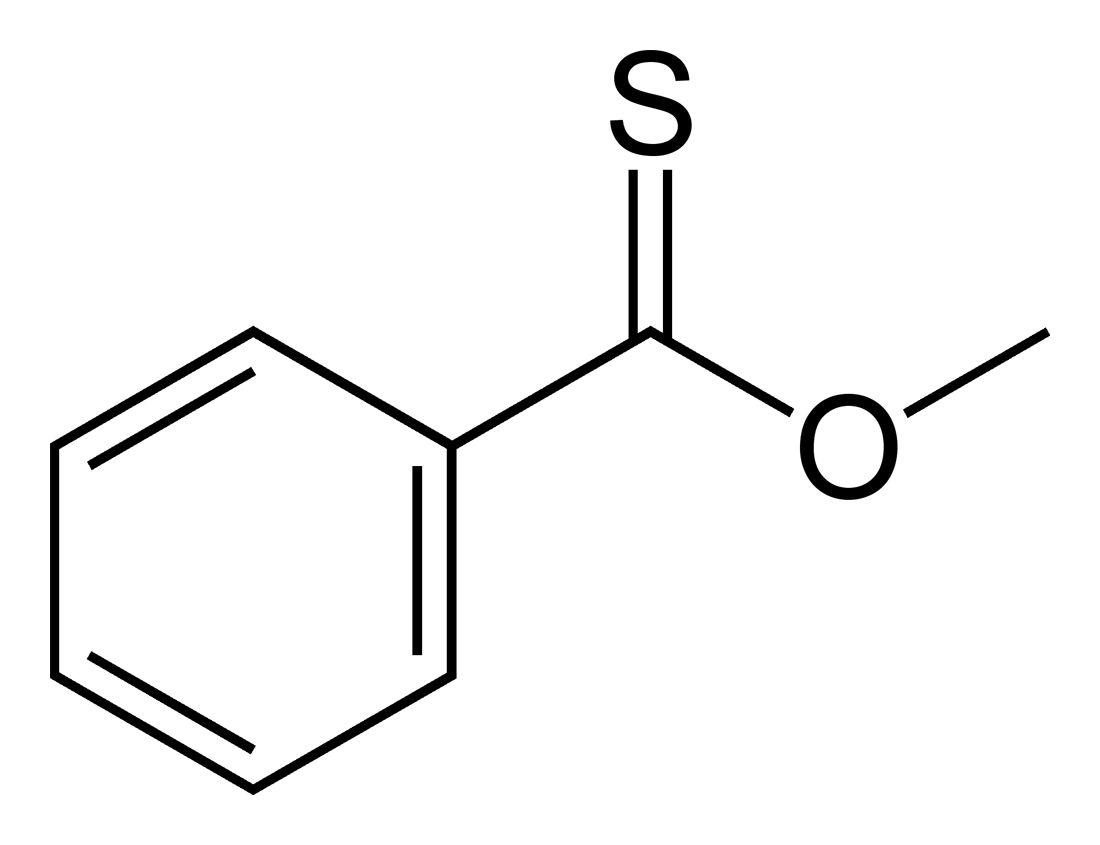
A thioester is an organic functional group in which an acyl (R–C(=O)–) fragment is bonded to a sulfur atom rather than to oxygen, giving a general connectivity often written as R–C(=O)–S–R'. For a concise depiction see the general structure. In concept they are analogous to esters but differ in electronic properties because the sulfur atom has different size and electronegativity compared with oxygen; a simple comparison is shown at ester vs thioester and the historical terminology is discussed at nomenclature sources.
Image gallery
5 Images



Structure and reactivity
The carbon–sulfur single bond adjacent to the carbonyl makes thioesters less stabilized by resonance than ordinary esters. This reduced delocalization renders the carbonyl more electrophilic, so thioesters are generally more reactive toward nucleophiles than corresponding esters or amides. Key structural points and comparisons appear in summaries such as comparative charts and mechanistic notes at reaction guides. Thioesters can form enolates and participate in classic condensations and acyl-transfer reactions.
Biological roles
Thioesters are central to metabolism. Acetyl‑CoA and other acyl‑CoA species are thioesters that serve as activated acyl donors in many biosynthetic and degradative pathways, including fatty acid synthesis and the citric acid cycle; useful introductions to these roles can be found at biochemical summaries and metabolic pathway resources. Enzyme-bound thioesters also appear on carrier proteins such as the acyl carrier protein (ACP) and drive otherwise unfavorable transformations by providing a relatively high-energy acyl linkage; further discussion is available at enzyme mechanisms and cellular energetics.
Synthesis and laboratory applications
Chemical preparation of thioesters commonly proceeds by coupling a carboxylic acid derivative with a thiol or by converting an acid to an activated intermediate (acid chloride, anhydride, or using carbodiimide coupling agents) before addition of a thiol; practical protocols are collected at experimental methods and synthetic notes. In organic synthesis thioesters are valued as acyl transfer reagents, intermediates in peptide ligation techniques, and partners in cross-coupling or Claisen-type condensations; selected applications are surveyed at synthetic applications and peptide chemistry.
Distinguishing features and notable facts
- Compared with esters and amides, thioesters are more reactive at the carbonyl and are thus useful as activated acyl donors in both enzymatic and synthetic contexts; see reactivity comparisons.
- They play a non-covalent and covalent role in metabolism: as small-molecule carriers (e.g., acetyl‑CoA) and as transient enzyme-bound intermediates; background information is at metabolism highlights.
- In laboratory work, handling of thiols and thioesters requires attention to odor and to potential side reactions such as disulfide formation; safety and handling notes are given at practical guidance.
Questions and answers
Q: What is a thioester?
A: A thioester is a molecule with a group C-S-CO-C, similar to an ester but with a sulfur atom instead of an oxygen one.
Q: How are thioesters synthesized?
A: Thioesters can be made from carboxylic acids using a thiol instead of an alcohol in the synthesis process.
Q: What is the significance of thioesters in biochemistry?
A: Thioesters are important intermediates in the production of ATP, which provides energy to the body. They are also produced in the body during reactions that create fatty acids.
Q: How are thioesters more reactive than esters and amides?
A: Thioesters are more reactive than esters and amides because they can be used as electrophiles and can engage in aldol reactions.
Q: What is the similarity between esters and thioesters?
A: Esters and thioesters are similar in that they can both be made from carboxylic acids.
Q: What is the difference between thioesters and esters?
A: The difference between thioesters and esters is that thioesters contain a sulfur atom instead of an oxygen atom.
Q: What is the function of thioesters in the production of ATP?
A: Thioesters function as intermediates in the production of ATP, which provides energy to the body.
Related articles
Author
AlegsaOnline.com Thioester Leandro Alegsa
URL: https://en.alegsaonline.com/art/99385