
Thermometer: principles, types, history, and applications
An instrument for measuring temperature. Overview of operating principles, major types (liquid-in-glass, bimetallic, digital, infrared), historical development, scales, uses, and safety considerations.
Overview
A thermometer is an instrument that measures temperature — the degree of hotness or coldness of a body or environment. Thermometers convert a physical response that depends on temperature into a readable value. That response may be the expansion of a fluid, bending of a metal strip, an electrical change in a sensor, or thermal radiation. For general context and scientific definitions see temperature.
Image gallery
10 Images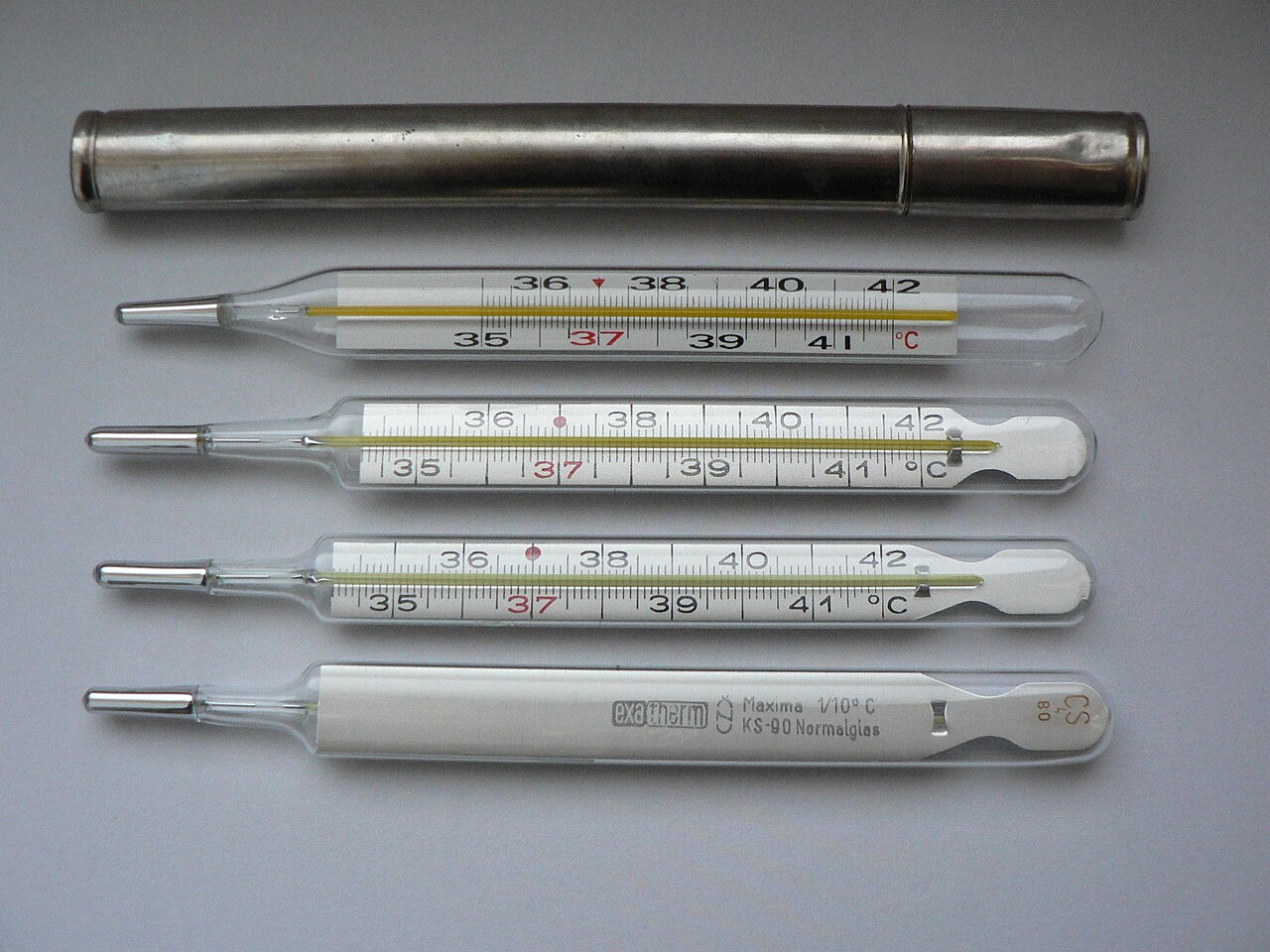



Common types and how they work
Modern thermometers fall into a few broad categories based on their sensing principle. Each type has advantages and limitations in range, speed, accuracy, robustness and cost.
- Liquid-in-glass: a reservoir of mercury or dyed alcohol in a narrow capillary expands or contracts with temperature change and indicates a level on a calibrated scale. These are simple and stable but mercury presents environmental and health concerns.
- Bimetallic: two metals with different thermal expansion coefficients are bonded; temperature changes cause the strip to bend and move a pointer. Often used in thermostats and oven dials because they are robust and easy to read from a distance.
- Electrical/digital: sensors such as thermistors, resistance temperature detectors (RTDs) and thermocouples produce an electrical signal that varies with temperature. Electronics convert that signal into a numeric display and enable data logging and remote sensing.
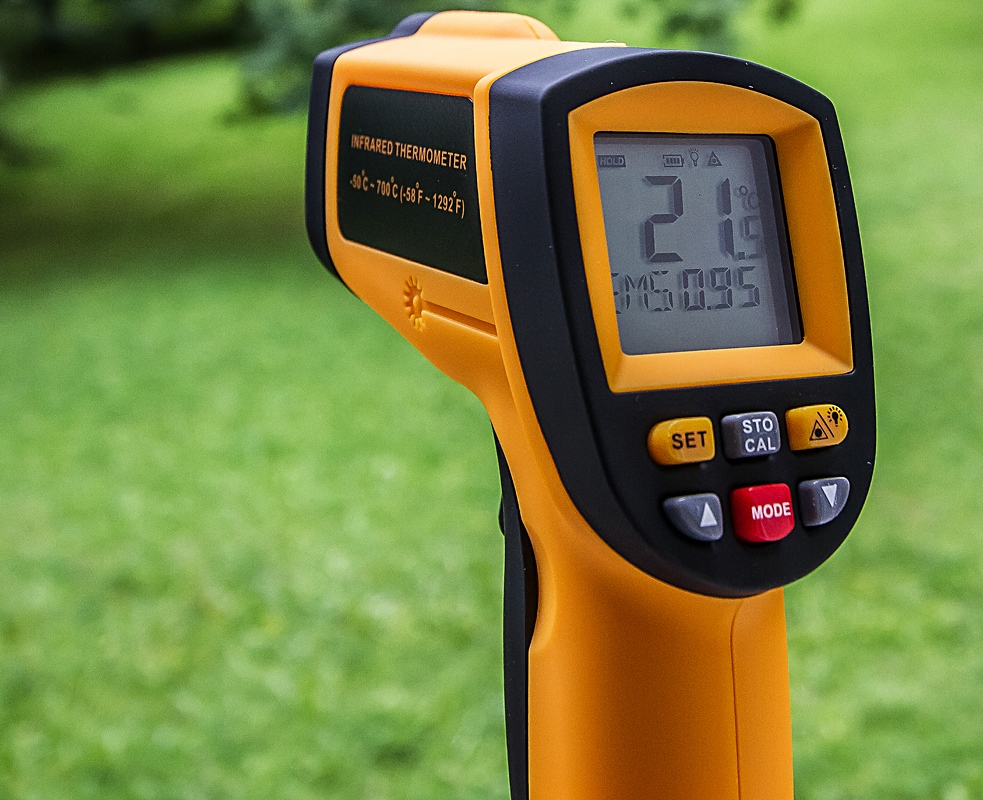
- Infrared (non-contact): measure thermal radiation emitted by an object to infer surface temperature. Useful for moving targets, high-temperature sources, or when contact is impractical.
History and development
Early temperature devices — sometimes called thermoscopes — tracked expansion or contraction of air or liquid without a numerical scale. Over the 17th and 18th centuries the design evolved: sealed liquid-in-glass instruments, standardized scales, and mechanically driven pointers all appeared. In the 18th century competing temperature scales were proposed, and later refinements led to more precise laboratory standards and internationally agreed reference points for calibration.
Scales and calibration
Temperature can be expressed in several scales: Celsius, Fahrenheit and Kelvin are the most common. Accurate thermometry relies on calibration against reproducible reference points (for example the melting and boiling behavior of pure substances under defined conditions) and standard procedures. Laboratory and industrial practice often reference international temperature scales to ensure measurements are comparable.
Applications and examples
Thermometers are ubiquitous. Typical uses include weather observation, clinical diagnosis, food safety, industrial process control, scientific research, HVAC systems and automotive engines. Choice of thermometer depends on required accuracy, measurement range, response time and environment (corrosive atmospheres, vacuum, high pressure, moving parts).
Safety, maintenance and notable considerations
Some traditional thermometers used mercury, which is toxic if spilled; many jurisdictions restrict mercury devices and favor alternatives such as alcohol-filled glass or digital sensors. Digital instruments may require periodic calibration and battery replacement. Infrared thermometers measure surface temperature and can mislead if emissivity or reflections are not accounted for. Proper selection, handling and calibration are important to obtain reliable readings.
Questions and answers
Q: What is a thermometer?
A: A thermometer is an instrument for measuring or showing temperature.
Q: What are the two types of thermometers mentioned in the text?
A: The two types of thermometers mentioned in the text are a concealed glass tube containing mercury or alcohol and a digital thermometer.
Q: How did early thermometers from the time of Galileo measure temperature?
A: Early thermometers from the time of Galileo measured the expansion and contraction of air.
Q: What did many thermometers use after the middle 17th century?
A: Many thermometers used alcohol or mercury after the middle 17th century.
Q: What kind of thermometer was invented in the 19th century?
A: A mechanical thermometer was invented in the 19th century.
Q: How did the mechanical thermometer work?
A: The mechanical thermometer worked by using a bimetallic strip to move a pointer.
Q: Is the mechanical thermometer still in use today?
A: Yes, the mechanical thermometer is still popular where people like to read temperature from a distance.
Related articles
Author
AlegsaOnline.com Thermometer: principles, types, history, and applications Leandro Alegsa
URL: https://en.alegsaonline.com/art/99309
Sources
- caringforkids.cps.ca : caringforkids.cps.ca