
Theoretical keys (music)
Keys whose signatures would require double-sharps or double-flats; rarely used in notation and usually replaced by enharmonically equivalent common keys.
Overview
In musical notation a "theoretical key" (sometimes called an "impossible key") refers to a tonal center that, if written with its conventional scale degrees, would require a key signature containing one or more double-sharps (x) or double-flats (bb). These notational forms are legitimate accidentals, but placing them in a key signature is uncommon because it makes reading and sight-reading difficult. For background on the basics of pitch organization and notation see music theory.

Image gallery
10 Images





Notation and characteristics
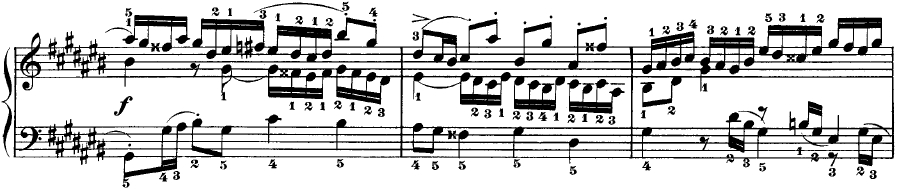
Standard key signatures use up to seven sharps or seven flats, each altering the pitch of a specific scale degree by one semitone. A theoretical key goes beyond that limit: to preserve the usual diatonic spelling of a major or minor scale (one of each letter name), a signature would have to include double accidentals. For example, the scale spelled as G♯ major requires an F to be raised twice (F##) in standard diatonic spelling, which is awkward to place into a concise signature. For more on key signatures and how they are constructed, consult key signatures.
Enharmonic equivalence and practical use
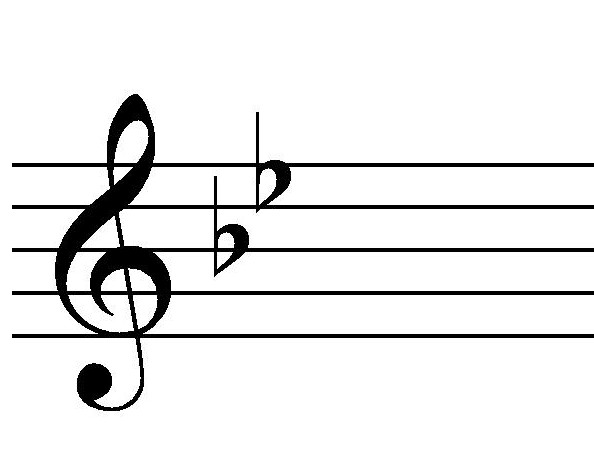
Because modern equal temperament treats certain pitches as identical (enharmonic), composers and editors normally rewrite theoretical keys using an enharmonically equivalent but simpler key signature. Thus G♯ major is usually written as A♭ major; the pitches sound the same on an equal-tempered instrument even though the spelled scale degrees differ. Similarly, theoretical forms involving double-flats or double-sharps are often avoided by choosing the nearest familiar key. When notated modulation or voice-leading demands specific spellings, composers may temporarily use double accidentals in the music itself, but rarely in a full key signature.
Examples and distinctions
- G♯ major (theoretical) vs A♭ major (practical enharmonic): same sounding pitches in equal temperament, different spelled scale degrees.
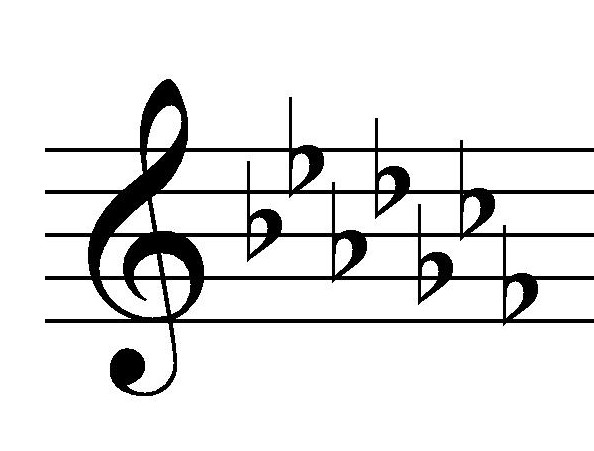
- Some keys that look complex—such as C♭ major—are not theoretical because their signatures use only single flats; they remain within the conventional seven-flat limit.
- On instruments or in tuning systems where enharmonic pitches differ (unequal temperaments, historical temperaments), the distinction between a theoretical key and its enharmonic counterpart can be musically significant.
History, pedagogy and rare uses
Historical treatises and modern pedagogy mention theoretical keys mainly to explain the logic of diatonic spelling, harmonic function, and the limits of key-signature notation. Composers of advanced chromatic music or theorists analyzing remote modulatory regions may encounter theoretical keys in their work. In practice, notation is usually simplified for performers: either the piece is transposed, the enharmonic key is used, or accidentals appear in the staff rather than in an impractically complex signature. For more on accidentals themselves see double-flats and double-sharps.
Notable considerations
Readers should note that the concept of a theoretical key is primarily notational and pedagogical. It helps explain why certain keys are rarely chosen for written music and why editors prefer enharmonic respellings. In contexts where exact tuning and interval sizes matter—historical performance, tuning research, or microtonal music—the spelled difference that creates a theoretical key can carry real sonic consequence, and then composers or theorists may treat the theoretical spelling as meaningful rather than merely notationally awkward.
Further reading
For practical guidance on applying these ideas to composition or analysis, look for discussions of enharmonic equivalence, key signatures, and chromatic harmony in standard music theory texts and reputable instructional resources. Online references and score editions often illustrate how editors choose simpler spellings over theoretical key signatures to aid performers and readers.
Questions and answers
Q: What are theoretical keys?
A: Theoretical keys are musical keys with key signatures that contain at least one double-flat or double-sharp.
Q: Why are double-flats and double-sharps rarely placed in the key signature?
A: Double-flats and double-sharps are used as accidentals, but they are rarely placed in the key signature because it would make reading the key signature very difficult.
Q: What is an example of a theoretical key?
A: An example of a theoretical key is G♯ major, which has a key signature with an F.
Q: How can we write music using this theoretical key?
A: We can write music using this theoretical key by writing it with the same notes as A♭ major, since these two keys are enharmonically equivalent.
Q: What does enharmonically equivalent mean?
A: Enharmonically equivalent means that two different musical keys have exactly the same notes.
Q: Why do we use equal temperament when writing music down? A: We use equal temperament when writing music down so that all notes sound equally in tune regardless of their position on the scale.
Related articles
Author
AlegsaOnline.com Theoretical keys (music) Leandro Alegsa
URL: https://en.alegsaonline.com/art/99261