
The Year of Living Dangerously (film)
1983 Australian–American romantic political drama directed by Peter Weir, set in 1965 Jakarta. Stars Mel Gibson, Sigourney Weaver and Linda Hunt; Hunt won the Academy Award for Best Supporting Actress.
The Year of Living Dangerously is a 1983 Australian–American romantic political drama directed by Peter Weir and adapted from the 1978 novel by Christopher Koch. The film follows an Australian journalist who arrives in Jakarta in 1965 and becomes entangled in a network of expatriates, local sources and an increasingly dangerous political environment. With its blend of personal drama and historical tension, the picture uses fictional characters to explore themes of duty, loyalty and the ethics of bearing witness.
Image gallery
2 Images
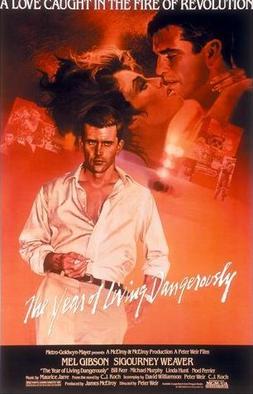
Plot overview
The protagonist, Guy Hamilton, is an inexperienced foreign correspondent who struggles to develop contacts and secure a major story. He befriends Billy Kwan, an observant local photographer whose perspective deepens Guy’s view of the society around him. Through Billy, Guy meets Jill Bryant, a British diplomat, and a complex relationship develops between the three. As political unrest grows and reports of organized action against the Communist Party circulate, Guy must choose between professional ambition and personal responsibility. The film traces his moral decisions against a backdrop of rumors, threats and escalating violence.
Cast and performances
The principal cast includes Mel Gibson as Guy Hamilton and Sigourney Weaver as Jill Bryant. Linda Hunt drew particular attention for her performance as Billy Kwan, a role she played on screen as a character whose gender differs from the novel’s depiction. Hunt’s portrayal earned her the Academy Award for Best Supporting Actress, a distinction that prompted discussion about casting, character interpretation and representation. Critics generally praised the cast for bringing emotional subtlety and human scale to a story set amid large historical forces.
Production and filming
For political and practical reasons the film was shot outside Indonesia, with filmmakers using locations that could stand in for 1965 Jakarta and careful period production design to evoke the era. The production emphasized atmosphere and local detail while negotiating the sensitivities involved in dramatizing a recent and contested political moment. Cinematic choices — lighting, sound and pacing — were used to create a sense of mounting tension as events in the city move toward crisis.
Historical context
The narrative is set during a turbulent year in Indonesian history that culminated in an attempted coup and a rapid shift in power that led to widespread anti-communist measures. The film does not attempt a documentary account; rather, it uses a partly fictional frame to ask how individuals—reporters, diplomats and residents—respond when ordinary life collides with political upheaval. Viewers are encouraged to consult historical sources to separate the film’s fictional elements from the complex reality of 1965 Indonesia.
Themes
Major themes include the responsibilities and limitations of journalism in dangerous times, the moral costs of ambition, and the personal consequences of political violence. The film also raises questions about cultural difference, the influence of foreign correspondents in volatile settings and the ethics of dramatizing recent events for international audiences.
Reception and legacy
On release, the film received praise for its atmosphere, direction and performances, and it helped raise international awareness of Australian cinema in the early 1980s. While Linda Hunt’s award was the most widely noted accolade, critics and scholars have since discussed the film’s interpretive choices about Indonesian history and its balance between romance, reportage and political drama.
Further reading and resources
- Film synopsis and credits
- Adaptation and author Christopher Koch
- Cast biographies and filmographies
- Contemporary critical reviews
- The original novel by Christopher Koch
- Mel Gibson: career context
- Linda Hunt: performance and awards
- Historical background on Indonesia in 1965
To better understand the events depicted, readers may compare the film with Koch’s novel and consult historical studies of mid-1960s Indonesia. The Year of Living Dangerously remains frequently cited as an example of cinema that mixes romantic drama, journalistic ambition and political crisis to examine how ordinary people react when confronted by extraordinary events.
Questions and answers
Q: When was The Year of Living Dangerously movie released?
A: The Year of Living Dangerously movie was released in 1983.
Q: Who is the main character in the movie?
A: The main character in the movie is journalist Guy Hamilton, portrayed by Mel Gibson.
Q: Where does the movie take place?
A: The movie takes place in Jakarta, Indonesia.
Q: With whom does Guy Hamilton form a friendship?
A: Guy Hamilton forms a friendship with dwarf photographer Billy Kwan, portrayed by Linda Hunt.
Q: Who is British diplomat Jill Bryant, and how does Guy Hamilton meet her?
A: British diplomat Jill Bryant, portrayed by Sigourney Weaver, falls for Hamilton, and she gives him key information about an approaching Communist uprising. Guy Hamilton meets Jill Bryant through Billy Kwan, his dwarf photographer friend.
Q: Does Guy Hamilton stay in Jakarta to pursue the story as the city becomes more dangerous?
A: Yes, Guy Hamilton stays in Jakarta to pursue the story as the city becomes more dangerous.
Q: Does Guy Hamilton face any threats as he gets closer to the government?
A: Yes, Guy Hamilton faces more threats as he gets closer to the government.
Related articles
Author
AlegsaOnline.com The Year of Living Dangerously (film) Leandro Alegsa
URL: https://en.alegsaonline.com/art/99151