
The Wealth of Nations — Adam Smith's Inquiry into Political Economy
A clear exposition of Adam Smith's 1776 work explaining division of labor, markets, supply and demand, factors of production, and its influence on economic thought and policy.
Overview
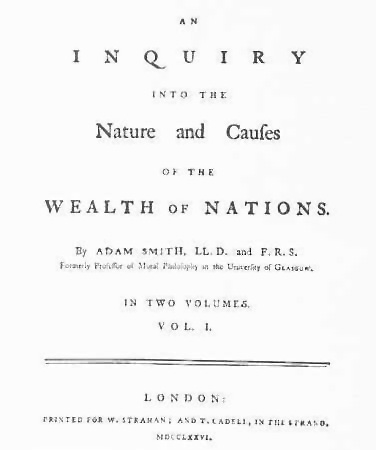
An Inquiry into the Nature and Causes of the Wealth of Nations, commonly called The Wealth of Nations, is a foundational 1776 work by the Scottish moral philosopher Adam Smith. It sets out a systematic analysis of how modern market economies generate wealth, growth, and productive specialization. Smith examined practical institutions and policies of his day to explain economic behaviour and to propose reforms that, he argued, would improve national prosperity.
Image gallery
7 Images



Core ideas and components
Smith advanced several interlocking concepts that remain central to economics. He made a case for the benefits of the division of labour in raising productivity, described how prices respond to relative scarcity through supply and demand, and identified land, labour, and capital as principal contributors to production. Smith also introduced the metaphor of the "invisible hand" to capture how individual self-interest can produce socially desirable outcomes under certain conditions.
Key themes include:
- Division of labour and specialization as engines of efficiency.
- Market mechanisms that coordinate production and consumption through price signals.
- Critique of mercantilist restrictions and monopolies in favour of freer commerce.
- Recognition of distinct public roles—defence, justice, and public works—where markets alone are insufficient.
Structure and historical context
The book is organized into several books that treat production, capital accumulation, commercial systems, critiques of contemporary trade policy, and public finance. Smith wrote against the backdrop of 18th-century mercantilism and state-sponsored monopolies such as the East India Company. While the work is often described as the birth of classical economics, it built on prior ideas and immediately joined an active debate about trade, taxation, and regulation — sometimes identified with the rise of classical economics and broader market economics.
Applications and examples
Smith used concrete examples to show how restrictive rules distorted economic incentives. He criticized policies that forced colonies to export raw materials and import finished goods, arguing that such regulations harmed both producers and consumers. He favored allowing commerce to flow with fewer artificial constraints, a position often summarized as support for freedom of trade. At the same time, Smith recognized the need to limit concentrations of political privilege that benefited rulers or powerful firms at the expense of wider prosperity.
Influence, interpretation and debates
The Wealth of Nations profoundly influenced subsequent economic thought and public policy, shaping debates about free markets, tariffs, and regulation. Economists and policymakers have variously invoked Smith to support market liberalization or to warn about limits of markets. His arguments about supply and demand and the role of competition are foundational to later theories; his caution about special privileges and monopolies continues to inform critiques of corporate power.
Distinctions and notable points
Several clarifications help avoid over-simplified claims. Smith did not argue for absolute laissez-faire in every sphere: he allowed for government functions that private markets would underprovide, such as infrastructure, education, and security. His moral philosophy background also left room for civic virtues and regulation to correct market failures. Readers should note that some familiar phrases and summaries — for example, the "invisible hand" — appear in limited contexts in his text, and later interpreters expanded their meaning.
For accessible introductions or editions, consult modern commentaries and annotated translations that situate Smith’s arguments in 18th-century institutions and in later economic developments. For further reading on Smith’s life and detailed exegesis, see resources about Adam Smith, the history of classical economics, debates over market economics, and critiques of mercantilism such as those responding to the policies of the East India Company. Other useful topics include the evolution of ideas about factors of production, contemporary discussions of market freedom, and historical examples of colonial trade rules referenced by Smith like restrictions on manufacturing in American colonies that shaped his critique of policy interventions.
Readers may follow linked entry points for broader context on the author, the book’s role in economic history, and how its central principles have been adapted and contested over the past two centuries. See additional materials indexed under trade policy, institutional histories of commerce, and scholarly treatments of the book’s structure and enduring influence here.
Questions and answers
Q: Who wrote The Wealth of Nations?
A: The Wealth of Nations was written by Adam Smith in 1776.
Q: What did Smith say about economics before his book?
A: Before Smith's book, economics was mainly focused on the king's personal interests and the wealth of a nation was measured by the gold and silver in the country.
Q: What did Smith believe should be used to measure a nation's wealth?
A: According to Smith, a nation's wealth should be measured by its yearly income.
Q: What are the three "factors of production" according to Smith?
A: According to Smith, land, labour, and capital are the three "factors of production".
Q: How does supply and demand affect prices?
A: Prices naturally adjust depending on how much or little there is of something; if there is too much (more supply), prices go down so that people have more reason to buy it. If there is high demand but not enough (scarcity), competition among buyers will drive up prices.
Q: What did Smith think about government interference in markets?
A: Smith believed that markets should be free from government interference; he thought it was better for money to flow freely between buyers and sellers without outside influence so that people could do what was best for themselves which would end up being best for society as a whole.
Related articles
Author
AlegsaOnline.com The Wealth of Nations — Adam Smith's Inquiry into Political Economy Leandro Alegsa
URL: https://en.alegsaonline.com/art/99095