
The Pentagon: U.S. Department of Defense Headquarters and Landmark Building
The Pentagon is the five-sided headquarters of the U.S. Department of Defense in Arlington, Virginia. It is noted for its size, distinctive design, history, and role in national defense.
Overview
The Pentagon is the central headquarters for the United States Department of Defense. Situated in Arlington, Virginia, just across the Potomac River from central Washington, D.C., it houses the offices of military and civilian leaders responsible for national defense policy, planning, and operations. The building is widely recognized for its distinctive five-sided plan and very large floor area, making it one of the world’s largest office buildings.
Image gallery
10 Images



Design and structure
Its five-sided geometry gives the complex a clear identity: concentric corridors and radial corridors organize workspaces around a series of rings and an open central plaza. The exterior is faced with light-colored limestone, a feature often noted in descriptions of the building and linked to its durability and appearance. The structure includes multiple above-ground floors and lower levels; in total there are several levels used for offices, services and utilities. Despite the building’s size, its layout was planned so that most points can be reached in a few minutes.
History and construction
Construction began in the early 1940s to meet an urgent need for a compact, centralized headquarters during World War II. The design and rapid construction reflected wartime priorities; the building was completed in the early 1940s. Over subsequent decades it has been remodeled and upgraded to support evolving technologies and security needs. The site and the building’s role have been the subject of study and public interest throughout American history.
Function, importance and uses
The Pentagon functions as the administrative and operational hub for the U.S. military. It contains offices for civilian leaders, uniformed service branches, joint organizations and support services. Beyond daily administrative work, the complex hosts strategic planning, logistics, training coordination, and ceremonial activities. It is both an office building and a symbol of the U.S. national defense establishment.
September 11, 2001 and resilience
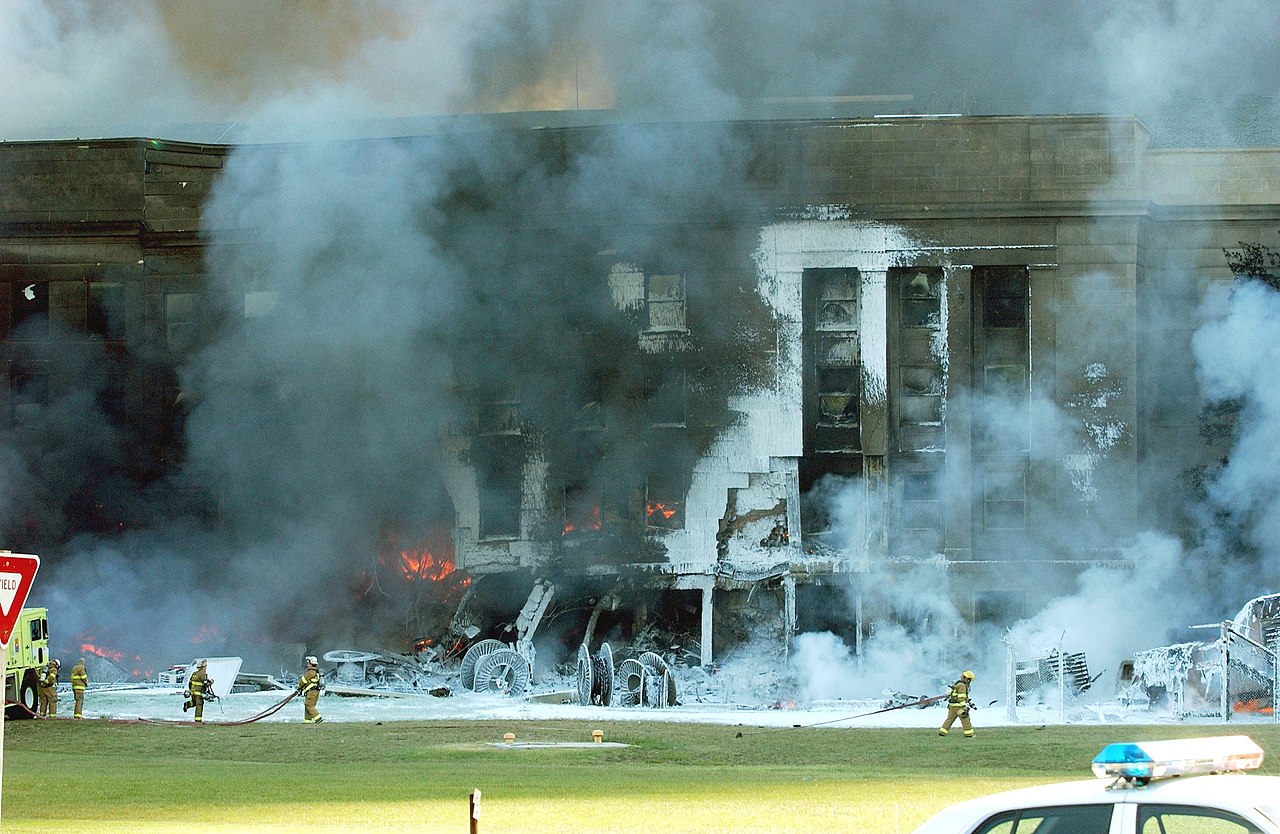
On September 11, 2001, the building was the target of a terrorist attack when an airliner was deliberately flown into the western side. The impact and subsequent fire caused loss of life and substantial damage to part of the structure. The attack resulted in hundreds of casualties across both the building and the aircraft, and prompted an extensive repair and reinforcement effort that restored and modernized the damaged sections while improving safety measures.
Notable facts and distinctions
- The Pentagon’s five-sided plan differentiates it from most large office complexes; the shape is a defining feature and often referenced in general descriptions — see pentagonal design.
- The exterior stone finish is commonly described as limestone; material and appearance are sometimes noted in architectural overviews — see building materials.
- Although large in total floor area, its interior organization emphasizes short travel times between offices — for further detail consult official references at official building information.
- The Pentagon’s location and relationship to the nation’s capital are often discussed in geographic and transportation contexts — see regional references at Arlington / Washington area resources.
Together, these aspects make the Pentagon both a practical workplace for tens of thousands of people and a prominent national landmark with historical, architectural, and institutional significance.
Questions and answers
Q: What is the Pentagon?
A: The Pentagon is the headquarters of the United States Department of Defense.
Q: Where is the Pentagon located?
A: The Pentagon is located in Arlington, Virginia near Washington, D.C.
Q: What is the shape of the Pentagon?
A: The Pentagon is in the shape of a pentagon.
Q: How many floors does the Pentagon have?
A: The Pentagon has seven floors.
Q: Is the Pentagon the largest office building in the world?
A: Yes, the Pentagon is the largest office building in the world.
Q: When did construction on the Pentagon begin?
A: Construction on the Pentagon began on September 11, 1941.
Q: What happened to the Pentagon on September 11, 2001?
A: On September 11, 2001, the Pentagon was hit with an airplane by terrorists, killing a total of 189 victims (125 in The Pentagon, 64 in plane).
Related articles
Author
AlegsaOnline.com The Pentagon: U.S. Department of Defense Headquarters and Landmark Building Leandro Alegsa
URL: https://en.alegsaonline.com/art/98607
Sources
- minneapolisfed.org : "Consumer Price Index (estimate) 1800–2008"
- pentagontours.osd.mil : "Facts: Navigating The Pentagon"
- nrhp.focus.nps.gov : "National Register Information System"
- dhr.virginia.gov : "Virginia Landmarks Register"
- greatbuildings.com : "The Pentagon - George Bergstrom - Great Buildings Online"
- pentagon.afis.osd.mil : The Pentagon, Facts & Figures
- pentagon.osd.mil : "Pentagon Facts & Figures"
- judicialwatch.org : "Flight 77, Video 2"
- defense.gov : "Pentagon Hot Dog Stand, Cold War Legend, to be Torn Down"
- hqda.army.mil : "How to Find a Room in the Pentagon"
- edition.cnn.com : "Man shoots 2 officers outside Pentagon"
- roadstothefuture.com : "Mixing Bowl Interchange Complex" · web.archive.org