
The Mikado (Gilbert and Sullivan operetta)
The Mikado is a two-act comic operetta by W. S. Gilbert and Arthur Sullivan set in a fictional Japanese town; premiered in 1885, it is noted for its satire, memorable songs, and lasting influence.
Overview
The Mikado, or The Town of Titipu is a two-act comic operetta with a libretto by W. S. Gilbert and music by Arthur Sullivan. First staged in London in 1885, it is one of the most popular works by the Gilbert and Sullivan partnership. The piece uses a fictionalised Japanese setting and a cast of broadly drawn characters to deliver a satire of British institutions and social mores.
Image gallery
10 Images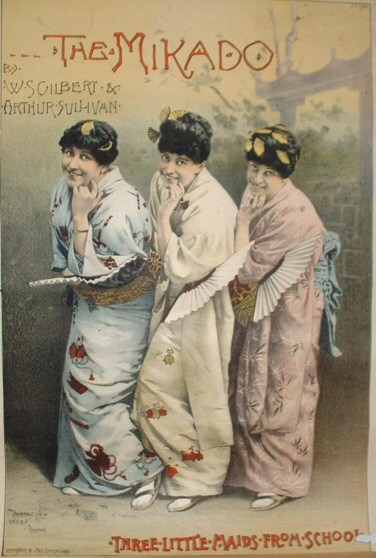


Structure, characters and notable numbers
The operetta is written in two acts and combines spoken dialogue with solos, ensembles and comic patter songs. Principal characters include the wandering minstrel Nanki-Poo, the Lord High Executioner Ko-Ko, the schoolmistress Yum-Yum and the dignified Mikado (the emperor). The action takes place in the imaginary town of Titipu and revolves around love, mistaken identity and the enforcement of ridiculous laws.
- Principal roles: Nanki-Poo, Yum-Yum, Ko-Ko, Pooh-Bah, Katisha, the Mikado.
- Famous numbers: "A Wand'ring Minstrel", "Three Little Maids", and Ko-Ko's patter song often cited as "I've Got a Little List".
Origins and premiere
The Mikado premiered at the Savoy Theatre in London on 14 March 1885, produced by the D'Oyly Carte Opera Company. It was the ninth of fourteen operettas created by the Gilbert and Sullivan team and enjoyed an exceptionally long original run. The piece was conceived during a period when artistic interest in Japanese art and culture — sometimes called Japonism — was widespread across Europe, and Gilbert later related an anecdote about a Japanese sword falling from his wall as sparking the idea for a Japanese setting.
Reception, influence and longevity
Audiences and critics responded enthusiastically to the operetta's wit, memorable melodies and theatrical invention. Its original run of several hundred performances made it one of the duo's most successful works, and it has remained a staple of light opera and amateur theatre repertory worldwide. The Mikado's songs and comic scenes have entered the popular repertoire and its format helped define the English comic operetta tradition.
Style, themes and modern perspectives
Although superficially set in an imagined Japan, The Mikado primarily satirises Victorian British social structures, legal absurdities and political pretensions by transposing them to an exoticised locale. This displacement allowed more pointed social commentary than a direct domestic setting might have permitted. In recent decades, however, producers and scholars have re-evaluated staging practices and visual representations, and many productions adapt costumes, casting and design to address concerns about racial stereotyping and cultural appropriation.
Legacy and contemporary productions
The Mikado continues to be staged in professional and amateur contexts, often reimagined to suit contemporary sensibilities while retaining Gilbert's comic libretti and Sullivan's score. Directors vary between traditional productions that evoke late-19th-century theatrical Japonisme and reinterpretations that emphasize the work's satire or relocate its action to neutral or updated settings. For reference on historical productions and scores, archival materials and company histories are commonly consulted.
For further reading on the authors and original staging, see material on W. S. Gilbert, Arthur Sullivan and the Savoy Theatre.
Questions and answers
Q: What is The Mikado?
A: The Mikado is a two-act operetta written by W. S. Gilbert with music by Arthur Sullivan.
Q: When did The Mikado premiere?
A: The Mikado premiered on 14 March 1885 at the Savoy Theatre in London.
Q: Who premiered The Mikado?
A: The D'Oyly Carte Opera Company premiered The Mikado.
Q: What is significant about the original run of The Mikado?
A: The original run of The Mikado had 672 performances, which was the longest original run of any Gilbert and Sullivan operetta.
Q: What was the cultural context for the creation of The Mikado?
A: At the time of The Mikado's creation, London was overwhelmed with all things Japanese, including tea shops, kimonos, and fans.
Q: Who wrote the book and lyrics for The Mikado?
A: W. S. Gilbert wrote the book and lyrics for The Mikado.
Q: How did Gilbert report getting the idea for The Mikado?
A: Gilbert reported getting the idea for The Mikado when a Japanese sword fell from the wall of his study.
Related articles
Author
AlegsaOnline.com The Mikado (Gilbert and Sullivan operetta) Leandro Alegsa
URL: https://en.alegsaonline.com/art/98461
Sources
- stagebeauty.net : A History of the Royal Command Performance