
Bearing (mechanical): devices for guided motion and load support
Mechanical bearings are components that constrain and support motion—rotational or linear—while reducing friction and wear. They range from plain sleeves to precision rolling, fluid, and magnetic designs.
Overview
A bearing is a machine element that permits controlled relative motion between two parts while supporting load. Bearings are most commonly used to allow rotational motion or linear motion with minimal friction, accurate positioning, and predictable life. By limiting degrees of freedom, bearings make shafts, axles, slides and other components operate smoothly and reliably in countless mechanisms.
Image gallery
6 Images


Types and classification
Bearings can be grouped by operating principle and by the directions of load they carry. Major categories include:
- Plain bearings (journal or sleeve bearings): simple surfaces that slide against each other; they rely on material properties and lubrication.
- Rolling-element bearings: use rolling parts to reduce sliding friction, the most familiar being ball bearings and various roller bearings (cylindrical, tapered, spherical, and needle rollers).
- Fluid bearings: separate surfaces by a thin fluid film (hydrodynamic or hydrostatic), often used where very low vibration and high speed are required.
- Magnetic and air bearings: support loads without contact using magnetic fields or pressurized air, suitable for ultra-high-speed or contamination-sensitive applications.
Components and materials
A typical rolling-element bearing contains inner and outer rings, rolling elements, and a cage or retainer that spaces the elements. Seals or shields and lubrication channels are common additions. Bearings are made from hardened steels, stainless steels, ceramics, or polymers depending on load, speed, temperature, and environmental requirements.
History and development
The basic idea of reducing friction between moving parts dates back to ancient technologies, but bearings evolved significantly during the industrial era as manufacturing precision and materials improved. Developments in mass production, heat treatment, and lubrication allowed the wide adoption of compact, high-performance rolling bearings in the late 19th and early 20th centuries. Modern designs now include advanced ceramics, engineered polymers and active magnetic systems.
Applications and importance
Bearings are ubiquitous: they appear in vehicles, electric motors, turbines, machine tools, household appliances, hard drives, and precision instruments. Choice of bearing affects efficiency, noise, accuracy, and durability. Engineers select bearings based on load type (radial, axial, or combined), speed, required life, maintenance interval, and operating environment.
Maintenance, failure modes and notable considerations
Proper lubrication, correct installation, and contamination control are critical to bearing life. Common failure modes include wear, fatigue (surface pitting), corrosion, and improper mounting. Specialized bearings—such as sealed units, self-aligning designs, or fluid-lubricated systems—address particular needs like misalignment, contamination, or extreme speeds. Understanding these trade-offs is central to reliable machine design.
Questions and answers
Q: What is a bearing?
A: A bearing is a device that allows fixed direction motion between two parts, usually rotation or linear movement.
Q: How are bearings categorized based on their functionality?
A: Bearings are broadly categorized based on the way they function, with the most common ones being plain bearings and rolling-element bearings.
Q: What are ball bearings?
A: Ball bearings are a type of rolling-element bearing where the rolling elements are spherical balls.
Q: What are roller bearings?
A: Roller bearings are a type of rolling-element bearing where the rolling elements are cylindrical, taper or spherical rollers.
Q: What are the two main types of rolling-element bearings?
A: The two main types of rolling-element bearings are ball bearings and roller bearings.
Q: How do plain bearings differ from rolling-element bearings?
A: Plain bearings are a type of bearing that uses a sliding motion rather than rolling elements, whereas rolling-element bearings use rolling elements to enable fixed direction motion.
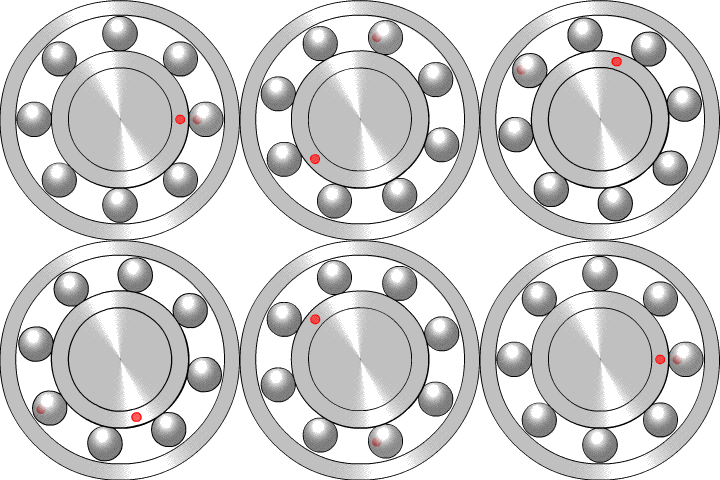
Q: Which type of bearing is shown in the pictures?
A: The pictures show ball bearings.
Related articles
Author
AlegsaOnline.com Bearing (mechanical): devices for guided motion and load support Leandro Alegsa
URL: https://en.alegsaonline.com/art/9834