
The Internationale: origins, lyrics, and global influence
An overview of The Internationale, a widely known socialist and labour anthem: origins, melody, translations, political use, notable versions and its continuing role in left-wing movements worldwide.
The Internationale is one of the most widely recognized songs of labour, socialism and international left-wing movements. Originally written in French in the late 19th century, its words and melody express solidarity among workers, a call for collective action and an aspiration to supplant oppressive systems. The refrain in French begins with "C'est la lutte finale," often rendered in English as "This is the final struggle," and the song has been translated into many languages and adapted to a variety of political and cultural settings.
Image gallery
2 Images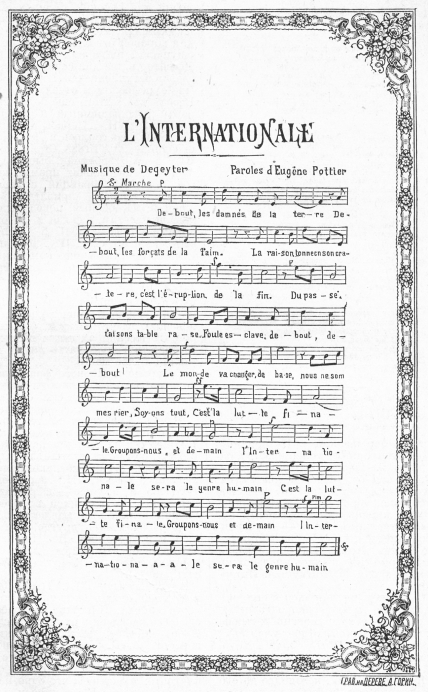

Origins and composition
The original French text was composed by Eugène Pottier in 1871 in the aftermath of the Paris Commune. Pottier's verses circulated in leftist circles before being paired with a distinct melody. The tune most commonly associated with the song was composed by Pierre Degeyter, a Belgian musician, rather than being sung to the melody of France's national anthem, La Marseillaise, as some early drafts had intended. The combination of Pottier's words and Degeyter's music established the version that spread internationally.
Translations, versions and official adoption
The song was translated and adapted into dozens of languages. A major Russian rendering was produced by Arkady Yakovlevich Kots in 1902; Kots's version became especially prominent and was used as a national anthem by the Russian Soviet Federative Socialist Republic after 1918 and by the Union of Soviet Socialist Republics in the early decades of the Soviet state. In 1944 the Soviet Union replaced The Internationale in official ceremonial use with a new state anthem composed by Alexander Alexandrov. In China, Qu Qiubai provided a well-known Chinese lyric version that became widely used among revolutionaries and activists.
Musical and lyrical characteristics
The melody of The Internationale is direct and march-like, intended for public singing by crowds rather than complex performance. Lyrically it stresses class solidarity, the overthrow of capitalist or oppressive structures, and the construction of a society based on equality and common ownership or social justice. Different translations and adaptations adjust tone and detail to local political traditions, ranging from militant language to more reformist or social-democratic emphases.
Uses, contexts and legacy
Throughout the 20th century The Internationale served as an anthem for communist parties, trade unions and socialist organizations around the world. It has been performed at labour rallies, funerals of activists, political gatherings, and state ceremonies in countries where socialist parties held power. In many places it also became a symbol of broader protest movements. Because of its political associations, its performance can be contentious: in some contexts it is celebrated as a hymn of solidarity, while in others it is criticized as an emblem of revolutionary politics.
Notable facts and distinctions
- The original title in French is L'Internationale, and the song is known under related titles in German and Russian.
- Different political traditions—communist, socialist and social-democratic—have all used or adapted versions of the song, sometimes with significant changes to the text.
- Although widely associated with revolutionary movements, many translations soften or reinterpret lines to fit reformist programmes or trade union campaigns.
- The tune is simple enough to be sung by untrained crowds, which contributed to its global spread.
Further reading and representative versions
- French original: L'Internationale
- German title and versions
- Russian text and Kots's translation
- Chinese version by Qu Qiubai
- Context: communism
- Context: socialism
- Context: social democracy
- Alternative socialist interpretations
- English translations and singable versions
- Relation to La Marseillaise and early proposals
- Pierre Degeyter, composer of the standard melody
- The Internationale used as an early Soviet anthem
- Replacement anthem and later Soviet music
- Alexander Alexandrov and the later state anthem
The Internationale remains a living piece of political culture: its words and tune continue to be adapted, quoted and debated by activists, historians and musicians. Whether encountered at a mass rally, in a classroom discussion of labour history, or heard in recordings, the song offers a concentrated expression of the internationalist ideals that have animated many social movements since the 19th century.
Questions and answers
Q: What is the name of the song?
A: The song is called "The Internationale".
Q: Who wrote the French version of the lyrics?
A: The French words were written by Eugene Pottier.
Q: Who composed the tune for "The Internationale"?
A: The tune was created by a Belgian named Pierre Degeyter.
Q: Who wrote the Russian version of "The Internationale"?
A: The Russian version was written by Arkady Yakolevich Kots (Аркадий Яковлевич Коц) in 1902.
Q: When did it become the national anthem of Russia and then later, the Soviet Union?
A: It became the national anthem of Russia in 1918 and that of the Soviet Union in 1922.
Q: Who wrote Chinese lyrics for "The Internationale"? A: The Chinese lyrics were written by Qu Qiubai (瞿秋白).
Q: What are some famous lines from this song? A: One famous line from this song is "C'est la lutte finale" which translates to "It's the final battle".
Related articles
Author
AlegsaOnline.com The Internationale: origins, lyrics, and global influence Leandro Alegsa
URL: https://en.alegsaonline.com/art/98212