
The Hague: seat of Dutch government and international justice
The Hague (Den Haag, 's‑Gravenhage) is a coastal city in South Holland that hosts the Dutch government, many international courts, embassies and cultural sites. It is the country’s administrative center.
Overview
The Hague, commonly called Den Haag and formally known in Dutch as 's‑Gravenhage, is a major city on the western coast of the Netherlands. It lies in the province of South Holland and forms one corner of the densely populated Randstad conurbation. Although it is not the constitutional capital (that title belongs to Amsterdam), The Hague functions as the seat of government and is home to national institutions, foreign embassies and many international organisations. The city itself contains several hundred thousand residents and a metropolitan area of roughly a million people.
Image gallery
10 Images


Government, law and institutions
The city is best known for hosting the Binnenhof, a medieval complex where the Dutch parliament meets, as well as royal offices and government ministries. The Noordeinde Palace, one of the working palaces of the Dutch monarch, is located nearby. The Hague also hosts important national judicial bodies such as the Supreme Court of the Netherlands and, internationally, houses institutions located in the Peace Palace, notably the International Court of Justice and other arbitral and legal bodies. Because of these institutions, international diplomacy and law are central to the city’s identity.
History and urban character
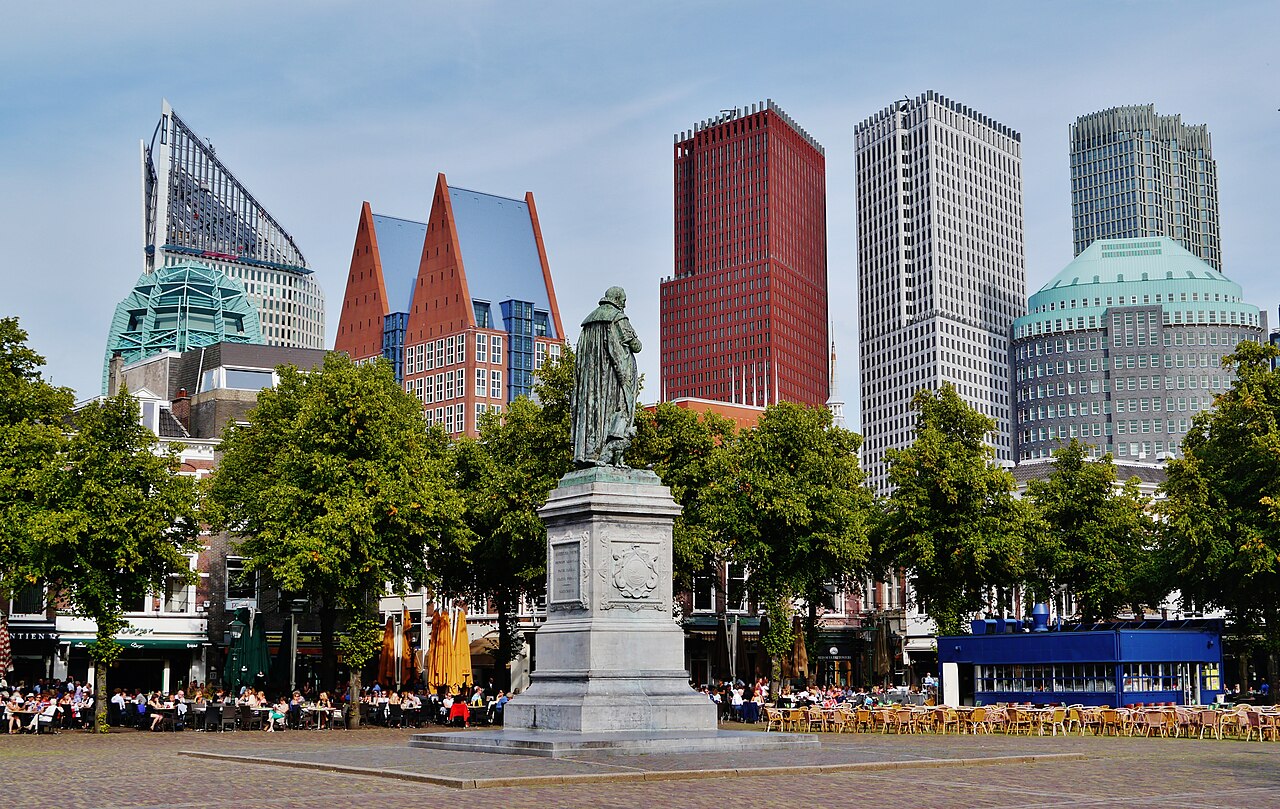
The Hague evolved from a 13th‑century hunting lodge and court into an administrative centre over many centuries. Its urban fabric mixes historic streets, government complexes and newer neighbourhoods. Parks, coastal dunes and a long beachfront at Scheveningen give the municipality a distinctive coastal character among Dutch cities. Architectural highlights range from medieval halls and 19th‑century civic buildings to 20th‑ and 21st‑century office clusters that accommodate international organisations and private firms.
Culture, economy and transport
The Hague hosts cultural institutions such as museums, theatres and festivals; it is also a centre for education, diplomacy, legal services and public administration. The local economy benefits from government employment, international organisations, legal and arbitration services, and a tourism sector that includes attractions like Madurodam and the seaside resort of Scheveningen. The city is well connected by rail and road: multiple railway stations link it to Amsterdam, Rotterdam, Utrecht and Schiphol airport, making it accessible for domestic and international visitors.
Notable sites and distinctions
- The Binnenhof and parliamentary chambers.
- The Peace Palace and several international courts and tribunals.
- Royal palaces and official residences.
- Scheveningen beach, the boulevard and piers.
- Museums, cultural venues and the miniature park Madurodam.
Further reading and resources
For authoritative information, municipal services, tourism, legal institutions and transport details consult the following resources:
- Official municipal information
- Local tourism and visitor guides
- General information on the Netherlands
- Amsterdam and national capital resources
- Rotterdam regional information
- Province of South Holland
- Metropolitan area and conurbation data
- Dutch national government portals
- Information about upper legislative chambers
- Information about lower legislative chambers
- Royal household and monarchy
- Constitutional and ceremonial roles
- Foreign diplomatic missions in the city
- Government ministries and agencies
- Constitutional status of Amsterdam
- International Court of Justice and Peace Palace
- United Nations related organisations
- Use of 'The Hague' as a metonym for international law
- Randstad and urban region information
- Overview of the Dutch Randstad conurbation
- Demographic information on the Dutch population
- Nearby cities such as Utrecht
- Amsterdam Airport Schiphol connections
- Rail travel and schedules
- National rail operator and services
- Local railway stations and transport hubs
This article provides a general introduction to The Hague’s role as a political and international centre, its coastal and cultural character, and practical avenues for further information.
Name and status
Since ancient times, the place name Die Haghe or Den Hag(h)e was used. Since 1602/1603 the municipality officially used the name 's-Gravenhage (Engl. "of the Count Hag"), which was considered more distinguished. The place was originally a hunting seat of the Counts of Holland.
Since 1990, the municipality has consistently used the name The Hague instead of 's-Gravenhage, partly because of the internationalization of the city - The Hague is considered the world capital of jurisdiction - and to emphasize the kinship with spellings in other European languages: English The Hague, French La Haye, Danish Haag, German Den Haag (formerly also: der Haag, mante im Haag), Italian L'Aia, Polish Haga, Russian Гаага Gaaga, Spanish La Haya, Turkish Lahey, Hungarian Hága.
In 1990, however, the proposal to officially rename the city The Hague was rejected. Since then, both names have been valid in parallel. Identity cards, passports and official documents of the city contain the name 's-Gravenhage, while for example the Dutch Railways or the Cyclists' Association use the shorter name Den Haag in plans and on signs.
The Hague is not officially a city, as it never received city status in the Middle Ages, and in the 19th century the distinction between village and city became administratively obsolete.
Situation and economy
The Hague is located in the west of the Netherlands. The city centre is about 6 km from the North Sea. The districts of Scheveningen and Kijkduin are located directly on the sea.
The city is part of the Randstad conurbation. In the immediate vicinity are other major cities, such as Rotterdam (20 km), Leiden (15 km) or Delft (8 km). The satellite town of Zoetermeer, founded in the 1970s, is located about 10 km east of The Hague.
South of the city, extending to the mouth of the Rhine at Hoek van Holland, is the Westland, about 20 by 20 km in size, a vast, continuous greenhouse landscape where vegetables and flowers are grown.
The city is rich in small and medium-sized commercial and industrial enterprises. It is obvious that the service sector with many offices of all kinds is an economic focus for a seat of government; in The Hague this is also the case. The "New Babylon" office complex in the centre is located in the immediate vicinity of the Central Station and its iconic design makes it one of the defining buildings of The Hague's skyline.

Related articles
Author
AlegsaOnline.com The Hague: seat of Dutch government and international justice Leandro Alegsa
URL: https://en.alegsaonline.com/art/98116
Sources
- commons.wikimedia.org : The Hague
- ad.nl : "Cookies op AD.nl - AD.nl"