
The Great Gatsby
Overview of F. Scott Fitzgerald's 1925 novel The Great Gatsby: plot, characters, themes, publication history, symbols, adaptations and lasting cultural influence.
Overview
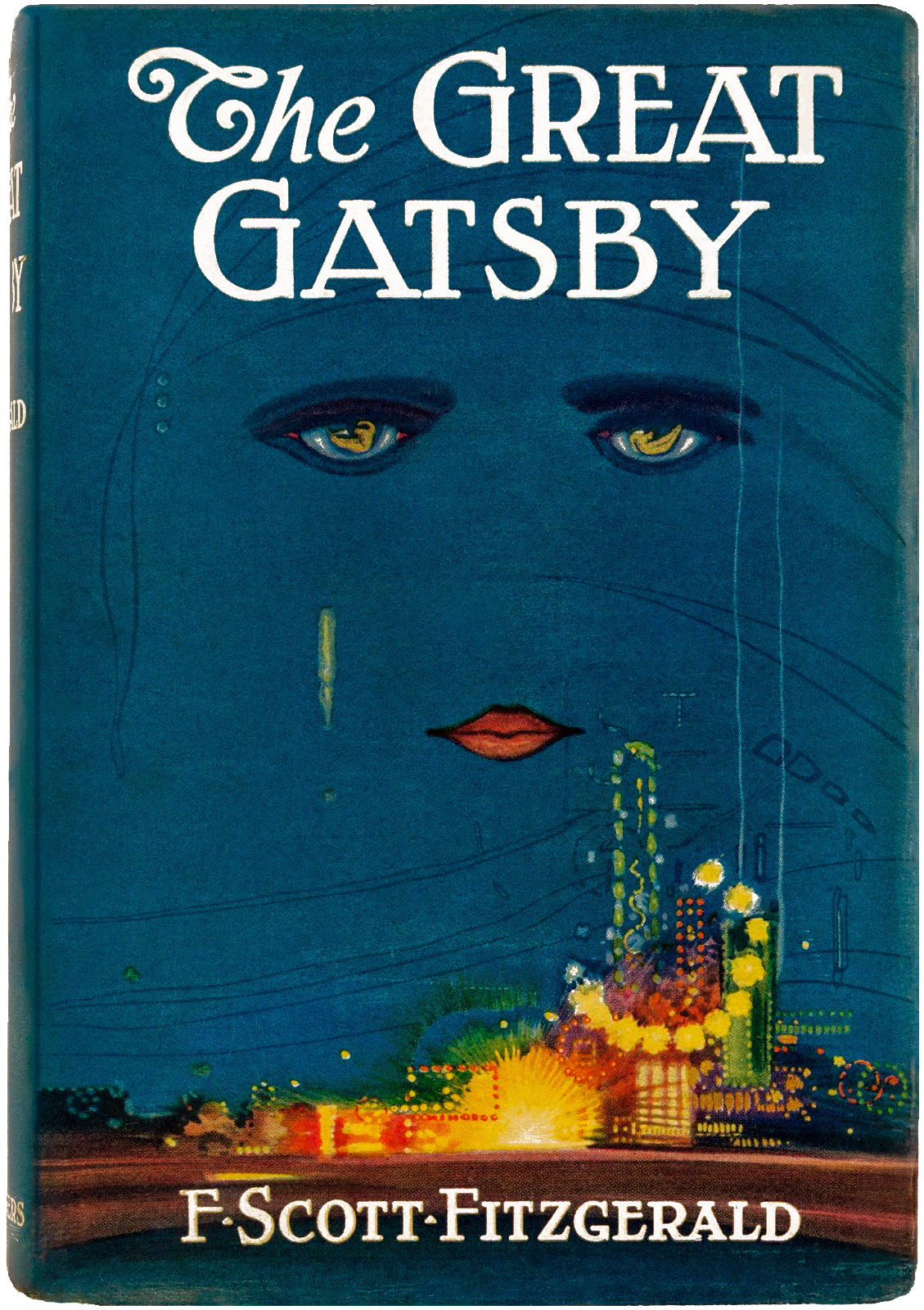
The Great Gatsby is a novel by F. Scott Fitzgerald, first published in 1925. Set in the Jazz Age, the book follows Nick Carraway as he observes and records the life of his neighbor Jay Gatsby. The action alternates between elegant enclaves on Long Island and the social bustle of New York City. Fitzgerald's spare, suggestive prose and the limited perspective of a reflective narrator allow the novel to examine themes of wealth, desire, identity and the so‑called American Dream.
Image gallery
10 Images


Plot and narrative approach
The story is told in the first person by Nick Carraway, a Midwesterner who relocates to the East Coast to work in finance. He rents a modest house in West Egg, a community of recently acquired fortunes, and becomes the neighbor of the mysterious and immensely wealthy Jay Gatsby. Gatsby is famously devoted to Nick's cousin, Daisy Buchanan, who lives across the bay in the more established East Egg with her husband, Tom. Much of the novel's drama comes from Gatsby's attempt to reunite with Daisy and to recover a past that proves difficult to recreate. Fitzgerald unfolds backstory and revelations incrementally, so the book reads both as a social chronicle and as a study of memory and illusion.
Principal characters and setting
Key figures include Jay Gatsby, Daisy Buchanan, Tom Buchanan, Jordan Baker, and the working‑class couple Myrtle and George Wilson. The novel draws sharp contrasts among settings: the glittering parties of West Egg, the old‑money reserve of East Egg, and the bleak industrial stretch known as the "valley of ashes," each of which dramatizes social divisions and moral blind spots. The settings themselves function like characters, shaping behavior and signaling values.
Major themes and symbols
Fitzgerald explores the tension between illusion and reality, the corrosive effects of wealth, the limits of reinvention, and the elusiveness of the American Dream. A few recurring symbols carry much of the novel's weight:
- Green light — the distant signal at the end of Daisy's dock that stands for Gatsby's aspiration and the desire to reclaim the past.
- Eyes of Dr. T. J. Eckleburg — a faded billboard that readers often read as a moral or spiritual witness to the characters' actions.
- Valley of ashes — a landscape of industrial ruin that represents social decay and the human cost of rapid modernization.
- Gatsby's parties — extravagant gatherings that reveal the spectacle of wealth, anonymity and the hollowness beneath surface gaiety.
Style and interpretation
Fitzgerald's style in the novel is economical yet evocative: images are carefully chosen and the narrator's voice blends admiration with critical distance. Critics and readers disagree about specific meanings, but common interpretive threads emphasize the novel's critique of materialism, its elegiac tone about lost possibility, and its probing of narrative reliability. Gatsby's background and the sources of his wealth are presented ambiguously; the text hints at questionable business dealings without fully detailing them, which fuels debate about authenticity and self‑creation.
Publication history, reception and teaching
Initial reviews were mixed and sales modest, but the novel's reputation rose over the decades and it is now widely taught in schools and universities across the United States. Many high schools include the novel in curricula according to various surveys, and it appears regularly on lists of important twentieth‑century English‑language fiction. The work's compact structure and rich symbolism make it a frequent subject of classroom analysis; teachers and students consult critical editions and biographies of F. Scott Fitzgerald as background for study. Occasionally guide materials or editions are identified by catalog or reference numbers such as 3351 in particular collections.
Adaptations and legacy
The Great Gatsby has inspired numerous adaptations for stage, film and other media. Each adaptation invites new readings of Gatsby, Daisy and the novel's social world while highlighting different aspects of tone, period detail and performance. The novel endures in part because it concentrates a set of social observations into a short, formally accomplished narrative: its characters, images and phrases continue to influence how readers and creators imagine wealth, longing and the limits of reinvention in twentieth‑century America. For readers seeking more, standard critical editions and reputable histories of the 1920s provide useful context for further study.
Further reading and study tips
Approach the novel by attending to the narrator's perspective, the pattern of revealed information, and how recurring images accumulate meaning across scenes. Compare different critical readings for perspectives on social critique, modernism and narrative technique. Historical background on the 1920s jazz culture, economic change and social mobility can deepen understanding without replacing close attention to Fitzgerald's language and structure. For concise biographical and historical context, see works on Fitzgerald, the 1920s, and cultural studies of the United States and the communities of Long Island. Primary interest often begins with the text itself and expands into criticism and historical sources from both academic and popular perspectives, including regional accounts of the Midwest that shaped the narrator's sensibility.


Storyline
The first-person narrator of the story is Nick Carraway, a young man who tries his hand at securities trading in New York in 1922 and moves into an old and modest house in West Egg on Long Island on the east coast of the United States. In the palatial house next door lives Jay Gatsby, the key character in the novel. Gatsby is a young millionaire and obscure businessman whose shrouded-in-mystery origins, obscure education, and seemingly immeasurable fortune provide material for many rumors. Although he hosts lavish dance parties for New York society at his home, he is lonely, as the plot reveals. At the bottom of his heart, he wants to bring back the past and be with the love of his life, Daisy, again. But during the time Gatsby was fighting in France as a soldier in World War I, Daisy married the rough-hewn ex-football and now polo player Tom Buchanan, a reactionary millionaire from a wealthy Midwestern family, with whom she now has a three-year-old daughter. The Buchanans live across the bay in East Egg. Tom has been cheating on his wife for some time with Myrtle Wilson, the wife of a simple gas station owner.
Nick Carraway is a second cousin of Daisy and visits the couple at their estate at the beginning of the narrative set during one summer. There he meets the young, attractive Jordan Baker, who is also an acquaintance of Daisy's. Jordan is a confident woman who takes care of herself, thoroughly likeable but with calculating traits. Nick and Jordan become closer in the course of the story, but ultimately do not enter into a relationship.
With Jordan's and eventually Nick's help, Gatsby reunites with his childhood sweetheart Daisy. Daisy is subsequently torn between her husband Tom Buchanan and Gatsby. During a meeting between the protagonists that eventually results in a trip to New York in Tom and Gatsby's cars, Tom realizes that he is in danger of losing Daisy to Gatsby. As a result, a verbal exchange develops between the two men, with both claiming Daisy's love. At the end of the argument, Tom sends Gatsby and Daisy home in anger.
On their way back, Myrtle Wilson, Tom's lover, runs into their car and is fatally injured. Daisy, who is at the wheel of the crashed car, drives on in a panic. Gatsby will explain hours later to Nick that he wants to take responsibility for the accident out of love for Daisy. Meanwhile, Tom tips off Myrtle's distraught husband, George Wilson, that Gatsby is the owner of the crashed car. From this, Wilson concludes that Gatsby caused the accident, and the next morning shoots Gatsby and then himself.
No one appears at Gatsby's funeral except the narrator, Nick, and Gatsby's father, Henry C. Gatz (Gatsby's real name was James Gatz), finally, a mysterious stranger whom Nick and Jordan had accidentally met months ago at one of Gatsby's debauched parties in the library, where, in a drunken state, he had admired the "authenticity" of the books in Gatsby's library.

Translations into German
- Maria Lazar, Th. Knaur Nachf., Berlin 1928.
- Walter Schürenberg, Blanvalet, Berlin 1953; Diogenes, Zurich 1974.
- Bettina Abarbanell, Zurich 2007.
- Reinhard Kaiser, Insel, Berlin 2011
- Lutz-W. Wolff, dtv, Munich 2001.
- Kai Kilian, Anaconda, Cologne 2011.
- Johanna Ellsworth, Nikol, Hamburg 2011.
- Hans-Christian Oeser, Reclam, Stuttgart 2012
Questions and answers
Q: Who is the author of The Great Gatsby?
A: The author of The Great Gatsby is F. Scott Fitzgerald.
Q: When was The Great Gatsby first sold?
A: The Great Gatsby was first sold in 1925.
Q: Where does the novel take place?
A: The novel takes place in New York City and Long Island in New York.
Q: What is the ranking of The Great Gatsby on Modern Library Association's list?
A: The Great Gatsby was number two on the Modern Library Association's list of "100 Best Novels of the 20th Century."
Q: Who is the main character telling the story of The Great Gatsby?
A: The story of The Great Gatsby is told by Nick Carraway, a man who moves to Long Island, New York, from the Midwest.
Q: Who is Jay Gatsby in the novel?
A: Jay Gatsby is Nick Carraway's next-door neighbor in West Egg who is in love with Nick's cousin Daisy.
Q: What is the main theme of The Great Gatsby?
A: The main theme of The Great Gatsby is about Jay Gatsby's hope to steal Daisy from her husband Tom, set against the backdrop of the class divide of "old rich" in East Egg and "new rich" in West Egg.
Related articles
Author
AlegsaOnline.com The Great Gatsby Leandro Alegsa
URL: https://en.alegsaonline.com/art/98095
Sources
- entertainment.time.com : "All-TIME 100 Novels"
- northport.k12.ny.us : northport.k12.ny.us