
30 St Mary Axe — The Gherkin, landmark office tower in London
Overview, design, history and significance of 30 St Mary Axe (the Gherkin), a distinctive London office skyscraper known for its tapered glass form, energy-conscious engineering and site history.
30 St Mary Axe, commonly called the Gherkin, is a commercial skyscraper in the City of London, the capital's financial district. The distinctive, rounded silhouette and patterned glass façade make it one of modern London's most recognizable buildings. It was developed to provide high-quality office space while responding to its prominent site and to evolving ideas about energy-efficient design.
Image gallery
6 Images


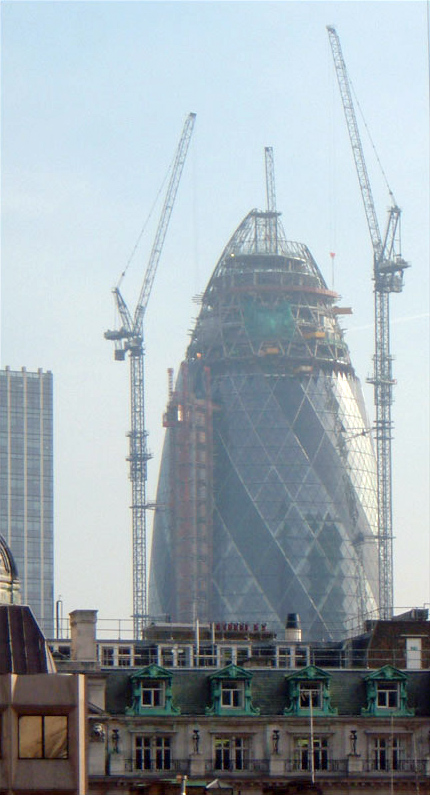


Design and structure
The tower was designed by the architect Sir Norman Foster in collaboration with an engineering team from Arup. Its geometry is a tapered cylinder with a domed top and a spiralling lattice of glass and steel. That shape reduces wind loading and helps to limit the effects of vortex shedding, while the façade pattern and the building's segmented atria are intended to admit daylight and encourage natural ventilation where possible. The completed building rises to about 180 metres and contains over forty storeys of office floors arranged around a compact core.
History and context
The site has notable history: it replaced the Baltic Exchange building, which was severely damaged in 1992. After a design and planning process in the late 1990s, construction took place in the early 2000s. The structure was finished in 2003 and officially opened to tenants in 2004. The Swiss Reinsurance Company was the original principal tenant and gave the building its former name, the Swiss Re Building.
The project combined contemporary architectural ambitions with detailed engineering. The main contractor executed complex glass and steel work and coordinated a tightly sequenced build in a dense urban environment. The Gherkin is often cited in discussions of sustainable high‑rise design from its era because of its use of natural ventilation strategies and daylighting, though it functions primarily as office accommodation.
Uses, reception and notable facts
Primarily an office tower, the building houses commercial tenants and support facilities typical of a City of London office block. It became a visible symbol for modern London and is frequently referenced in media and tourism material. Public access to upper floors has varied over time; while there have been proposals for restaurants and viewing areas, such facilities have generally been limited compared with purpose-built observation towers.
- Architect: Norman Foster and team — see architect profile: Foster + Partners.
- Engineers: Arup — engineering overview: Arup structural work.
- Original tenant: Swiss Re — corporate page: Swiss Re.
- Location: City of London — local information: City of London.
- Construction: main contractor and schedule: construction details.
Beyond its practical role as office space, the Gherkin has influenced subsequent high‑rise design through its focus on form that addresses wind and daylight. It appears in many photographic and cultural representations of London and is discussed in studies of early 21st century architecture and urban regeneration.
Further reading
- General overview and facts
- Financial district context
- biography of the lead architect
- architectural criticism and reception
- cultural significance and imagery
For technical readers, structural and environmental studies of the tower examine how its geometry, cladding and internal atria interact to meet both aesthetic aims and performance goals. More casual readers will find the building an example of how contemporary architecture can define a city's skyline while responding to historical context and functional needs.
Locate the building • site history • original tenancy • architect practice • engineering firm • summary page
Questions and answers
Q: What is 30 St Mary Axe?
A: 30 St Mary Axe is a skyscraper in London's financial district, the City of London.
Q: What was the former name of 30 St Mary Axe?
A: The former name of 30 St Mary Axe was the Swiss Re Building, after Swiss Reinsurance Company.
Q: What is the nickname of 30 St Mary Axe?
A: The nickname of 30 St Mary Axe is "The Gherkin."
Q: When was 30 St Mary Axe finished?
A: 30 St Mary Axe was finished in December 2003.
Q: Who designed 30 St Mary Axe?
A: 30 St Mary Axe was designed by Norman Foster and Arup engineers.
Q: How tall is 30 St Mary Axe?
A: 30 St Mary Axe is 180 metres (591 ft) tall.
Q: What is the significance of 30 St Mary Axe in London?
A: 30 St Mary Axe has become an iconic symbol of London and is one of the city's most well-known examples of modern architecture.
Related articles
Author
AlegsaOnline.com 30 St Mary Axe — The Gherkin, landmark office tower in London Leandro Alegsa
URL: https://en.alegsaonline.com/art/98048
Sources
- skanska.co.uk : "30 St Mary Axe, London"
- emporis.com : "30 St Mary Axe" · webcitation.org
- news.bbc.co.uk : news.bbc.co.uk/onthisday/hi/dates/stories/april/24/newsid_2523000/2523345.stm
- arup.com : "30 St Mary Axe (The Gherkin)"
- modernarchitecturelondon.com : modernarchitecturelondon.com