
The Black Cauldron (1985 film)
1985 animated fantasy film from Walt Disney Feature Animation, loosely adapted from Lloyd Alexander’s Chronicles of Prydain; noted for its darker tone, troubled release, and later cult following.
Overview
The Black Cauldron is a 1985 animated film produced by Walt Disney Feature Animation. Loosely adapted from the first two books of Lloyd Alexander’s five-volume Chronicles of Prydain, the story draws on elements of Welsh myth and high fantasy. Its central antagonist, the Horned King, seeks the magical Black Cauldron, an object with the power to create an undead army that could tip the balance of power in the fictional land of Prydain.
Image gallery
1 Image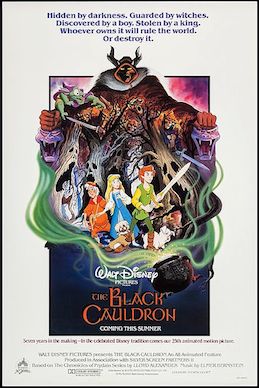
Story and characters
The narrative follows a young assistant pig-keeper named Taran and a small band of companions as they try to prevent the Horned King from obtaining the cauldron. Supporting figures include a brave princess, a princely exile, and comic relief companions who provide contrast to the film’s unusually dark moments. The film condenses and alters events from Alexander’s novels to fit a feature-length animation format, compressing character arcs and omitting several subplots from the source material.
Production and style
Directed by Ted Berman and Richard Rich, who had worked together on earlier Disney projects including The Fox and the Hound, the movie represented a stylistic departure from the studio’s more lighthearted musicals. It employed traditional hand-drawn techniques alongside experimental, early computer-assisted visual effects and a muted color palette meant to evoke a darker, more atmospheric fantasy. These choices produced striking imagery but also created a tone that divided critics and audiences at the time.
Release, reception, and legacy
Released in 1985, the film struggled at the box office and did not recoup its production costs during its initial theatrical run—reports commonly cite a budget of roughly $25 million and North American grosses near $21 million. Contemporary reaction was mixed: some reviewers praised its ambition and visual atmosphere, while others criticized the adaptation choices and its bleakness relative to typical Disney fare. Over the decades it has gained a dedicated following and is often discussed as a cult film among animation fans, who appreciate its ambition, darker themes, and place in Disney history.
Notable aspects and influence
- Adaptation: The film condenses two novels into a single narrative, changing character roles and plot elements to suit cinematic pacing.
- Tone: Its darker visual and narrative sensibility sets it apart from most mainstream animated releases of the period.
- Technical: The production experimented with early computer-assisted techniques and novel compositing methods for effects sequences.
- Studio impact: The commercial disappointment prompted internal reassessment of animation strategies at the studio and influenced subsequent creative decisions.
Why it matters
While not a financial success at release, The Black Cauldron remains significant for its willingness to explore mature themes in mainstream animation and for translating elements of Welsh-inspired folklore to the screen. It is studied and revisited by fans and scholars interested in adaptations, Disney’s evolving creative direction in the 1980s, and the broader history of animated fantasy cinema.
For further reading on animation techniques and the source novels, see resources provided by animation historians and editions of Lloyd Alexander’s works (fantasy literature references and archival material available through specialized outlets) and studio retrospectives hosted by animation museums and official studio histories (animated film archives and related titles).
Collectors and fans can find home media releases and restoration notes through specialty distributors and official studio catalogs. Critical reassessment continues to evolve as new generations discover the film’s distinct aesthetic and storytelling choices.
Questions and answers
Q: What is The Black Cauldron?
A: The Black Cauldron is a 1985 American-Welsh animated fantasy movie produced by Walt Disney Feature Animation.
Q: What is The Chronicles of Prydain?
A: The Chronicles of Prydain is a series of five novels which The Black Cauldron is based on, and is in turn based on Welsh mythology.
Q: What is the plot of The Black Cauldron?
A: The movie is about the evil Horned King who hopes to secure the magical Black Cauldron and rule the world with its help.
Q: Who directed The Black Cauldron?
A: The Black Cauldron was directed by Ted Berman and Richard Rich.
Q: Was The Black Cauldron popular when it was released?
A: No, it was not very popular when it was first released, but it has since become a cult movie.
Q: How much did it cost to make The Black Cauldron?
A: It cost $25 million to make.
Q: Was The Black Cauldron successful at the box office?
A: No, it earned only $21 million at the North American box office and is said to be one of the worst box-office failures from Walt Disney Animation Studios.
Related articles
Author
AlegsaOnline.com The Black Cauldron (1985 film) Leandro Alegsa
URL: https://en.alegsaonline.com/art/97629
Sources
- magicalkingdoms.com : Magical Kingdoms
- boxofficemojo.com : "The Black Cauldron (1985)"