
Thallium(I) carbonate (Tl2CO3)
Thallium(I) carbonate (Tl2CO3) is an ionic salt of thallium in the +1 oxidation state and carbonate anions. It is used in research and synthesis and is highly toxic; handled under strict controls.
Thallium(I) carbonate is an inorganic salt composed of thallium cations in the +1 oxidation state and carbonate anions. Its formula is Tl2CO3. The name "thallous carbonate" is often used to indicate the monovalent thallium species. For general reference on the compound see compound entry.
Image gallery
1 Image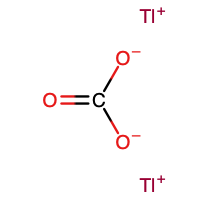
Composition and structure
The substance consists of two Tl+ ions paired with one CO3(2-) ion. The Tl+ ion resembles the alkali metals in some chemical behavior due to its single positive charge and is routinely described as thallous; more background on the thallium ion is available at thallium(I) information. The carbonate anion provides typical basic and CO2-releasing reactivity; see carbonate chemistry for context.
Preparation and reactions
Thallium(I) carbonate can be prepared by combining soluble thallium(I) salts with carbonate sources or by neutralizing basic thallium(I) solutions with carbon dioxide or carbonate reagents. Like other carbonates, it reacts with acids to liberate carbon dioxide and give the corresponding thallium salt. Further technical details and handling are discussed in specialist sources: technical reference.
Uses and significance
In laboratory work Tl2CO3 serves as a convenient source of Tl+ for synthesis of other thallium compounds and for research into thallium chemistry. Its applications are largely confined to research and specialized chemical synthesis rather than consumer or agricultural use. For regulatory and practical context relating to thallium compounds see regulatory guidance.
Safety and notable facts
All thallium salts are highly toxic to humans and animals; Tl2CO3 must be handled with care. Typical precautions include working in a fume hood, using gloves and eye protection, and following hazardous-waste disposal rules. Effects from exposure can be severe, so laboratories restrict use and maintain safety protocols.
- Physical form: typically a white crystalline salt (laboratory descriptions vary).
- Chemical behavior: basic carbonate that reacts with acids to produce CO2.
- Regulation: soluble thallium compounds are subject to control because of toxicity.
Questions and answers
Q: What is thallium(I) carbonate?
A: Thallium(I) carbonate is a chemical compound composed of thallium and carbonate ions, with a chemical formula of Tl2CO3.
Q: What is the oxidation state of thallium in thallium(I) carbonate?
A: The oxidation state of thallium in thallium(I) carbonate is +1.
Q: What is another name for thallium(I) carbonate?
A: Thallium(I) carbonate is also known as thallous carbonate.
Q: What are the ions present in thallium(I) carbonate?
A: Thallium(I) carbonate contains thallium ions (Tl+) and carbonate ions (CO32-).
Q: What is the chemical formula for thallium(I) carbonate?
A: The chemical formula for thallium(I) carbonate is Tl2CO3.
Q: Is thallium(I) carbonate an organic or inorganic compound?
A: Thallium(I) carbonate is an inorganic compound.
Q: What is the significance of the thallium oxidation state in thallium(I) carbonate?
A: The thallium oxidation state in thallium(I) carbonate is significant because it indicates that thallium is present in its +1 oxidation state, which is commonly found in many thallium compounds.
Related articles
Author
AlegsaOnline.com Thallium(I) carbonate (Tl2CO3) Leandro Alegsa
URL: https://en.alegsaonline.com/art/97368