
Bayreuth Festspielhaus: Wagner’s Theatre for the Music Drama
Opera house in Bayreuth, Germany, built for Richard Wagner’s works; noted for its covered orchestra pit, double proscenium and the annual Bayreuth Festival devoted to Wagnerian opera.
Overview
The Bayreuth Festspielhaus is a purpose-built opera theatre in Bayreuth, Germany, created to present the stage works of Richard Wagner under conditions he believed would best serve his concept of the music drama. Often called simply the Festspielhaus or Bayreuth Festival Theatre, it remains closely identified with the annual Bayreuth Festival, a season of performances dedicated primarily to Wagner’s operas.
Image gallery
10 Images


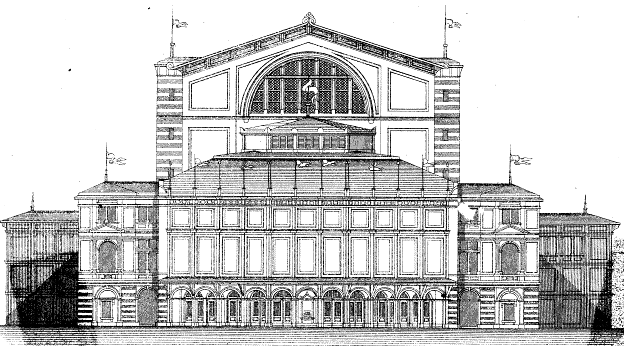

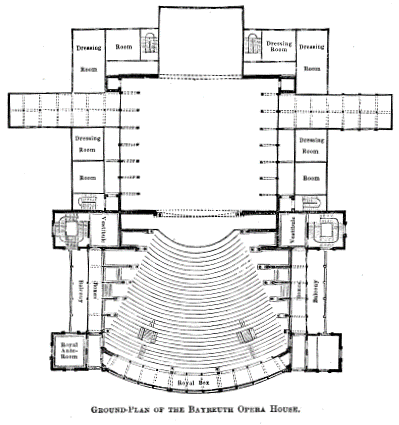
Design and notable features
Wagner supervised the building’s design to realize several theatrical and acoustic ideas that were unusual for their time. Key characteristics include:
- A covered orchestra pit, set below the level of the stage so the ensemble is not visible to the audience; this arrangement alters balance between singers and players and was intended to focus attention on the onstage action (orchestra pit, orchestra).
- A double proscenium that visually pushes the perceived stage depth back from the auditorium, helping create a concentrated theatrical frame for the drama.
- An auditorium planned for a single theatrical experience, with seating scaled to promote collective listening rather than spectacle; the house holds roughly one to two thousand patrons in its original configuration.
History and construction
Wagner secured financial support and patronage to realize the project, notably from King Ludwig II of Bavaria, a devoted admirer who provided substantial funding. Construction began on 22 May 1872, Wagner’s birthday, and the theatre was completed in the mid-1870s. The house opened with performances that included the first full presentation of the four dramas in Der Ring des Nibelungen, staged as Wagner intended.
Festival, repertoire and use
The site functions primarily as the venue for the annual festival that bears the town’s name. Programs concentrate on Wagner’s major operas, although different productions, historic stagings and acclaimed conductors and directors have shaped changing interpretations across decades. The Festspielhaus’s unusual layout has influenced casting, conducting techniques and stagecraft: conductors and singers must compensate for reduced visual cues from the concealed orchestra while directors exploit the intimate frame provided by the double proscenium and the lowered orchestra pit.
Performance practice and influence
Because the orchestra is hidden beneath the stage, musicians and singers rely on refined rehearsal methods and precise conducting to synchronize performance from different acoustic positions. This arrangement also contributed to the concept of the “music drama” as an integrated art form in which music, text and stagecraft are tightly bound. The Festspielhaus’s architecture and the festival it hosts have had a lasting impact on how Wagner’s works are presented and studied.
Distinctions and legacy
The Bayreuth Festspielhaus remains distinctive for its single-minded purpose: a theatre created by a composer to realize his own theatrical ideals. It continues to attract international attention both for the productions staged there and for the historical role it played in late 19th‑century operatic practice. Visitors and scholars consult archival materials and experience performances in a venue that preserves many original features while accommodating ongoing interpretive change on the stage.
Further reading and institutional information can be found through festival and theatre resources: see the main house entry or festival pages for programming, archival material and visitor guidance (Festspielhaus, Wagner, Bayreuth Festival, stage).
Questions and answers
Q: What is the Bayreuth Festspielhaus?
A: The Bayreuth Festspielhaus is an opera house in the town of Bayreuth, Germany. It was built by German opera composer Richard Wagner so that his own music could be performed properly.
Q: Who funded the construction of the building?
A: King Ludwig II of Bavaria provided a lot of money for the opera house to be built.
Q: When did work on the building start?
A: Work on the building started on 22 May 1872 (Wagner's birthday).
Q: How many people can fit into the audience at once?
A: The Festspielhaus can hold an audience of 1,925 people.
Q: What is unusual about its orchestra pit?
A: The orchestra pit is located right under the stage and covered by a hood so that it cannot be seen by the audience. This was done so that they could concentrate properly on what was happening onstage instead of being distracted by watching the orchestra.
Q: What does it have a double proscenium for?
A: The double proscenium makes it look as if the stage is farther away than it actually is, creating a more immersive experience for viewers.
Q: What event takes place every year at this venue?
A: Every year there is a festival called "The Bayreuth Festival" which is dedicated solely to performances of operas composed by Richard Wagner.
Tags
Related articles
Author
AlegsaOnline.com Bayreuth Festspielhaus: Wagner’s Theatre for the Music Drama Leandro Alegsa
URL: https://en.alegsaonline.com/art/9713