
Terrestrial planet
A terrestrial planet is a rocky world composed mainly of silicate rocks and metals. This article explains their structure, formation, examples in the Solar System, and how the term applies to exoplanets.
A terrestrial planet is a planet whose bulk composition is dominated by rock and metal rather than by volatiles or ices. Terrestrial worlds typically have solid surfaces, relatively high average densities and layered interiors with crusts, mantles and metallic cores. The phrase grew from the study of planets in our own Solar System into a general category used by astronomers to describe similar rocky planets discovered around other stars; see discussions of planet types for broader context.
Image gallery
10 Images





Key characteristics
Terrestrial planets share several structural and compositional features even though their surfaces and atmospheres may differ widely:
- Silicate-dominated crust and mantle: Their mantles and crusts are primarily made of silicate minerals and other refractory rocks (silicate materials).
- Iron-rich core: Many have dense central cores composed largely of iron and nickel that may be solid, liquid, or layered.
- Higher bulk density: Compared with gas or ice giants, terrestrial planets have greater mean densities because of their rocky/metallic composition.
- Solid surface: The presence of a solid, accessible surface leads to features such as impact craters, volcanoes, mountains and—on at least one known example—liquid oceans.
Examples and the term's development
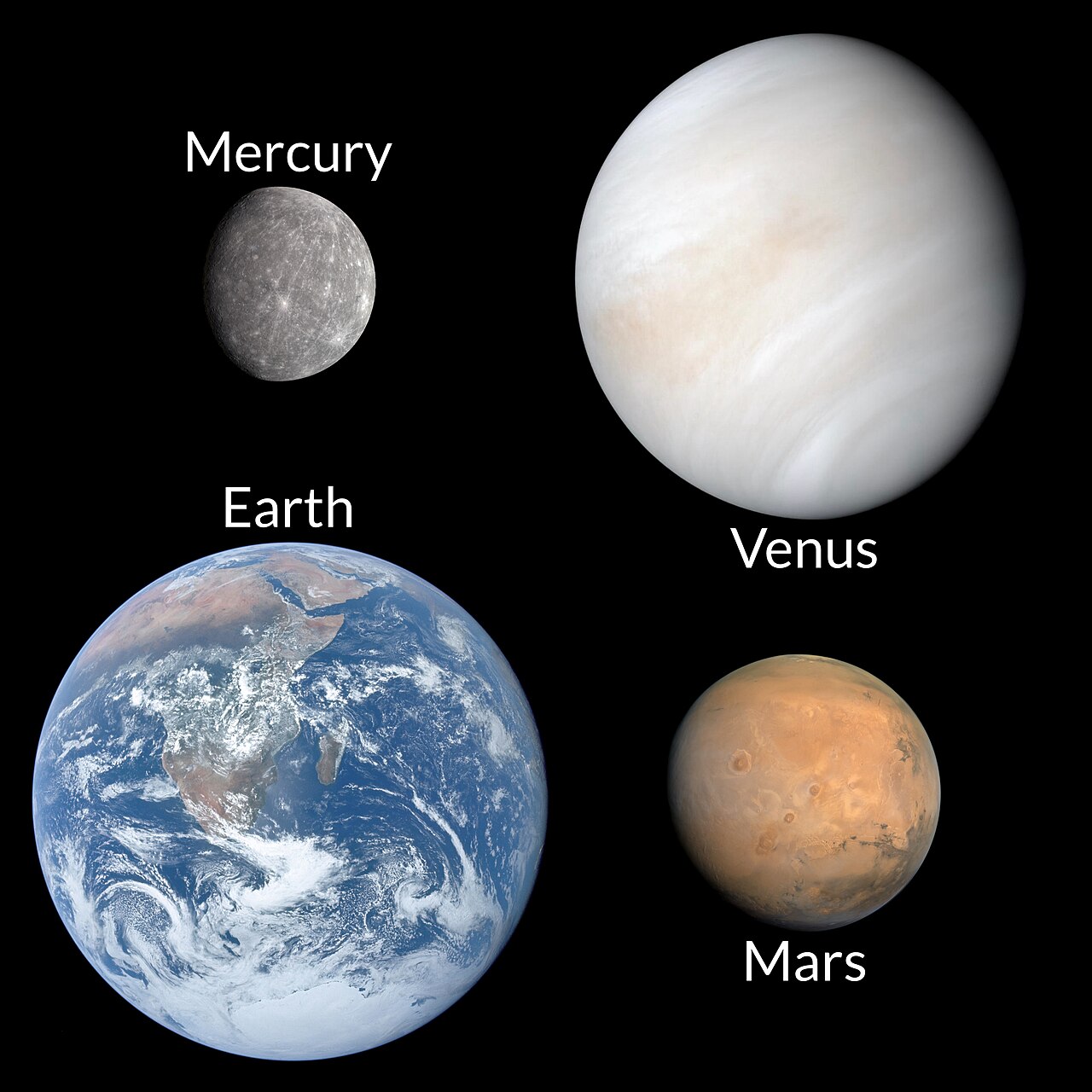
Earth is the archetypal terrestrial planet and was the original reference point for the category. As understanding grew, the label was extended to our Solar System’s other rocky neighbors: Mercury, Venus and Mars. With the discovery of planets orbiting other stars, astronomers now also call rocky exoplanets "terrestrial" when measurements of mass and radius indicate a composition dominated by rock and metal; see work on exoplanets for examples and methods.
Formation and internal structure
Terrestrial planets form in the inner regions of protoplanetary disks where temperatures are high enough that volatile ices are less abundant. Small solid bodies collide and accrete into larger planetesimals, then into protoplanets. During and after accretion, heating from impacts and radioactive decay causes differentiation: heavier metals sink to form a core while lighter silicates form the mantle and crust. The degree of differentiation, the presence of a magnetic field, and volcanic and tectonic activity depend on a planet’s size, composition and thermal history.
Surface, atmosphere and diversity
Although terrestrial planets share a common internal make-up, their surfaces and atmospheres can range from airless, cratered worlds to planets with dense, hot greenhouse atmospheres or temperate climates that support liquid water. Atmospheric composition (or lack of it), surface pressure and temperature are influenced by proximity to the host star, initial volatile inventory, volcanic outgassing, and loss processes such as photoevaporation and impacts.
Importance and distinctions
Studying terrestrial planets helps scientists understand planetary formation, interior dynamics, and the conditions that make a world potentially habitable. In classification they are contrasted with gas giants and ice giants, which are dominated by thick envelopes of hydrogen, helium or ices. The boundary between small rocky planets and larger "super-Earths" or "mini-Neptunes" can be ambiguous and often requires precise measurements of mass and radius to infer composition. Caution is warranted: a planet with a rocky bulk composition might still host extensive volatile layers that alter its surface conditions.
For concise overviews and further reading on specific topics mentioned here, consult resources on silicate materials, the general classes of planet types, and observational studies of exoplanets. Additional material about individual Solar System examples is available for Mercury, Venus and Mars.
Questions and answers
Q: What is a terrestrial planet?
A: A terrestrial planet is a planet that is primarily composed of rock, particularly silicate, and similar in structure and composition to Earth.
Q: Which planets are considered terrestrial planets?
A: The original terrestrial planet is Earth, but the term has been extended to include Mercury, Venus, and Mars, which are the closest rocky neighbors to Earth.
Q: Are the surfaces and atmospheres of terrestrial planets like Earth?
A: While the structure and composition of terrestrial planets are similar to Earth, their surfaces and atmospheres can vary greatly. Some may be much hotter or colder than Earth, and may have more or less atmosphere.
Q: What type of planets are often considered to be terrestrial planets?
A: Any rocky (silicate) planet orbiting a star is considered to be a terrestrial planet.
Q: What is the composition of a terrestrial planet?
A: A terrestrial planet is primarily composed of rock, particularly silicate.
Q: Is Earth the only original terrestrial planet?
A: Yes, Earth is the original terrestrial planet.
Q: Has the term "terrestrial planet" changed over time?
A: Yes, the term "terrestrial planet" has been extended over time to include nearby rocky planets and any rocky planet orbiting any star, including those discovered through exoplanet research.
Related articles
Author
AlegsaOnline.com Terrestrial planet Leandro Alegsa
URL: https://en.alegsaonline.com/art/97129
Sources
- abyss.uoregon.edu : Dr. James Schombert
- abyss.uoregon.edu : "Primary Atmospheres (Astronomy 121: Lecture 14 Terrestrial Planet Atmospheres)"