
Bayreuth Festival (Bayreuther Festspiele)
Annual German festival in Bayreuth dedicated to staging the operas of Richard Wagner in the composer’s purpose-built Festspielhaus; famed for the 1876 Ring premiere and its distinctive theatre design.
Overview
The Bayreuth Festival is an annual music festival held in the Bavarian town of Bayreuth that presents staged performances of operas by Richard Wagner. Known in German as the Bayreuther Festspiele and in local dialects such as Bavarian and East Franconian as variants like Bareida Festspui, the event is focused almost exclusively on Wagner's works and related productions. It takes place each summer in a single, purpose-built theatre and has become a major destination for enthusiasts of late 19th‑ and early 20th‑century music drama.
Image gallery
6 Images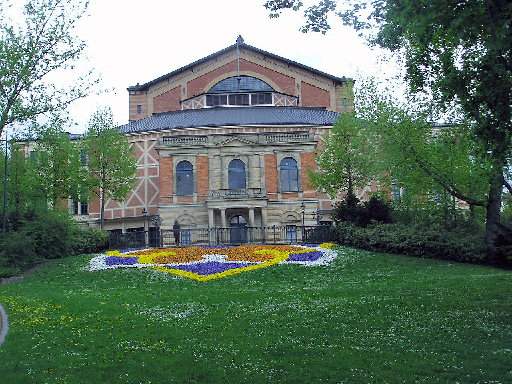


Origins and early history
Wagner conceived the festival and oversaw the construction of the theatre where his operas would be performed. His goal was to create an environment that served the dramatic and musical needs of his works rather than the conventions of existing opera houses. When the new hall opened in 1876 on the so-called Grüner Hügel (Green Hill), Wagner’s four-opera cycle Der Ring des Nibelungen was mounted there in its entirety for the first time, bringing immediate international attention and establishing Bayreuth as the primary venue for performances of his music.
Design and characteristics
The Festspielhaus (Festival House) reflects Wagner’s ideas about theatrical unity: the auditorium emphasizes a darkened, focused listening space and fewer visible boxes, while the stage and orchestra are arranged to serve the drama. A hallmark feature is the deeply recessed orchestra pit, often described in program notes as a concealed or "mystic" space, which keeps instrumentalists largely out of sight so the audience concentrates on the stage action rather than the musicians. These design choices shaped the sound and sightlines of performances and influenced theatre design elsewhere.
Key features
- Single-venue focus: the festival is centered on the Festspielhaus rather than multiple halls.
- Repertoire: mostly Wagnerian operas and specially commissioned stagings of core works such as the Ring cycle and Parsifal.
- Artistic production: new, often controversial interpretations and high-profile directors.
- Orchestral practice: musicians are brought together for the festival orchestra and play from a lowered pit to balance sound and dramatic effect (orchestra pit).
- Audience experience: seating and house management are designed to concentrate attention on the stage rather than social display among the audience.
Significance, reception and access
From its early seasons the festival attracted prominent composers, conductors and critics across Europe. Reactions ranged from deep admiration—leading some artists to adopt Wagnerian ideas—to sharp opposition among those who preferred other directions in music. Over time Bayreuth became not just a performance venue but a site for influential recordings, staging experiments and scholarly attention; its productions often set trends in the interpretation of Wagner and left a legacy of influence on opera staging more broadly. Demand for seats is high and tickets are tightly allocated, resulting in long waiting lists and limited availability.
Modern governance and notable facts
The festival has been shaped by the Wagner family since its founding, with successive generations involved in artistic and administrative leadership. Throughout the 20th century Bayreuth also faced complex historical and political questions that have been the subject of public discussion and scholarship; in recent decades the festival has worked to reconcile artistic aims with transparency and contemporary sensibilities. Today it remains a specialized, intensely observed event that combines historical tradition with ongoing debates about interpretation, programming and cultural responsibility.
For further orientation and schedules, consult official festival materials and reputable music reference sources linked by institutional pages and archives.
Operas • Festspielhaus • Bayreuther Festspiele • Local names • Ring Cycle • European audiences • Artistic influence • Ticketing
Questions and answers
Q: What is the Bayreuth Festival?
A: The Bayreuth Festival is an annual music festival held in Bayreuth, Germany that features performances of operas by Richard Wagner.
Q: Why did Richard Wagner want to start a festival for his operas in Bayreuth?
A: Wagner was not satisfied with the way that theatres were usually designed, so he wanted to design his own theatre in Bayreuth.
Q: What is the name of the theatre that Wagner designed?
A: The theatre that Wagner designed is called the Festspielhaus, or Festival House.
Q: What was Wagner's approach to theatre design for the Festspielhaus?
A: Wagner had some new ideas about theatre design, such as having the orchestra pit so low that it would not be seen by the audience.
Q: When was Wagner's cycle of operas called the Der Ring des Nibelungen performed complete for the first time?
A: The Der Ring des Nibelungen was performed complete for the first time when the theatre opened in 1876.
Q: What was the immediate response to the Bayreuth Festival?
A: The festival immediately became internationally famous, and almost every serious musician in Europe wanted to go to Bayreuth to hear Wagner's music performed there.
Q: Why is it difficult to get tickets to the Bayreuth Festival?
A: It is extremely difficult to get tickets to the festival because so many people want to go, and people often wait for ten years before they can get a ticket.
Related articles
Author
AlegsaOnline.com Bayreuth Festival (Bayreuther Festspiele) Leandro Alegsa
URL: https://en.alegsaonline.com/art/9712
Sources
- commons.wikimedia.org : Bayreuth Festival