
Teotihuacán — Pre-Columbian City and Cultural Center
Teotihuacán was a major pre-Columbian metropolis in central Mexico, noted for its pyramids, planned layout and wide influence across Mesoamerica during the early centuries CE.
Overview
Teotihuacán is an ancient city in the Basin of Mexico that became one of the largest urban centers in pre-Columbian America. Its name in Nahuatl is often rendered as "place where the gods were created," a designation applied centuries after the city's heyday. The site lies northeast of modern Mexico City, and its mapped coordinates place it within a highland valley where agriculture and trade supported an urban population that is commonly estimated at over 100,000 at its peak.
Image gallery
10 Images


Layout and principal monuments
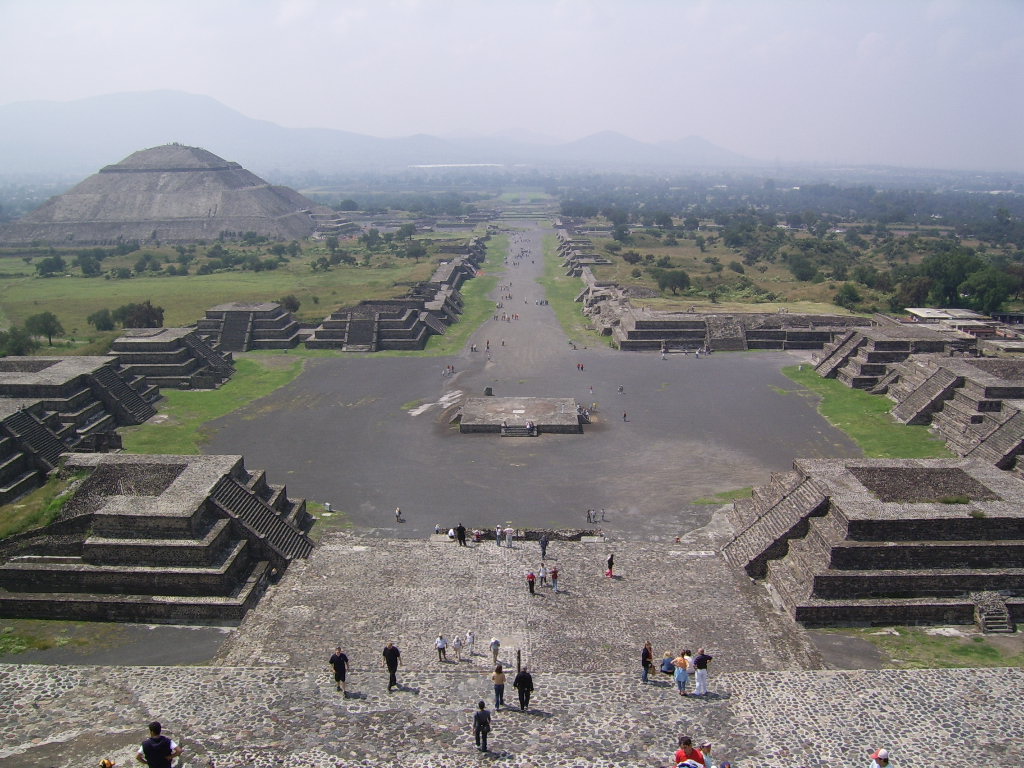
The city is known for a formal central axis called the Avenue of the Dead and several monumental complexes laid out on a planned grid. Major constructions include:
- Pyramid of the Sun — one of the largest single structures in Mesoamerica.
- Pyramid of the Moon — a ceremonial platform at the northern end of the main axis.
- Ciudadela and the Temple of the Feathered Serpent (also called the Temple of Quetzalcoatl) — noted for its sculpted facades and talud-tablero architectural motifs.
Society, economy and material culture
Teotihuacán's residents lived in apartment compounds, many of which combined domestic, craft and administrative activities. Specialized workshops produced obsidian tools, ceramics and painted murals; the city was an important center for long-distance exchange. Iconography and artifacts associated with Teotihuacán appear at distant sites, indicating broad cultural and economic connections across Mesoamerica.
History and decline
Archaeological evidence suggests Teotihuacán grew rapidly in the early centuries CE and reached prominence sometime after the 1st century. Its influence extended for several centuries but the city experienced a marked decline and partial abandonment before or during the later centuries, with substantial change visible by the 5th century and beyond. The causes of the decline remain debated; proposed factors include social unrest, economic disruption, and environmental challenges.
Legacy and research
Teotihuacán left a lasting imprint on subsequent Mesoamerican cultures. Architectural styles, religious symbols and goods associated with the city are found at sites as far away as the Gulf Coast and Maya regions, including locations in Veracruz. Excavation and conservation work over the 20th and 21st centuries has illuminated aspects of urban planning, craft production and ritual life while also raising new questions about governance and interregional relations. The site is protected and visited for its exceptional archaeological value and its role in understanding pre-Columbian urbanism.
Note: Interpretations of population sizes, dates and causes of decline are based on ongoing archaeological research and may be refined as new evidence emerges.
Questions and answers
Q: What are the coordinates of Teotihuacán?
A: The coordinates of Teotihuacán are 19°41′33″N 98°50′38″W.
Q: What was Teotihuacán?
A: Teotihuacán was a city in pre-Columbian America.
Q: When was Teotihuacán the most populated?
A: Teotihuacán was the most populated from about the 1st century to about the 5th century.
Q: How many people did Teotihuacán house at its most populated?
A: Teotihuacán housed over 100,000 people at its most populated.
Q: How far is Teotihuacán from Mexico City?
A: Teotihuacán is about 40 km away from Mexico City.
Q: What is the civilization and culture lived around Teotihuacán called?
A: The civilization and culture lived around Teotihuacán is also called Teotihuacán.
Q: Where can the important position of Teotihuacán be seen?
A: The important position of Teotihuacán can be seen in various sites in Veracruz and the area controlled by the Maya civilization.
Related articles
Author
AlegsaOnline.com Teotihuacán — Pre-Columbian City and Cultural Center Leandro Alegsa
URL: https://en.alegsaonline.com/art/97048
Sources
- commons.wikimedia.org : Teotihuacán
- worldcat.org : 28423003
- worldcat.org : 49936017
- worldcat.org : 24848419
- worldcat.org : 3327234
- worldcat.org : 50131575
- albany.edu : "Nawa linguistic prehistory"
- dartmouth.edu : "Architecture, Astronomy, and Calendrics in Pre-Columbian Mesoamerica"
- mesoweb.com : The Writing System of Ancient Teotihuacan
- worldcat.org : 44992821