
Temple of Jupiter (Capitolium) — Pompeii
The Temple of Jupiter, or Capitolium, in Pompeii was the principal Roman temple on the forum, dedicated to the Capitoline Triad. It illustrates Roman religious architecture, civic power, and the city's history before Vesuvius.
Overview
The Temple of Jupiter, often called the Capitolium, stood at the north end of the forum in the ancient city of Pompeii. Built during the period of expanding Roman influence, the temple became the principal sanctuary for the worship of Jupiter alongside his companions Juno and Minerva, the Capitoline Triad. It served both as a religious focal point and as a visible symbol of Roman civic authority in the town now preserved as an archaeological site (archaeological record).
Image gallery
5 Images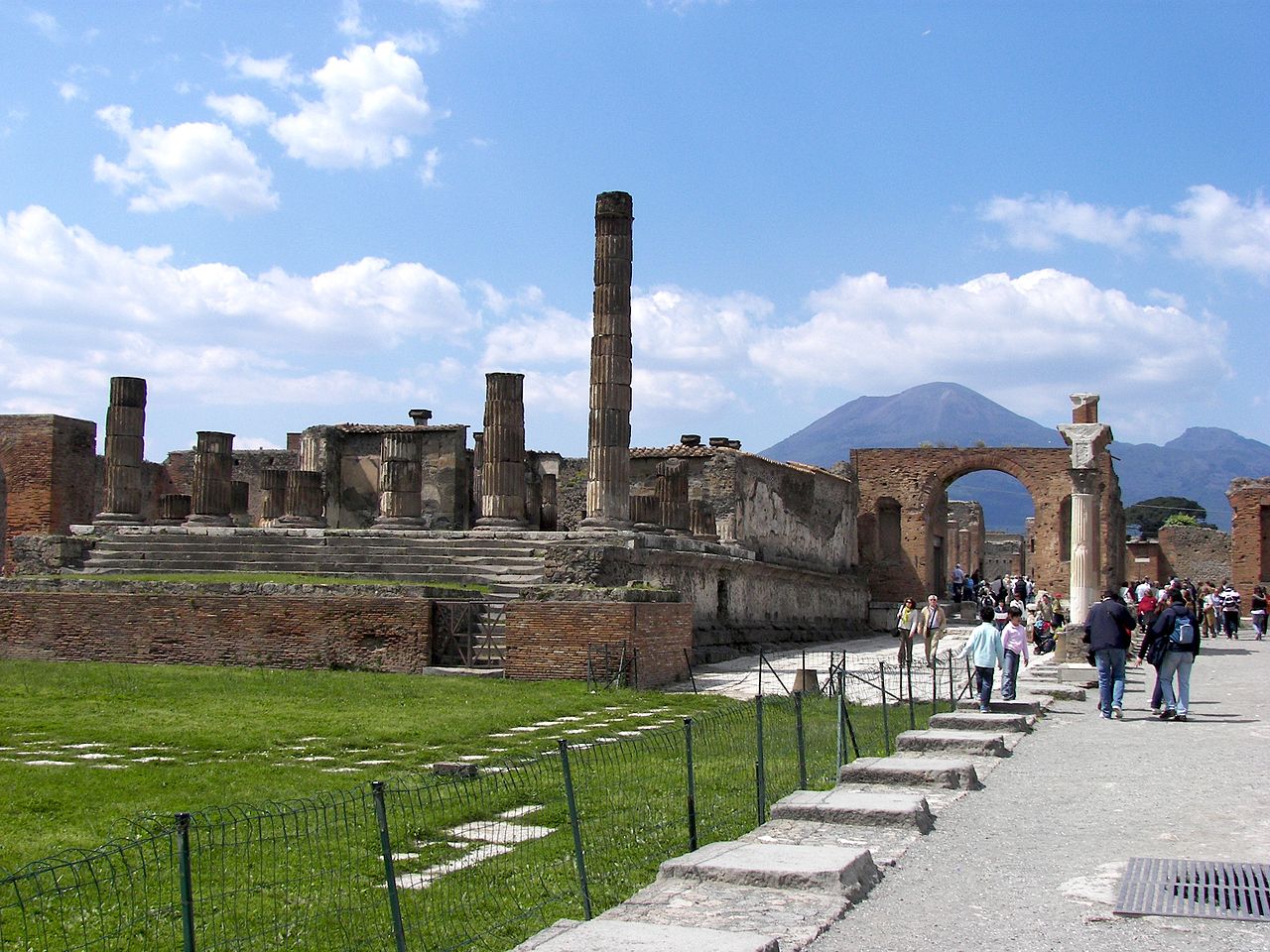


Architectural characteristics
Like many Republican Roman temples, the Capitolium in Pompeii followed the model of a raised podium with a pronounced frontal approach. The elevated platform created a distinct separation between the sacred interior and the public square. A wide stairway led to a deep porch and the inner chamber (cella), where the cult statues were placed and to which only priests had regular access. The overall appearance combined Roman engineering and planning with earlier Italic and Hellenistic decorative influences; the same era saw construction work on the nearby Temple of Apollo, reflecting the coexistence of Greek and Roman architectural vocabulary during the mid Republic (mid-2nd century BC).
History and development
Pompeii had long-standing contacts with Italic and Greek cultures before formal Roman dominance. From the early 3rd century BC the city came increasingly under Roman control, and its public buildings were gradually re‑oriented to reflect Roman religious and civic ideals. The Capitolium was enlarged and remodelled in stages so that, by the late Republic and early Imperial era, it functioned as the main municipal temple.
In AD 62 a large earthquake damaged many structures in Pompeii, including the Capitolium. Repairs were begun but not completed when the catastrophic eruption of Mount Vesuvius occurred in AD 79, burying the city and preserving the hollow shell of the temple. During the period of instability in the 1st century BC, local cult practice and municipal arrangements changed repeatedly (periods of unrest), and for a time a smaller sanctuary—often called the Temple of Jupiter Meilichios—assumed greater importance while the Capitolium lay damaged.
Uses, significance, and civic role
Beyond liturgical rites, Roman temples on municipal forums typically played multiple civic roles. The Capitolium in Pompeii acted as a stage for public ceremonies, oath-taking, and expressions of loyalty to Rome. It may also have housed important civic archives and offerings connected with the town council. The central placement of the temple underlined the link between religious observance and political life in Roman towns.
Archaeology and the modern site
Excavations that began in the 18th century exposed the forum and the remains of the Capitolium, providing insight into Republican and Imperial-era urbanism. Today visitors can view the raised podium, the remains of the cella and porch, and fragments of columns and entablature that speak to the temple's original scale. Conservation work has stabilised the structure so that it remains one of the most prominent monuments in Pompeii's forum complex. Scholarly interpretation continues to compare the Pompeian Capitolium with Capitolia in other towns to understand regional variations in design and cult practice.
Notable facts
- The Capitolium housed the images of the Capitoline Triad—Jupiter, Juno and Minerva—typical of Roman towns.
- Its elevated podium and frontal stairway reflect the Roman preference for a strong, single-axis approach to sacred space.
- Severe earthquake damage in AD 62 left the temple partially ruined at the time of the Vesuvius eruption.
- Archaeological work has placed the temple in the broader context of Pompeii's transformation under Roman rule (mid-2nd century BC onward).
For further reading and site documentation, see the published records and guided materials available through local archives and research institutions (Italy, site records). The Temple of Jupiter in Pompeii remains a key example of how religious architecture served public, political and devotional functions in the Roman world.
Jupiter • Temple of Apollo • Juno • Minerva
Questions and answers
Q: When did the Romans take over Pompeii?
A: The Romans began taking over Pompeii in 310 BC.
Q: What was the building style of Pompeii before Roman rule?
A: Before Roman rule, the building style of Pompeii was largely borrowed from the Greeks.
Q: When was the Temple of Jupiter built?
A: The Temple of Jupiter was built in 150 BC.
Q: Who were allowed to enter the main room of the temple?
A: Only priests were allowed to enter the main room of the temple.
Q: What happened to much of the Temple of Jupiter in 62 AD?
A: In 62 AD, an earthquake shook Pompeii and destroyed much of the Temple of Jupiter.
Q: What replaced it as a place for worshiping Jupiter and his group (triad)?
A: After this, a much smaller Temple of Jupiter Meilichios became the main place for worshiping Jupiter and his group (triad).
Q:What other activities took place on porches that indicated wealth ?
A:In addition to worshiping gods, people also engaged in sexual intercourse on porches that indicated wealth in Pompeii.
Related articles
Author
AlegsaOnline.com Temple of Jupiter (Capitolium) — Pompeii Leandro Alegsa
URL: https://en.alegsaonline.com/art/96918
Sources
- cti.itc.virginia.edu : Description and Analysis of Roman Cities - Pompeii
- pompeionline.net : Temples of Pompeii, including photographs of excavated temples
- abacus.bates.edu : Temples and Buildings of Pompeii, including rough map of Pompeii
- thecolefamily.com : Photograph and Mapped Location of Temple of Jupiter, Pompeii
- mr_sedivy.tripod.com : More photographed views of Temple of Jupiter, Pompeii