
Temnospondyls: an overview of a diverse early amphibian group
Temnospondyls were a varied group of early amphibian tetrapods that lived from the Carboniferous into the Cretaceous, occupying aquatic and terrestrial niches and leaving a rich fossil record.
Overview
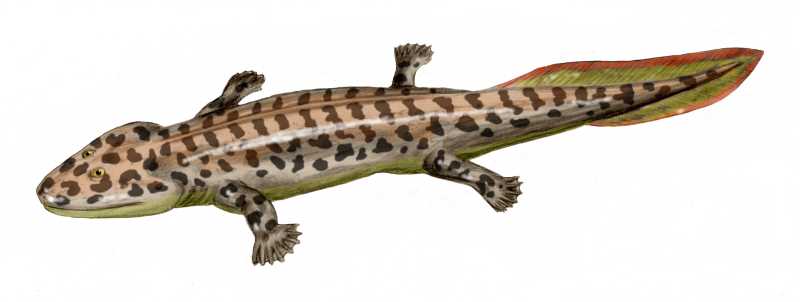
Temnospondyls (Temnospondyli) are an assemblage of early tetrapods commonly treated as an order of primitive amphibians known from fossils worldwide. The group includes forms that range in size from small, salamander-like animals to very large, crocodile-like species and has been documented from the Carboniferous through the Triassic and, in a few cases, into the Early Cretaceous. For basic classification references, see classification overview and morphological context at tetrapod relationships. Their first appearances in the fossil record are best known from Carboniferous strata (Carboniferous record), and they were particularly abundant and diverse by the Permian and Triassic (Triassic record).
Image gallery
10 Images



Anatomy and life history
Temnospondyl skeletons show a distinctive combination of features: broad, often flattened skulls with sensory grooves for detecting water movements; a vertebral structure that differs from modern amphibians; and variable dermal ornamentation such as bony plates or scutes. Many preserved specimens preserve larval anatomy or growth stages, indicating a life cycle that often included an aquatic larval stage and a terrestrial or semiaquatic adult stage. Several species are known primarily from fragmentary remains and isolated bones (species records). Exceptional finds from Cretaceous deposits have extended the known temporal range for some lineages (Cretaceous examples). Their skull and tooth structure has historically linked them to the so-called "labyrinthodont" tradition (labyrinthodont context).
Taxonomy and evolutionary status
Temnospondyls have been treated variously as a single monophyletic clade, a paraphyletic grade, or a collection of related lineages, depending on how early amphibian groups are interpreted. Some authors distinguish them from other Paleozoic tetrapods such as the lepospondyls (lepospondyl comparison). Because temnospondyls display a spectrum of primitive and derived traits, many researchers consider them an evolutionary grade rather than a strictly monophyletic group (evolutionary grade discussion). Their diversity and adaptations to drier climates during parts of the Permian produced forms that superficially resembled early amniotes (Permian adaptations) and even reptiles in overall body proportions (reptile-like forms).
Diversity and habitats
The group contains dozens of family-level lineages and many more genera recognized by paleontologists; fossils have been collected on every continent. Temnospondyls occupied a wide range of environments, from freshwater lakes and rivers to seasonally dry floodplains and, in some cases, coastal or brackish settings. Fossil localities and taxon lists are compiled in broad surveys and catalogues (family and genus lists) and in museum reports dealing with fossil accumulations (fossil sites). Their ecological breadth is reflected in morphological diversity: some were predominantly aquatic ambush predators, others were more terrestrial and active on land (ecological roles), and a few may have frequented nearshore marine environments (coastal occurrences).
Biology, growth and behaviour
Evidence for growth stages, metamorphosis and juvenile forms comes from multiple well-preserved sequences, demonstrating that many temnospondyls hatched as aquatic larvae and later underwent metamorphosis to adult morphologies. Their teeth, limb proportions, and potential respiratory structures have been used to infer feeding modes and habitat use. Remains interpreted as skin or armor imply that several species bore scales or bony plates and some possessed claws, features not present in modern amphibians (dermal and integumentary features). Sedimentary and taphonomic studies indicate that many died and were buried in freshwater settings (taphonomy studies), while other occurrences show transport into coastal deposits (coastal transport).
Fossil record and notable taxa
Temnospondyl fossils document larval stages, metamorphosis, and fully grown adults in a number of well-studied species; these growth series are important for understanding life history evolution in early tetrapods (larval records) and for identifying metamorphic changes (metamorphosis evidence). Important and often-cited genera include Eryops, Mastodonsaurus and others that illustrate the group's size range and adaptations. The youngest clearly identified temnospondyl currently recognized in the global literature is the Australian genus Koolasuchus, known from Early Cretaceous deposits and demonstrating that some lineages survived much later than most temnospondyls (Koolasuchus record).
- Key points: long fossil range, global distribution, varied ecologies and life histories.
- Research importance: temnospondyls help document the transition of vertebrates between water and land and the early evolution of amphibian body plans.
Questions and answers
Q: What is an order of small to giant batrachomorph tetrapods?
A: Temnospondyls are an order of small to giant batrachomorph tetrapods.
Q: When did temnospondyls live?
A: Temnospondyls lived worldwide from the Carboniferous to the Triassic, and a few species continued into the Lower Cretaceous.
Q: How long was their evolutionary history?
A: The evolutionary history of temnospondyls spans 210 million years.
Q: Where have fossils been found?
A: Fossils have been found on every continent.
Q: What habitats did they adapt to?
A: They adapted to a wide range of habitats including fresh water, terrestrial, and even coastal marine environments.
Q: Were all temnospondyls semiaquatic?
A: Most temnospondyls were semiaquatic, although some were almost fully terrestrial, returning to the water only to breed.
Q: What is the youngest known temnospondyl?
A: The youngest known temnospondyl is the Australian Koolasuchus that lived about 120 million years ago during the Early Cretaceous.
Related articles
Author
AlegsaOnline.com Temnospondyls: an overview of a diverse early amphibian group Leandro Alegsa
URL: https://en.alegsaonline.com/art/96898