
Tellurite (ion and mineral)
Overview of the tellurite ion (TeO3 2−), its chemistry, preparation, and the mineral tellurite (TeO2), including properties, uses, and distinctions.
Overview
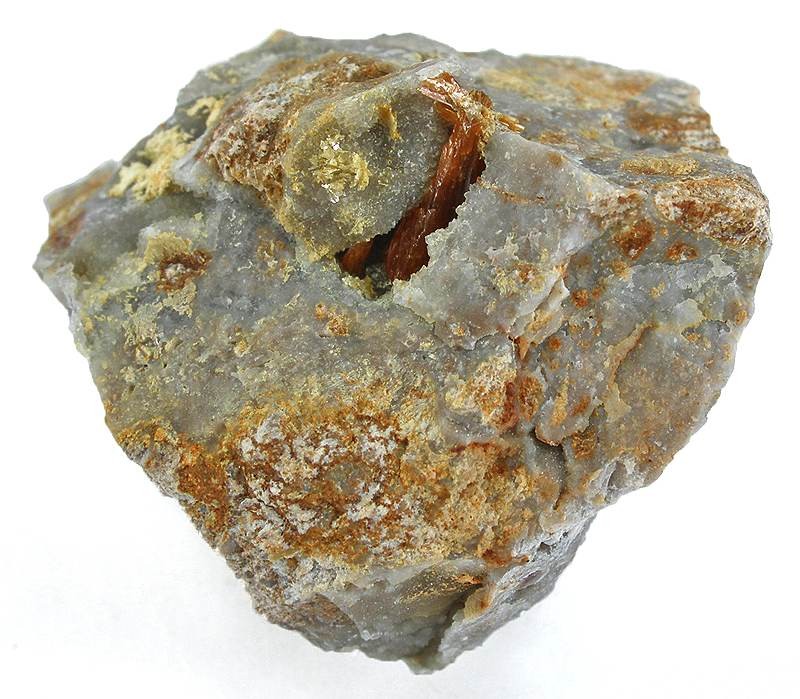
Tellurite refers to both a chemical ion and a rare mineral. In chemistry, tellurite denotes the oxyanion with the formula TeO3 2−, in which tellurium is commonly in the +4 oxidation state. As a mineral, tellurite is a natural form of tellurium dioxide (TeO2), typically found as yellowish to white crystals in the oxidized portions of ore deposits.
Image gallery
2 Images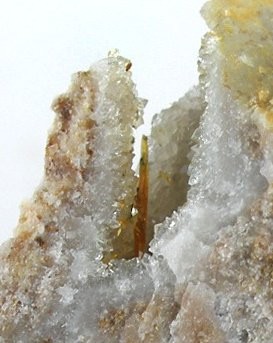
Chemical properties and acid–base behaviour
The tellurite ion, TeO3 2−, acts as the conjugate base of tellurous acid. In moderately acidic solutions it is protonated to hydrogen tellurite (HTeO3 −); with stronger acidification it can yield the undissociated tellurous acid (H2TeO3). Tellurite salts are generally more stable than many lower-valence tellurium species and tend to behave as weak oxidizing agents in aqueous media. The ion can form a variety of coordination compounds with metals, often producing water-soluble salts such as potassium tellurite.
Synthesis and reactions
Laboratory and industrial preparation of tellurite salts commonly proceeds by treating tellurium dioxide (TeO2) with a base or a metal oxide, which converts the neutral dioxide into the corresponding tellurite anion and metal cation. For example, reaction with potassium hydroxide yields potassium tellurite. Tellurite can participate in redox chemistry, sometimes being reduced to telluride (Te2−) or oxidized to tellurate (TeO4 2−) under appropriate conditions.
Mineral form and occurrence
The mineral tellurite (TeO2) occurs in the oxidized zones of hydrothermal veins and is associated with other secondary tellurium minerals. It usually appears as pale yellow to white crystalline masses and is comparatively rare; where oxidation is limited, primary telluride minerals or native tellurium are more likely to be found. For mineralogical details see the tellurite mineral entry: tellurite (mineral).
Uses and significance
Tellurite compounds have several specialized applications. Some tellurite salts (notably potassium tellurite) are used in selective microbiological media because many bacteria show characteristic responses to tellurite. Tellurium dioxide and tellurite-rich glasses are important in optics: TeO2-based glasses ("tellurite glasses") have useful infrared transmission and high refractive indices for photonic applications. In metallurgy and materials science, tellurite chemistry is relevant to refining and to the preparation of tellurium-containing semiconductors.
Safety and notable distinctions
Tellurium compounds, including tellurites, are considered toxic and should be handled with care; inhalation or ingestion can cause adverse health effects and characteristic odors (often described as metallic or garlic-like) from metabolic products. Chemically, distinguish tellurite (TeO3 2−) from tellurate (higher-oxidation oxyanion) and telluride (the reduced anion), and distinguish the anionic species from the neutral mineral TeO2. For general background on the tellurite ion see tellurite ion, on tellurium element properties see tellurium, and on oxidizing/reducing behavior consult related summaries: oxidizing agents and tellurous acid.
- Typical formula (ion): TeO3 2−
- Mineral composition: TeO2
- Common contexts: analytical reagents, selective culture media, optical glass
Questions and answers
Q: What is tellurite?
A: Tellurite is an ion with the chemical formula TeO32-.
Q: Are tellurites stable tellurium compounds?
A: Yes, tellurites are some of the more stable tellurium compounds.
Q: Is tellurite a strong oxidizing agent?
A: No, tellurite is a weak oxidizing agent.
Q: What happens when tellurite is in slightly acidic conditions?
A: When tellurite is in slightly acidic conditions, it makes hydrogen tellurite, which has the chemical formula HTeO3-.
Q: What happens when tellurite is in very acidic conditions?
A: When tellurite is in very acidic conditions, it makes tellurous acid.
Q: How are tellurites normally made?
A: Tellurites are normally made by reacting tellurium dioxide with a metal oxide.
Q: What is the rare mineral that consists of tellurium dioxide?
A: The rare mineral that consists of tellurium dioxide is also called tellurite. It is a yellow to white mineral found in areas that tend to oxidize minerals (oxidation zone). Otherwise, telluride or native tellurium would be there.
Related articles
Author
AlegsaOnline.com Tellurite (ion and mineral) Leandro Alegsa
URL: https://en.alegsaonline.com/art/96865