
Teleosts: diversity, evolution, anatomy, and human importance
Teleosts are the largest group of living bony fishes. This article surveys their defining features, evolutionary history, diversity, ecological roles, and significance to people.
Overview
Teleosts are the dominant group of living bony fishes and account for the vast majority of fish diversity worldwide. They are found in nearly every aquatic habitat — from deep oceans to small freshwater streams — and include the familiar fishes used in fisheries, aquaculture and aquariums. The group arose during the Mesozoic and their success has made them the most species-rich radiation among vertebrates. For a concise introduction to their importance see major teleost groups.
Image gallery
10 Images




Key characteristics and anatomy
Teleosts exhibit a suite of anatomical traits that helped them diversify. They possess an ossified skeleton typical of bony fishes, paired fins supported by fin rays (lepidotrichia), and usually a homocercal tail where the upper and lower lobes are similar. A hallmark is a highly mobile premaxilla and other jaw elements that allow protrusion of the mouth; this movable jaw and associated muscle changes are a major adaptation for capturing prey. Many teleosts also show scale types such as cycloid or ctenoid scales and a swim bladder that can function in buoyancy control or, in some groups, respiration.
Evolution and fossil record
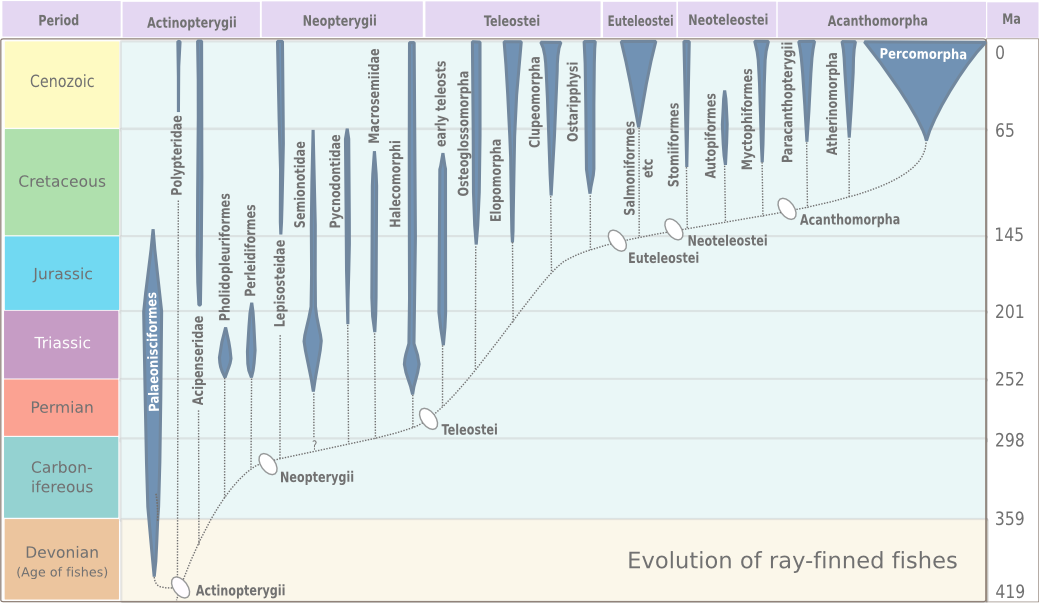
Early teleost fossils appear in the Mesozoic; the oldest known remains date back to the later part of the Triassic and become more abundant in the Jurassic and Cretaceous. Their ancestry traces to earlier ray-finned fishes and forms related to the Holostei clade. Over the Cenozoic and Mesozoic eras teleosts experienced several major radiations, a pattern often summarized as rapid diversification in new ecological niches. The higher-level placement of teleosts can be described by their position among vertebrate groups: vertebrates, jawed fishes, bony fishes and ray-finned fishes (Vertebrata, Gnathostomata, Osteichthyes, Actinopterygii). For a brief timeline see fossil context.
Diversity, classification, and examples
Teleosts include tens of thousands of described species and represent roughly the majority of modern fish species recognized by ichthyologists. They range from tiny gobies to large pelagic predators. Major orders and families contain familiar animals used by humans and known from nature:
- commercial fishes such as tuna, salmon and cod
- freshwater staples like carp and catfish
- popular aquarium fishes including cichlids and goldfish
- small model organisms used in research, notably the zebrafish
Classification of teleosts reflects evolutionary relationships; textbooks often present them in a sequence of nested groups indicating their evolutionary order.
Ecology, behavior and human importance
Ecologically, teleosts occupy roles as herbivores, predators, filter feeders and detritivores. Reproductive modes vary: most are egg-layers, but internal fertilization and forms of live-bearing occur in several families. Many teleosts show parental care, complex mating systems or social behaviors. For people, teleosts are central to global food supplies, aquaculture industries, recreational fishing and scientific research. Their biological diversity underpins fisheries, ecosystem services and cultural practices across the world; managing teleost populations is a key concern in conservation and fisheries science (see paleobiology and modern studies at research resources).
Notable distinctions and final notes
While teleosts are ray-finned bony fishes, they should be distinguished from cartilaginous fishes (sharks and rays) and from more primitive or closely related actinopterygians. Their success stems from a combination of anatomical innovations, ecological flexibility and active radiations through geological time. For further reading and data compilations consult curated sources and taxonomic databases linked here: evolutionary summaries, diversification studies, vertebrate overviews, jawed fish resources and practical guides on bony fish anatomy. Additional general references include actinopterygian surveys, museum pages at access points, and educational portals summarized at introductory links.
Questions and answers
Q: What are teleosts?
A: Teleosts are the dominant fish of the present day and include 20,000 living species.
Q: When did teleosts arise?
A: Teleosts arose in the Mesozoic era.
Q: What is the clade Holostei?
A: The clade Holostei is a group of fish that includes bowfins, from which teleosts evolved.
Q: When do the oldest teleost fossils date back to?
A: The oldest teleost fossils date back to the late Triassic.
Q: How did teleosts evolve during the Mesozoic and Cainozoic?
A: During the Mesozoic and Cainozoic, teleosts diversified.
Q: What percentage of all known fish species are teleosts?
A: 96 percent of all known fish species are teleosts.
Q: What adaptation do teleosts have that improves their ability to grab fast-moving prey?
A: Teleosts have a movable jaw and changes in the jaw muscles that make it possible for them to protrude their jaws outwards from the mouth, which improves their ability to grab fast-moving prey.
Related articles
Author
AlegsaOnline.com Teleosts: diversity, evolution, anatomy, and human importance Leandro Alegsa
URL: https://en.alegsaonline.com/art/96808
Sources
- fishbase.org : "FishBase"
- ucmp.berkeley.edu : "Telostei"
- youtube.com : Video of a slingjaw wrasse catching prey by protruding its jaw
- youtube.com : Video of a red bay snook catching prey by suction feeding
- pnas.org : pnas.org/content/109/34/13698
- currents.plos.org : "The Tree of Life and a new classification of bony fishes"
- doi.org : 10.1371/currents.tol.53ba26640df0ccaee75bb165c8c26288