
Tefnut: Egyptian goddess of moisture, lioness, and early creation
Tefnut was an ancient Egyptian deity associated with moisture, rain and fertility, often shown as a lioness or woman with a lion's head; she appears in creation myths as a child of the creator god and mother of Nut and Geb.
Overview
Tefnut is an ancient Egyptian goddess closely linked with water and moisture, the life-giving side of weather, and with fertility. She occupies a central place in Heliopolitan theology as an early member of the Ennead, the family of creator deities. Her character blends nurturing aspects of moisture with protective and fierce lioness qualities.
Image gallery
6 Images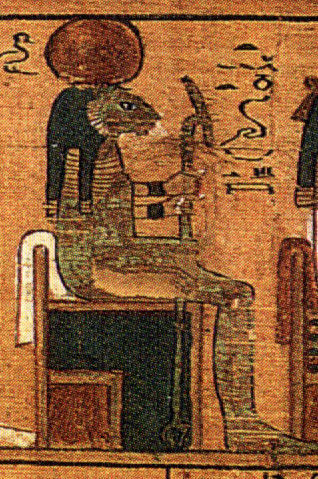


Myth, origin and family
In creation accounts Tefnut is paired with the air god Shu; sources attribute their origin to a primordial creator who is variously named Atum, Ra or Amun. In some versions the first pair are produced by a creative act of Atum and then separate the sky and the earth. Tefnut and Shu are parents of the sky goddess Nut and the earth god Geb, making her ancestor to major figures such as Isis, Osiris and Set.
Iconography and symbols
Tefnut is often represented as a lioness or as a woman with the head of a lion and sometimes with a solar disk, reflecting links to royal power and the sun cult. Egyptian reliefs and statuary show her in human form or as a lioness, and she shares visual traits with other feline goddesses; the imagery appears in temple reliefs and ritual objects (art and iconography). She is associated with the lioness as a protective presence and is sometimes depicted holding symbols of life and authority.
Worship and cult
Worship of Tefnut was centered in Heliopolis and the cities influenced by its theology. Her cult rarely formed vast independent temple complexes but appears across religious texts and temple programs where she functions within the family of creator deities. Her pairing with Shu is important for ritual accounts that stress cosmic order and the separation of sky and earth.
Attributes, roles and legacy
- Primary domains: moisture, dew, rain and the nourishing aspect of water.
- Protective role: invoked as a lioness guardian in funerary and royal contexts.
- Family ties: mother of Nut and Geb, part of the Heliopolitan Ennead.
- Syncretism: occasionally merged or associated with other feline goddesses and solar aspects (woman with lioness head).
Scholars note variant spellings and forms of her name and cautiously reconstruct her etymology from Egyptian vocabulary. Tefnut's combination of life-giving moisture and fierce feline imagery made her a flexible symbol in Egyptian religion: both a source of fertility and a powerful protector within the cosmological family of gods. For more specialized discussions see related entries on water, lion deities and the Heliopolitan creation tradition (water, lioness, Atum, Ra, Amun, art and iconography, fertility, lion head, solar disk, woman with lioness head, Shu, Nut, Geb).
Questions and answers
Q: Who was Tefnut?
A: Tefnut was an ancient Egyptian goddess of water and fertility.
Q: Who created Tefnut?
A: Tefnut was created by Atum, Ra, or Amun along with her brother and husband, Shu.
Q: Who were Tefnut's children?
A: Tefnut was the mother of Nut and Geb.
Q: What is Tefnut associated with?
A: Tefnut is associated with the lion.
Q: How is Tefnut represented in art?
A: Tefnut is represented as a woman with the head of a lion with a Sun disc.
Q: Who was Tefnut's husband?
A: Tefnut's brother, Shu, was also her husband.
Q: What was Tefnut's significance in ancient Egyptian culture?
A: Tefnut was an important goddess in ancient Egyptian culture who was associated with the vital elements of water and fertility.
Related articles
Author
AlegsaOnline.com Tefnut: Egyptian goddess of moisture, lioness, and early creation Leandro Alegsa
URL: https://en.alegsaonline.com/art/96749