
Tcl (Tool Command Language)
Tcl is a small, embeddable scripting language designed around simple command syntax and string processing. Often paired with Tk for GUIs, it is used for automation, rapid prototyping and embedding in applications.
Overview
Tcl (commonly pronounced either "T-C-L" or "tickle") is a high-level, interpreted scripting language originally designed to glue together tools and to be easy to embed in applications. Its core design treats programs as sequences of commands and words, with a lightweight, consistent evaluation model that emphasizes strings and simple substitution. Tcl interpreters are available for many operating systems, and the language is often paired with the Tk toolkit for building graphical user interfaces in a package commonly called Tcl/Tk. For general documentation and entry points into the language, see Tcl documentation.
Image gallery
1 Image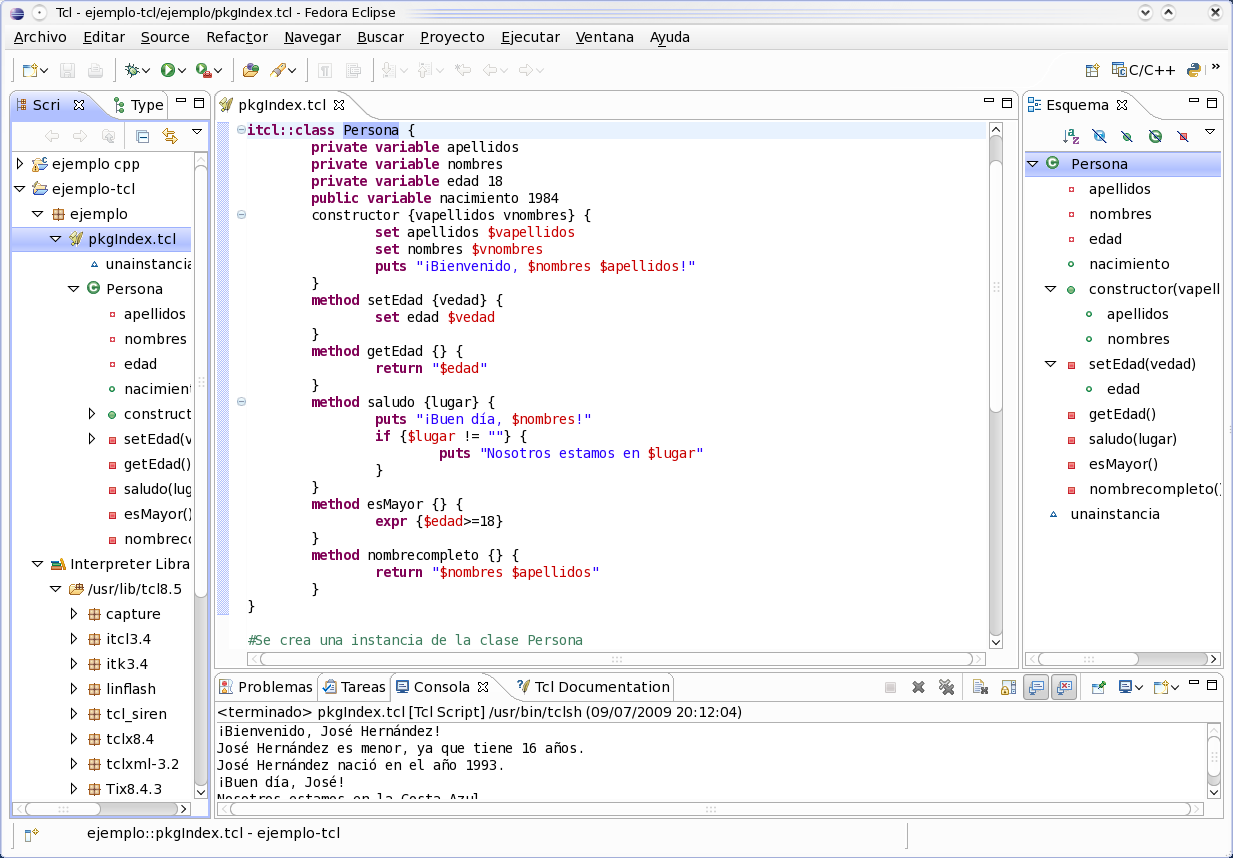
Language characteristics
Tcl programs are composed of commands; every command returns a string result and errors are managed by the interpreter. The language adopts dynamic typing and a minimal core: values are represented as strings and conversion to other types happens as needed. Common features include variables, lists, associative arrays (dicts), control structures, and procedures. The parser rules for quoting, substitution and command nesting make Tcl concise for many text-processing and orchestration tasks. For explanations of command semantics and variable handling, consult language reference and variable and substitution guide.
History and development
Tcl was created by John Ousterhout in the late 1980s as a "tool command language" to simplify integrating programs and building reusable extensions. The companion Tk toolkit was developed to give Tcl an easy-to-use GUI layer; Tk later gained bindings for other languages as well. Over time Tcl grew a stable core and multiple extension systems, and it spawned object systems such as incr Tcl (Itcl), XOTcl and the newer TclOO. The language has evolved through community-maintained releases and academic and commercial contributions—background and project history are available at project history and community pages like community resources.
Common uses and ecosystem
Tcl is frequently used where embeddability, small footprint, or strong string processing is needed. Typical domains include:
- Automation and testing (notably the Expect extension for automating interactive programs).
- Rapid prototyping and scripting inside C or C++ applications—Tcl provides a C API to embed an interpreter and to expose application functions to scripts.
- Graphical applications using Tk, and GUI toolkits that expose similar interfaces to other languages.
- Configuration languages, build tooling, and lightweight servers or daemons where a compact interpreter is advantageous.
Useful tools and extensions are documented across package repositories and tutorials; further reading and resources include extension catalogs, interpreter ports at platform builds, and portability notes at cross-platform guides. Information about embedding Tcl in other software can be found at embedding reference.
Notable features and distinctions
Tcl's design emphasizes simplicity and extensibility. Key characteristics that distinguish it from many other scripting languages include:
- String-oriented core: native representation of data as strings with coerced conversions when required.
- Embedding API: a compact C API intended to allow programs to create and control Tcl interpreters.
- Extensible object systems: multiple OO layers exist, enabling different design styles (class-based or prototype-based).
- Event-driven programming: built-in event loop and facilities for coroutines and asynchronous scripts.
- Safe interpreters: mechanisms to restrict scripts when running untrusted code.
Many developers encounter Tcl through specific toolchains: the Expect automation tool, the Tk GUI and related bindings, or when working with applications that embed Tcl. Tcl/Tk has historically been accessible from other language ecosystems as well; for example, Tk interfaces are exposed to Python via its standard GUI wrapper in common distributions—see Tk and Python and installation notes at packaging information.
Although newer languages have become popular for scripting and GUIs, Tcl remains valued in domains that require a simple, embeddable interpreter, clear command syntax, and efficient text manipulation. Its modest size, rich extension ecosystem, and long history make it a pragmatic choice for integration, testing, and environments where stability and an unobtrusive runtime matter.
Questions and answers
Q: What is Tcl?
A: Tcl (pronounced "tickle" or tee cee ell /ˈtiː siː ɛl/) is a high-level programming language that can be used for many things. It was made to be easy to use, but able to do many tasks.
Q: What kind of language is Tcl based on?
A: Tcl's language is based on commands which tell the computer what to do or how to save a variable. It can do object-oriented, imperative, functional, or procedural styles.
Q: How is Tcl used in C?
A: Tcl is used a lot in C to create prototypes quickly.
Q: Is there an interpreter available for different operating systems?
A: Yes, interpreters are available for many operating systems so many different kinds of computers are able to run Tcl code.
Q: Why is it good for embedded systems?
A: Tcl is a very small language which means it is good for embedded systems.
Q: What does the acronym “Tk” stand for?
A: The acronym “Tk” stands for Tool Command Language.
Q: Is Tk part of the normal Python installation ? A: Yes , when combined with Tk , it's called 'Tcl/Tk' and it's part of the normal Python installation .
Related articles
Author
AlegsaOnline.com Tcl (Tool Command Language) Leandro Alegsa
URL: https://en.alegsaonline.com/art/96618
Sources
- tcl.tk : "Tcl/Tk License Terms"
- docs.activestate.com : "Tcl Dev Kit - Compiler"
- itc.conversationsnetwork.org : "PHP on Hormones – history of PHP presentation by Rasmus Lerdorf given at the MySQL Conference in Santa Clara, California"
- blogs.msdn.com : Windows PowerShell : PowerShell and WPF: WTF
- tcl.tk : "Language"
- tcl.tk : "Uses for Tcl/Tk"
- stanford.edu : "History of Tcl"
- tcl.tk : "History of Tcl"
- awards.acm.org : "John K Ousterhout - Award Winner"