
Tawny Owl (Strix aluco): description, behaviour and distribution
Stocky, medium-sized woodland owl of Eurasia. Resident and territorial, known for nocturnal hunting, silent flight, asymmetrical hearing, cavity nesting and varied plumage across several subspecies.
The tawny owl (Strix aluco) is a stocky, medium-sized true owl widely distributed across much of Europe and large parts of Asia. It is primarily nocturnal and most often associated with mature woodlands, parkland and large gardens where cavities and old trees provide nest sites. The species is resident in much of its range and defends territories year-round; its familiar two-note hoot is used in territorial signalling and pair communication. General information and species summaries are available in species accounts.
Image gallery
10 Images


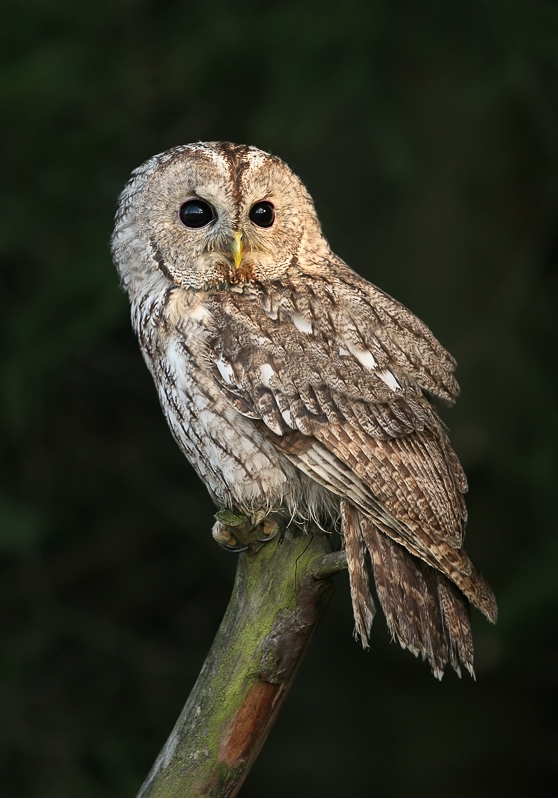

Appearance and variation
Tawny owls are compact with a rounded facial disc, dark eyes and no ear tufts. Plumage varies from warm rufous-brown to grey-brown and darker morphs; this polymorphism helps with camouflage among tree trunks and mossy bark. The underparts show streaking or barring, and the overall patterning breaks up the bird’s outline in dappled light. For discussion of recognised forms and subspecies see subspecies notes.
Taxonomy and subspecies
Classified in the genus Strix, the tawny owl has several regional subspecies across its broad range. Subspecies differ mainly in tone and pattern rather than in fundamental structure. Taxonomic treatments and regional checklists provide more detail on named populations and variation; consult consolidated listings at taxonomic resources and regional syntheses at range overview.
Range, habitat and nesting
The species occupies a wide swath of Eurasia and favours mature deciduous and mixed woodland, hedgerow systems, large parks and urban green spaces. It is adaptable to semi-urban environments where suitable nesting cavities or artificial nest boxes are available. Typical nest sites are tree cavities, old crow or magpie nests, cliff crevices in some areas, and nest boxes provided by conservation groups. Practical guidance on suitable nest provision and habitat management is summarised in nesting resources and habitat descriptions at woodland habitat pages.
Behaviour, territories and social life
Tawny owls are largely solitary outside the breeding season; pairs establish and defend territories that they occupy throughout the year. Territorial behaviour includes calling, bill-clapping and aerial displays. Young birds disperse from their parents when independent, and many fail to secure a territory, which can result in high juvenile mortality. Monitoring and residency studies are discussed in regional reports such as residency and monitoring.
Diet, hunting techniques and predators
As nocturnal predators, tawny owls feed mainly on small mammals such as rodents in rural areas, while birds and invertebrates can form a larger part of the diet in towns and cities. Hunting typically involves perching and listening, followed by a silent glide to seize prey. They may occasionally take other small owls, but larger raptors such as eagle-owls and accipitrine hawks can predate adults; mammals like foxes or martens are important causes of mortality among fledglings. For detailed dietary studies see diet studies and broader raptor ecology at nocturnal raptors.
Sensory adaptations and flight
Although popular descriptions emphasise exceptional night vision, the tawny owl’s retinal sensitivity is broadly comparable to other nocturnal birds; its outstanding ability to detect and localise prey depends heavily on auditory specialisations. Asymmetrically placed ear openings produce subtle timing and intensity differences between the two ears, enabling precise three-dimensional localisation of sounds even under leaf litter. Specialized feather structure reduces noise in flight, enabling silent approach. See comparative anatomy and sensory research at retina studies and ear asymmetry research.
Breeding and life cycle
Breeding pairs typically lay a small clutch of eggs in a secluded cavity. Both adults may participate in incubation and feeding of nestlings, with the female often spending more time on the eggs and young. Young owls fledge after several weeks but remain dependent on parents for some time. Successful recruitment into the breeding population depends on availability of territories and nest sites. Habitat management to retain old trees and cavities benefits breeding success and local population viability.
Conservation and human interactions
Tawny owls are generally common and able to persist in a range of semi-natural and human-modified landscapes, but local declines can occur where woodland continuity and nest sites are lost. They are valued both as biodiversity components and as controllers of rodent populations. Conservation actions include retention of veteran trees, provision of nest boxes, and monitoring of long-term population trends. Practical advice and regional conservation summaries can be found in monitoring guides and species overviews at species accounts and range summaries.
- Key features: stocky build, rounded face, dark eyes, mottled plumage for camouflage.
- Habitat: mature woods, parkland, large gardens and urban green zones.
- Diet: mainly small mammals; birds and invertebrates locally important.
- Breeding: cavity nester, territorial and largely resident.
Further detailed regional information and field identification notes are provided by local field guides and ornithological organisations; useful starting points include habitat pages at woodland habitats, nesting guidance at nesting resources, and surveys or ecological overviews at nocturnal raptor pages.
Questions and answers
Q: What is the tawny owl?
A: The tawny owl or brown owl is a medium-sized owl that can be found in woodlands across much of Eurasia.
Q: How many recognized subspecies of the tawny owl are there?
A: There are eleven recognized subspecies of the tawny owl.
Q: Where does the tawny owl usually make its nest?
A: The tawny owl usually makes its nest in a tree hole where it can protect its eggs and young against potential predators.
Q: What happens to young birds who cannot find a vacant territory?
A: Many young birds starve if they cannot find a vacant territory once their parental care ceases.
Q: What does the tawny owl hunt?
A: The tawny owl hunts mainly rodents, usually by dropping from a perch to seize its prey. In towns, its diet includes a higher proportion of birds.
Q: What adaptations and abilities aid the tawny owl in night hunting?
A: Vision and hearing adaptations and silent flight aid the tawny owl in night hunting.
Q: What is key to the tawny owl's hunting ability?
A: The asymmetrically placed ears of the tawny owl are key to its hunting ability, giving it excellent directional hearing.
Related articles
Author
AlegsaOnline.com Tawny Owl (Strix aluco): description, behaviour and distribution Leandro Alegsa
URL: https://en.alegsaonline.com/art/96564
Sources
- iucnredlist.org : Strix aluco