
Tantō: The Japanese short dagger — design, history and cultural uses
The tantō is a traditional Japanese short sword or dagger associated with samurai. This article describes its form, common blade types, historical development, practical uses and cultural significance.
The term tantō refers to a traditional Japanese short sword or dagger. It occupies a space between a large knife and a short sword, and in Japanese arms classification it is closely related to other short blades such as the Japanese short sword, the short sword category and the small dagger form often described simply as a dagger. Typical tantō blades are compact — commonly about a few dozen centimetres in length — and were produced in many shapes and finishes. Historically the tantō was both a practical close‑quarters weapon and an object of decorative metalwork, and it retained a prominent place in Japanese material culture across several centuries.
Image gallery
10 Images

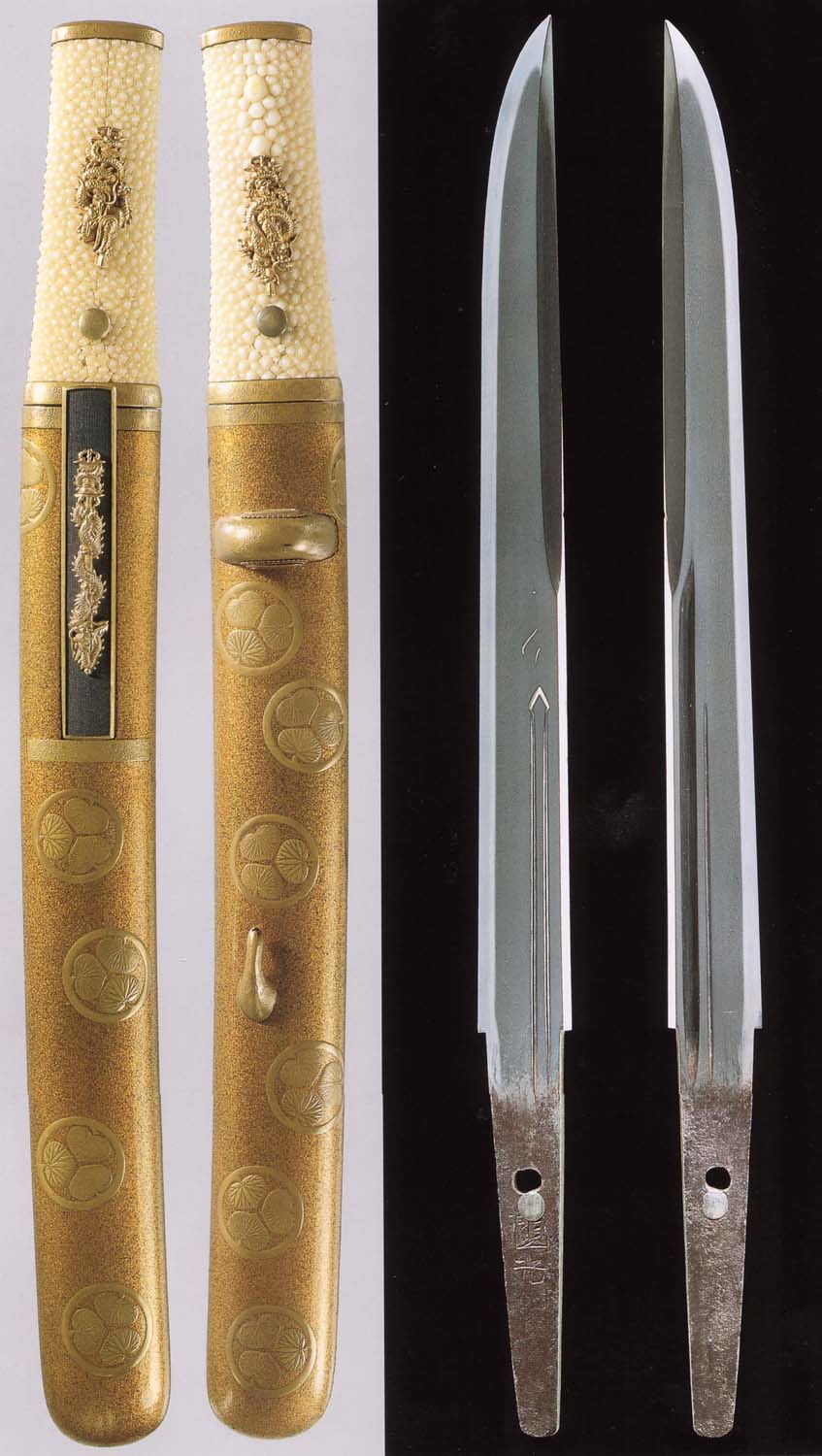
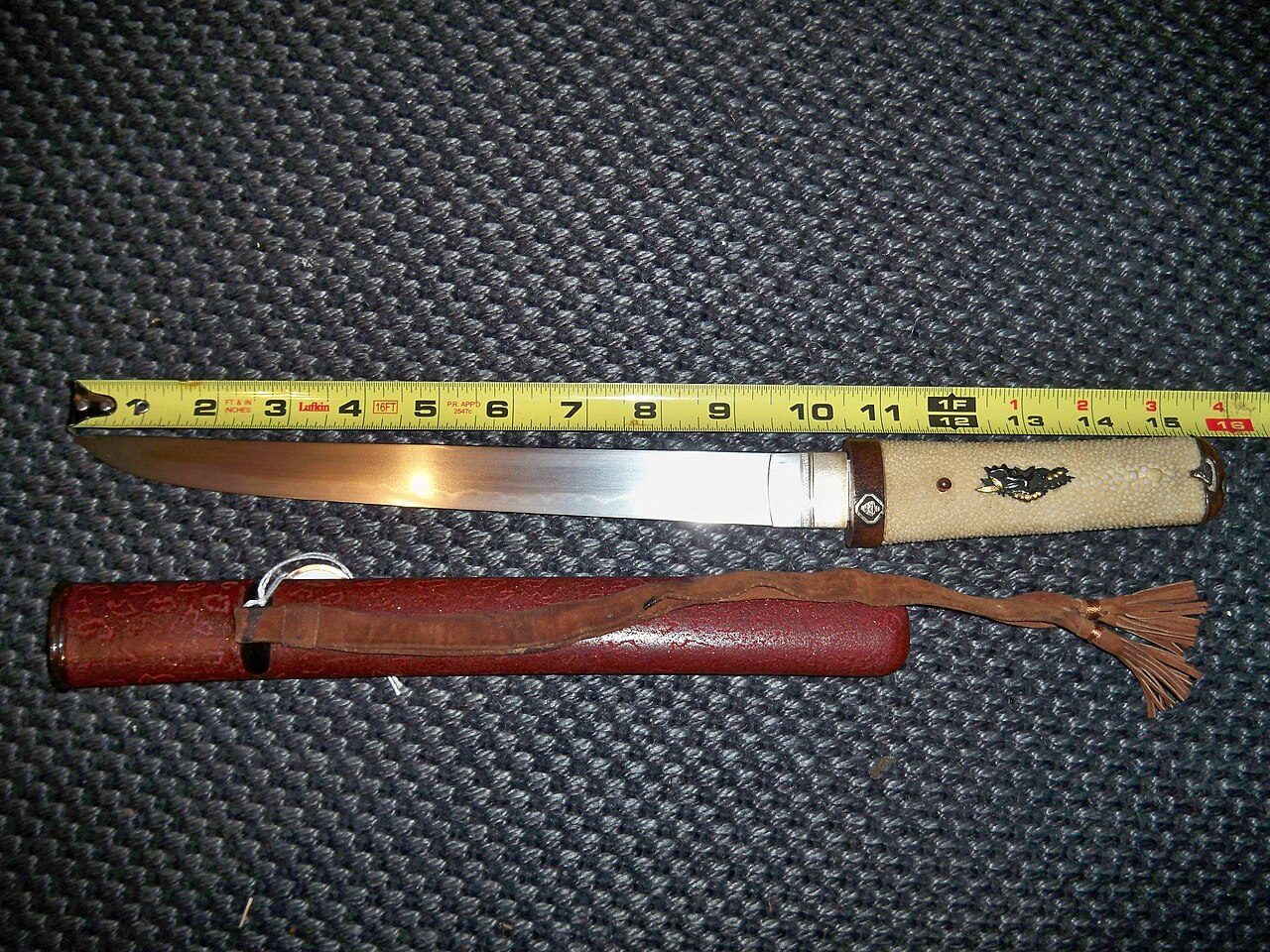


Form and components
Structurally, a tantō is built like a full‑sized Japanese sword but on a smaller scale. It usually has a single‑edged blade with a defined tip (kissaki), a spine (mune), and an edge that was often given a visible temper line (hamon) by differential quenching. The hilt (tsuka) accommodates a tang and is often wrapped and fitted to a scabbard (saya) in the same manner as larger swords. The guard (tsuba) may be present or omitted: common guard treatments include a full tsuba, the minimalist aikuchi style with no protruding guard, and the shallow rimmed hamadashi form. These smaller guards made some tantōs easier to conceal and more comfortable for household carry.
Blade geometry varies according to intended use. Some tantōs have a flat, thick cross section suited to stabbing, while others are slim and curved to deliver cutting strokes. A few rare pieces are double‑edged (moroha), and specialist types may feature an elongated point (kissaki‑moroha‑zukuri). A short form known as the ko‑wakizashi or simply larger wakizashi‑sized blade blurred the boundary between wakizashi and tantō in actual practice; conversely, shorter versions intended for women’s carry are often called kaiken or kaikan in some records.
History and development
The tantō first emerged in recognizable form during the classical and medieval eras of Japan. It traces its origins to earlier cutting and thrusting blades, and it grew in technical sophistication through periods of warfare and artisan specialization. Early examples appear in the same broad timeframe as developments in mounted and foot combat, and the type matured during the Kamakura period when swordmaking as a craft reached a high point. Regional workshops and schools produced distinctive forms; master smiths and workshops are frequently cited in collections and scholarship for their characteristic tempering, geometry and finishing techniques (noted swordsmiths were associated with particular styles).
Across later medieval periods many tantōs became longer or thinner in response to battlefield demands and stylistic fashion, while in times of peace the craft emphasized aesthetic elements such as patterned hamon and decorated fittings. The relative calm of the Edo period changed both the volume and character of production: fewer battlefield blades were needed, but collectors and patrons still commissioned finely made tantōs for ceremonial and household use. Major historical eras such as the Heian, Kamakura, Muromachi and Nambokuchō are important reference points for scholars tracing changes in form and finishing.
Uses, techniques and cultural roles
Functionally, the tantō was valued for close‑quarters fighting and as a secondary weapon when an opponent closed distance. Its compact size made it practical as a concealed or personal defense instrument carried in a sash (obi) with the edge up for rapid deployment. Because it could be worn without an obviously projecting guard, variants like the aikuchi were convenient for indoor or civilian carry. The tantō is also associated with domestic and ritual contexts: women of samurai households commonly kept small daggers such as the kaiken for personal defense and household rites. In discussions of ritual suicide, sources distinguish between different practices: some accounts describe seppuku or related acts performed with different implements depending on gender and circumstance, and specialist short blades were part of those customs in certain settings.
Beyond the purely functional, many tantōs are regarded as works of art. Smiths experimented with different cross‑sections, temper patterns and forging methods, and fittings were frequently embellished by metalworkers, lacquerers and inlayers. Collectors prize examples that show a combination of technical excellence and aesthetic refinement: elegant hamon, consistent geometry, finely made tang and high‑quality koshirae (mountings) distinguish the most admired pieces.
Styles, classifications and notable variants
- Guard types: tsuba (full guard), aikuchi (no prominent guard), hamadashi (small rimmed guard) — small guards favored concealment.
- Blade forms: hira‑zukuri (flat, thick cross‑section), shobu‑zukuri (with a ridge and sometimes a blood groove), moroha (double edged), kissaki‑moroha‑zukuri (long point), kaikan/kaiken (short household dagger).
- Functional variants: longer short swords sometimes called ko‑wakizashi, and larger wakizashi whose dimensions overlap with long tantōs.
Although not as ubiquitous on open battlefields as the katana or yari, the tantō occupies an important place in the study of Japanese arms as both a practical tool and an expression of metalworking art. Contemporary interest spans museums, private collectors and practitioners of traditional martial arts who study tanto‑jutsu techniques; modern makers and conservators continue to research historical methods and materials to preserve and reproduce authentic examples for study and display. For further reading on related blade types and technical details see links to general references and specialized studies: overview of short Japanese blades, classification of short swords, dagger forms, measurement and naming conventions, guard styles, weapon construction, domestic daggers, historical periods, smithing schools, Edo period production, ritual practices.
Questions and answers
Q: What is a tantō?
A: A tantō is a Japanese short sword or dagger with a single-edged blade and curved shape. It was designed for soft targets and was thought to be a hidden weapon of the samurai.
Q: When did the tantō first appear?
A: The tantō first appeared during the Heian Period (795-1192 A.D.).
Q: What are some of the different styles of tantōs?
A: Some of the different styles of tantōs include hira-tsukuri, uchi-sori, o-tantō, sunobi tanto, ko-wakizashi, hira-zukuri, shobu-zukuri, moroha, kissaki-moroha zukuri and kaikan.
Q: How were traditional tantōs sized?
A: Traditional Tantos had an overall length of 11.93 in (1 shaku) and blades ranging from 5in to 12in (12 1/2 cm to 30 cm). Blades that were bigger than 13 to 14 inches were called ko-wakizashi meaning "small short sword."
Q: How did the size and shape of the tanto change over time?
A: During the Nambokucho period (1336–1392 A.D.), tanto's became longer than 15.75 inches (37 cm), blades became thinner and broader making them even more dangerous. During Muromachi Period (1336–1573 A.D.) they become narrower again while their quality improved due to professional smiths appearing at this time. At the beginning of Edo period (1603–1867 A.D.) heat treated blades edges became more waved making them more beautiful in appearance as well as being effective weapons..
Q: How was it carried by samurai warriors?
A: The tanto was usually carried in a wide cloth belt (obi) with its edge up and handle turned towards right side when worn by samurai warriors .
Q: What type of ritual suicide could be performed using a tanto?
A: It is considered that different types of tanto's were used for ritual suicides such as seppuku or hara kiri where women samurai would cut their own throat while men samurai would use wakizashi swords for disembowelment
Author
AlegsaOnline.com Tantō: The Japanese short dagger — design, history and cultural uses Leandro Alegsa
URL: https://en.alegsaonline.com/art/96314