
Tamamo-no-Mae: the legendary fox-woman of Japanese myth and the Killing Stone
Tamamo-no-Mae is a famous figure in Japanese folklore: a beautiful, cunning woman revealed to be a nine-tailed fox spirit whose death produced the Sesshō-seki (Killing Stone) and inspired dramas and interpretations.
Overview
Tamamo-no-Mae is a prominent figure in Japanese mythology and folklore, remembered as a supernatural woman of extraordinary beauty and intelligence who appears in medieval narrative cycles and later popular drama. Her story survives in a range of sources, from prose collections compiled in the Muromachi period to performing arts and travel literature, and it has been retold and reinterpreted over centuries. Scholars and readers treat Tamamo-no-Mae both as a single named character and as a representative instance of broader kitsune (fox spirit) traditions.
Image gallery
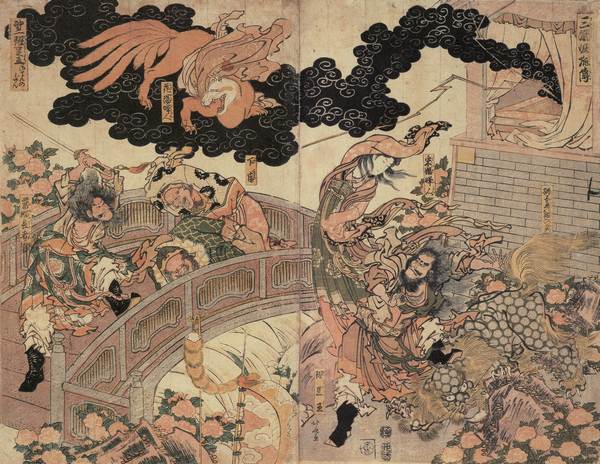
5 Images


Appearance and attributes
In the best-known variants Tamamo-no-Mae is introduced as a dazzling courtier who never seems to age, whose garments remain immaculate, and whose presence is accompanied by an unearthly fragrance. Accounts emphasize her wide learning—she answers questions on music, religion, astronomy and statecraft with equal ease—and her influence at court. That combination of glamor, wit, and uncanny perfection sets her apart in stories about deceptive supernatural beings. Many retellings describe subtle signs that undermine appearances: slips of information, prophetic knowledge, or strange occurrences in the imperial household.
The narrative: charm, illness, and revelation
The central plot thread concerns a reigning emperor who falls mysteriously ill while Tamamo-no-Mae is in his service. After ordinary remedies and religious rites fail, an astrologer or diviner reveals what others have suspected: the woman is not human but an enchanted fox with multiple tails (commonly depicted with nine tails)—a kitsune in disguise—whose presence undermines the ruler and aims ultimately at political disruption. Versions of the story sometimes assert an ambition to seize the throne or otherwise tip the balance of power; other retellings focus on jealousy, supernatural malice, or the fox's appetite for mischief. Once identified, Tamamo-no-Mae vanishes from the court, and a manhunt is mounted to drive out or destroy the creature.
Hunt, death, and the Sesshō-seki
Hunters and warriors are sent to find the malignant spirit. In many accounts the fox is slain on the Nasu plain by a heroic archer (often named Miura-no-suke and accompanied by Kazusa-no-suke in some tellings). Where the animal dies it is said that its corpse transforms into a cursed stone known as the Sesshō-seki, or "Killing Stone," which emits poisonous qualities that bring death to those who touch it. The spirit of Tamamo-no-Mae is then described as lingering—in one variant it becomes known as Hoji—and haunting the stone until a Buddhist priest intervenes.
Exorcism and later literary echoes
A monk or holy man, sometimes called Genno in popular retellings, performs rites to secure the fox spirit's salvation and to free the place from its malign influence. That episode, in which Buddhist ritual converts or pacifies the spirit, is a frequent moralizing element: it demonstrates the efficacy of religious practice and the possibility of redemption, even for a dangerous supernatural being. The story is also recorded in travel literature: the famous haikai writer Matsuo Bashō mentions visiting the stone in Oku no Hosomichi, where the place becomes a focal point for reflection on impermanence and strange fame.
Cultural impact and dramatic adaptations
Tamamo-no-Mae's tale has inspired a variety of artistic and theatrical works. Traditional forms include nō drama and kabuki plays that stage the encounter between human and spirit, dramatize the hunt, or explore the aftermath and repentance. Contemporary retellings appear in novels, manga, and popular media, where elements of the legend—shape‑shifting, nine tails, seductive cunning—are adapted to new contexts. Examples of preserved dramatic treatments and studies can be found in collections of noh and kabuki, and in annotated prose editions of the medieval tales (Otogizoshi and related prose anthologies are often cited).
Motifs, interpretations, and related figures
- Folkloric motif: the fox as a trickster, seductress, or supernatural tester of human virtue appears across East Asia; Tamamo-no-Mae is one high-profile Japanese instance.
- Political allegory: some readers interpret the story as a cautionary tale about courtly intrigue, misplaced trust, or the vulnerability of sovereign power to unseen forces.
- Religious dimension: the conversion or pacification of the spirit by a Buddhist priest illustrates how Buddhist ritual was woven into folk narratives to resolve social anxieties about pollution and death.
- Regional associations: the Nasu plain and the Sesshō-seki became local points of pilgrimage and literary attention, entering travel writing and local lore (Imperial Court settings and place-names recur in variants).
Notable facts and modern responses
The Sesshō-seki remained a named landmark into modern times and was visited by writers and travelers. In March 2022 the stone famously split, an event that attracted press coverage and social comment; while some authors and observers joked that the fox spirit might be freed, others treated the break as a portent or as an opportunity for renewed attention to the tale. The Tamamo-no-Mae legend continues to be cited in discussions of kitsune lore, gendered tropes in myth, and the long life of medieval stories in Japan's cultural imagination. For further background on the texts and performance history see editions and catalogs of medieval prose and theatre mythology studies, folklore surveys, and specialist treatments of the medieval narrative tradition (courtesan-figure studies and imperial court contexts are often informative).
Selected themes and resources
- Identity and disguise: how human appearance can mask a nonhuman agency.
- Power and vulnerability: the tale addresses the fragility of political authority faced with supernatural influence.
- Redemption and ritual: Buddhist intervention as a method of social and spiritual resolution.
- Performance and memory: the story's adaptations in literature, theatre, and travel writing preserve and reshape its meaning (nine-tail motifs and ambitions toward the throne reappear regularly).
Because Tamamo-no-Mae appears in many versions and genres, readers are encouraged to consult different retellings—medieval prose, classical travelogues, and theater scripts—to appreciate how the figure has been used to entertain, warn, and reflect cultural values. Additional bibliographic and textual pointers are available in academic surveys of Japanese myth and in annotated editions of the relevant prose and performance texts (kitsune studies and primary-name indexes are useful starting points).
Questions and answers
Q: Who was Tamamo-no-Mae?
A: Tamamo-no-Mae was a legendary figure in Japanese mythology and folklore. In the Otogizoshi, a collection of Japanese prose written in the Muromachi period, she was said to be a courtesan under the Japanese Emperor Konoe who was renowned for her beauty and intelligence.
Q: What made Tamamo-no-Mae so special?
A: Tamamo-no-Mae's body mysteriously always smelled wonderful, and her clothes never became dirty. She answered every question posed to her, whether about music, religion, or astronomy. Because of her beauty and intelligence, everyone in the Imperial Court adored her.
Q: Why did Emperor Konoe become ill?
A: Emperor Konoe suddenly and mysteriously fell ill after some time had passed. An astrologer told him that Tamamo-no-Mae was the cause of his illness because she was actually an evil fox with nine tails (kitsune) trying to take over the throne.
Q: How did Miura-nosuke kill Tamamo-no Mae?
A: The fox appeared to Miura-nosuke in a dream as the beautiful young woman again and begged for its life but he refused. Early the next day, hunters found it on the Plain of Nasu and Miura shot it with an arrow killing it instantly.
Q: What happened to Tamamo no Mae's spirit after death?
A: After death, Tamamo no Mae's spirit became Hoji which haunted Sessho seki or Killing Stone until Genno performed certain spiritual rituals which caused Hoji to surrender and swear not to haunt it anymore.
Q: What is Matsuo Bashō's famous book about?
A: Matsuo Bashō's famous book is called The Narrow Road to the Deep North (Oku no Hosomichi) which tells of visiting Sessho seki where Tamamo no Mae died.
Q: What does it mean when Sessho seki split on March 5th 2022?
A: When Sessho seki split on March 5th 2022 many people humorously said that this meant that Tamamo no Mae is now free however there is also a more general belief that this could be an omen of impending tragedy
Related articles
Author
AlegsaOnline.com Tamamo-no-Mae: the legendary fox-woman of Japanese myth and the Killing Stone Leandro Alegsa
URL: https://en.alegsaonline.com/art/96172
Sources
- ddb.libnet.kulib.kyoto-u.ac.jp : "Tamamo-no-mae (Synopsis)"
- khandro.net : "Japanese Dakini"
- godchecker.com : "Hoji - Spiritual Being"
- kitsune.org : "The Death Stone"
- uoregon.edu : "Station 9 - Sesshoseki"