
Taiping Rebellion (1850–1864)
A large-scale mid-19th century civil war in China led by Hong Xiuquan that established the Taiping Heavenly Kingdom and caused tens of millions of deaths, profoundly affecting the late Qing state.
Overview
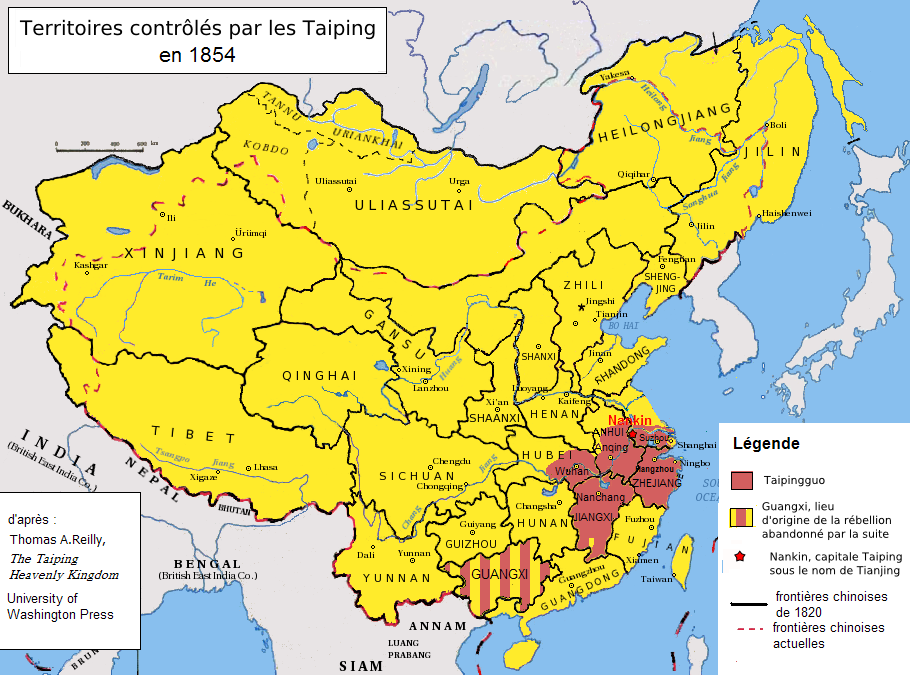
The Taiping Rebellion was a major civil war in China that lasted from 1850 to 1864. It was led by Hong Xiuquan, who founded the Taiping Heavenly Kingdom and promulgated a heterodox, Christian-influenced, millenarian vision. Modern estimates of deaths associated with the conflict vary, but scholars commonly place the toll in the tens of millions, making it one of the deadliest internal wars in human history. The rebellion mounted the most serious organized challenge to Qing rule in the dynasty's late period.
Image gallery
10 Images


Origins and aims
The movement began among impoverished populations in southern China and drew on social grievances, local economic distress, and religious ideas. Hong Xiuquan claimed to have received visions and taught doctrines that combined elements of Christianity with his own reinterpretations. The Taiping program sought sweeping social reform: proposals included communal land redistribution, strict moral codes, prohibition of opium and gambling, limits on traditional elite privileges, and measures intended to expand roles for women. In practice, many reforms were unevenly applied and the movement's governance evolved as it expanded.
Course of the conflict
Taiping forces captured large swathes of territory and in 1853 took Nanjing, which they made their capital and renamed Tianjing (Heavenly Capital). The rebels' armies—derisively called "Long Hairs" by opponents—initially achieved significant successes, but internal rivalries, leadership disputes, and disciplinary problems weakened them over time. The Qing state, aided by newly formed provincial armies and with material support from foreign powers in varying degrees, mounted a prolonged counteroffensive. Key Qing commanders organized regional forces that gradually recaptured territory and besieged Taiping positions.
Consequences and legacy
The rebellion devastated large regions, disrupted agriculture and commerce, and produced a huge civilian death toll. It undermined the central authority of the Qing dynasty and accelerated the rise of powerful provincial military leaders, which had long-term implications for Chinese politics and decentralization. The crisis also prompted internal debate within China about reform and modernization and influenced later revolutionary movements that eventually overthrew the Qing.
Key facts
- Dates: 1850–1864
- Leader: Hong Xiuquan (founder of the Taiping Heavenly Kingdom)
- Capital: Nanjing (renamed Tianjing)
- Estimated deaths: tens of millions (scholarly estimates vary)
- Notable features: millenarian ideology, radical social program, major challenge to Qing rule
Questions and answers
Q: What was the Taiping Rebellion?
A: The Taiping Rebellion was a civil war in China from 1850 to 1864 led by Hong Xiuquan.
Q: Who led the Taiping Rebellion?
A: The Taiping Rebellion was led by Hong Xiuquan.
Q: What was the goal of the Taiping Rebellion?
A: The goal of the Taiping Rebellion was to overthrow the ruling Qing Dynasty and change society.
Q: How many people died during the Taiping Rebellion?
A: Around 20 million people, mostly civilians, died during the Taiping Rebellion.
Q: What was the Taiping Heavenly Kingdom?
A: The Taiping Heavenly Kingdom was a state that Hong Xiuquan established during the Taiping Rebellion.
Q: How many people joined the Taiping Heavenly Kingdom?
A: At its height, the Taiping Heavenly Kingdom had about 30 million people joining it.
Q: What were Taiping rebels nicknamed as?
A: The Taiping rebels were nicknamed as the Long Hair (长毛, cháng máo).
Related articles
Author
AlegsaOnline.com Taiping Rebellion (1850–1864) Leandro Alegsa
URL: https://en.alegsaonline.com/art/95944
Sources
- worldcat.org : 3467844
- books.google.com : Google books access