
Taíno — Indigenous peoples of the Caribbean
Overview of the Taíno: origins, society, economy, spiritual life, European contact, demographic change, archaeology and cultural legacy across the Bahamas and the Antilles.
The Taíno were an indigenous people of the Caribbean who created island societies with shared cultural traits prior to sustained European colonization. Archaeological, linguistic and historical evidence indicates their ancestors moved northward from the Caribbean coast of South America and settled island chains over many centuries. By the late first and early second millennium CE communities characteristic of what scholars call Taíno culture were established in the Bahamas, the Greater Antilles and the northern Lesser Antilles.
Image gallery
10 Images




Origins and migration
Most researchers link Taíno cultural roots to Arawakan-speaking populations that expanded from parts of South America. Movements of people, plants and technologies across coastal and island routes produced regional varieties of settlement and material culture. By around 1200 CE a recognizable pattern of villages, agriculture and craft was widespread. When Christopher Columbus arrived in the Americas in 1492 he encountered Taíno communities in the Bahamas and on larger islands such as Cuba, Jamaica, Hispaniola and Puerto Rico.
Language and social organization
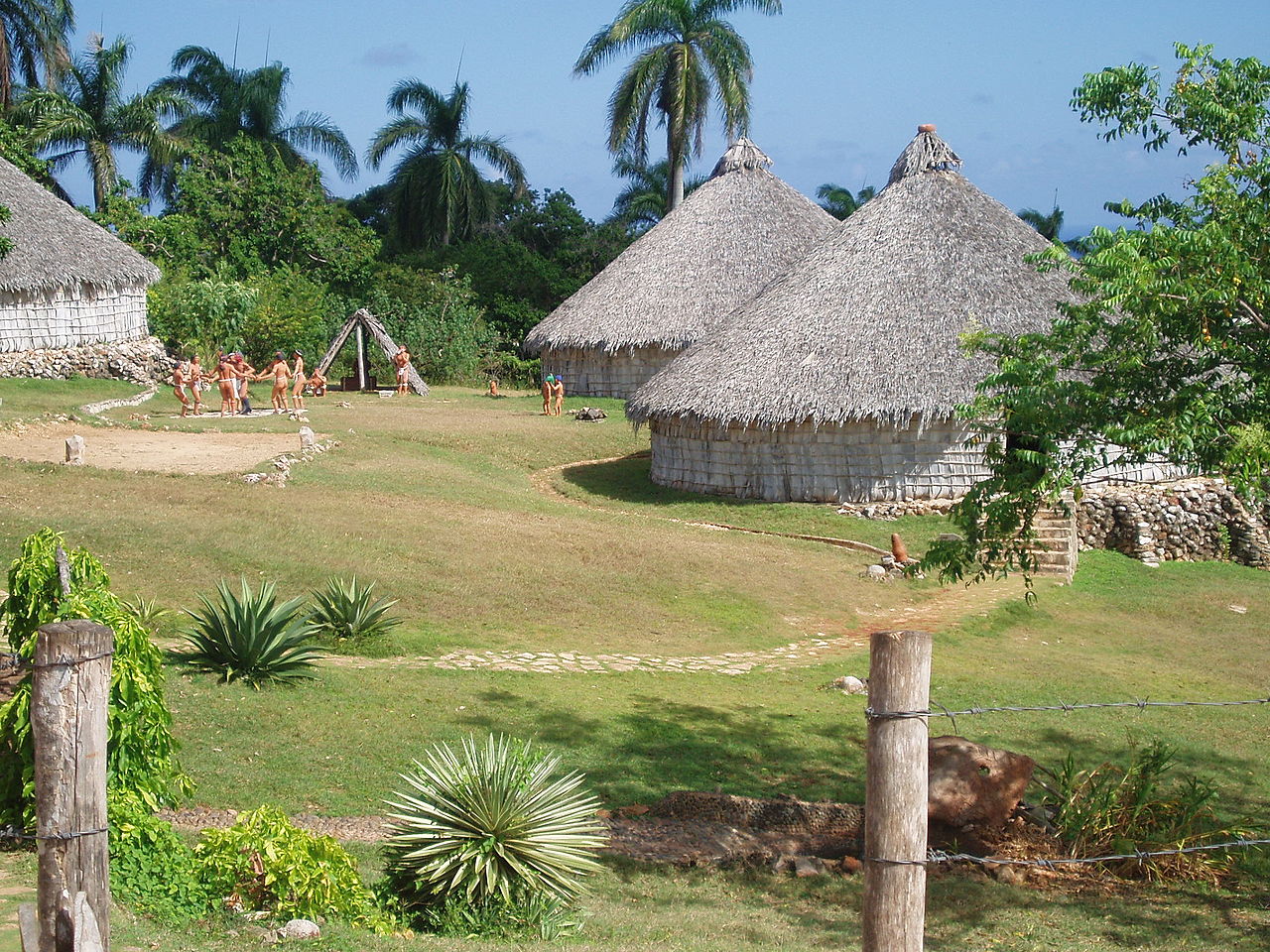
The Taíno spoke varieties within the wider Arawakan linguistic family and shared cultural forms with related mainland groups, though island life shaped distinctive institutions. Villages (yucayeques) were organized around plazas and communal structures. Political leadership rested with caciques (chiefs) supported by a class of caregivers, artisans and religious specialists (behique). Social distinctions recorded by early observers included noble families, commoners and persons with ritual roles.
Economy, settlement and daily life
Taíno subsistence combined agriculture, coastal fishing and inter-island exchange. Cultivated staples included cassava (yuca) processed into flatbread (casabe), maize and root crops; fruit trees and small-scale horticulture were widespread. Canoes enabled fishing, travel and trade between islands. Craft production included pottery, carved zemis (ritual figures), woven items and tools fashioned from stone, bone and wood.
Belief, art and material culture
Spiritual life involved ancestor veneration, ceremony and the use of ritual objects. Zemis functioned as focal points for memory, social cohesion and religious practice. Oral histories, songs and designs on ceramics and body art conveyed lineage, identity and cosmological ideas. Tobacco, ceremonial feasts and communal gatherings featured in many accounts of Taíno belief and social ritual.
Contact, disease and colonial impact
Initial encounters with arriving Europeans and their ships—most prominently the Spanish—brought profound and rapid changes. Contact introduced new pathogens, technologies and economic pressures. Systems of forced labor, violent conflict and social disruption under Spanish colonial policies contributed to sharp population declines and the disintegration of many traditional community structures within decades of first contact.
Demographic change and continuity
Although early population losses were severe, continuity persisted in many forms. People of mixed ancestry, surviving communities and cultural retention allowed Taíno influence to remain visible in place names, agricultural practices and local knowledge. Linguistic traces and words adopted into European languages—such as canoe, hammock, hurricane, tobacco and related terms—attest to cultural exchange.
Archaeology, history and modern research
Archaeological excavation, ethnohistorical study and recent genetic research contribute to a more detailed and nuanced understanding of Taíno societies. Excavations document settlement patterns, subsistence remains and craft production, while archival sources record early encounters and social change. Contemporary studies emphasize regional diversity and long-term connections between island and mainland populations, including links to broader Arawak cultural worlds.
Legacy and revival
Taíno cultural legacies continue in the Caribbean through language traces, folk practices, place names and community identities. Cultural revival and scholarly work seek to recover and teach traditional knowledge, reconnect communities to ancestral practices, and acknowledge Taíno contributions to Caribbean history. Resources for further context and comparative study often refer to broader entries on indigenous histories and island geography (indigenous peoples, coastal origins at the Caribbean coast, South American connections at South America, timelines such as 1200 CE, the Lesser Antilles and the Greater Antilles, and accounts of Columbus and European arrival in the Americas).
- Geographic scope: Bahamas and parts of the Greater and northern Lesser Antilles.
- Cultural markers: village organization, agricultural staples (cassava, maize), zemi iconography and canoe travel.
- Historical significance: first sustained European descriptions of Caribbean life and an enduring influence on regional culture.
For island-specific context consult entries for Cuba, Jamaica, Hispaniola and Puerto Rico, and for colonial histories see materials on Spanish expansion and its consequences.
Questions and answers
Q: Who were the Taínos?
A: The Taínos were an indigenous people that lived in the Americas before Columbus arrived there.
Q: Where did the Taínos come from?
A: The Taínos came from the Caribbean coast of South America.
Q: When did the Taínos move northward to the island chain of the Lesser and Greater Antilles?
A: The Taínos moved northward to the island chain of the Lesser and Greater Antilles around 1200 CE.
Q: Where were the Taínos living when Christopher Columbus came to the Americas?
A: When Christopher Columbus came to the Americas, the Taínos were living in the Bahamas, the Greater Antilles (Cuba, Jamaica, Hispaniola, and Puerto Rico), and some islands of the northern Lesser Antilles.
Q: How was the culture of the Taínos different from the culture of the Arawak people?
A: The culture of the Taínos was different from the culture of the Arawak people (another indigenous group of South America).
Q: Who were the first people that the Spanish met in the Americas?
A: The Taínos were the first people that the Spanish met in the Americas.
Q: From where did the Taínos originally migrate to the Caribbean Islands?
A: The Taínos originally migrated to the Caribbean Islands from the Caribbean coast of South America.
Related articles
Author
AlegsaOnline.com Taíno — Indigenous peoples of the Caribbean Leandro Alegsa
URL: https://en.alegsaonline.com/art/95934
Sources
- elmuseo.org : "Caciques, nobles and their regalia"