
Battle of Stamford Bridge (25 September 1066)
Decisive 1066 clash near Stamford Bridge in which Harold Godwinson defeated an invading Norwegian force under Harald Hardrada; a major event immediately preceding the Norman invasion of England.
Overview
The Battle of Stamford Bridge was fought on 25 September 1066 near the village of Stamford Bridge in the East Riding of Yorkshire, in England. An English army commanded by King Harold Godwinson confronted an invading Norwegian force led by King Harald Hardrada, which included troops and ships carrying men allied to Harold's estranged brother Tostig. The engagement ended with a clear English victory: Hardrada and Tostig were killed and many of the Norwegians were slain or captured. Contemporary and later accounts stress the ferocity of the fighting and the rapidity with which Harold marched north to surprise the invaders.
Image gallery
8 Images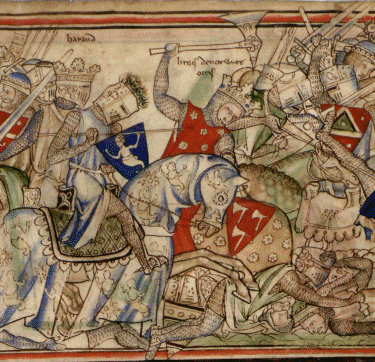




Background
The confrontation at Stamford Bridge occurred in a year of competing claims to the English throne. After the death of Edward the Confessor earlier in 1066, rival claimants sought to secure support and invade. Harald Hardrada, an experienced Norwegian king, mounted an expedition to press his claim in the north of England. He was joined by English exiles, notably Tostig Godwinson, creating a combined force that temporarily occupied parts of Northumbria. Harold Godwinson, recently crowned king in London, marched his army northward to meet this threat.
Opposing forces and tactics
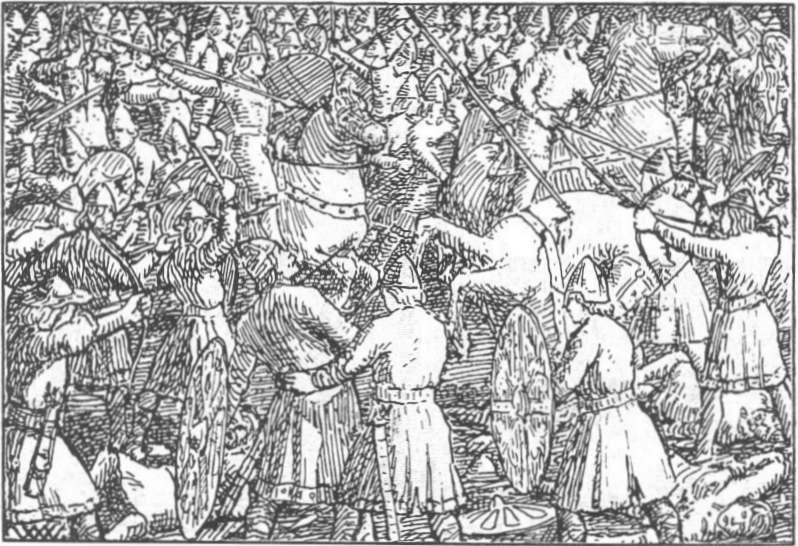
Medieval sources describe an English army composed of household troops and levies making use of the shield-wall, while the Norwegian force fought as heavy infantry renowned for axe and seax use. The English attack is reported to have been sudden, catching many Norsemen unprepared. Exact numbers are uncertain and modern historians caution against taking saga figures at face value; nevertheless, the encounter is widely regarded as a large, hard-fought set-piece battle of the period.
The fighting
Accounts emphasize close-quarters combat on open ground and at narrow crossing points. Later narratives recount an episode of a lone Norse defender holding a bridge against the English until he was overcome; such tales feature in saga literature but are treated cautiously by scholars as possibly legendary or embellished. The fighting concluded with the collapse of Norwegian resistance when their leaders were killed and organized resistance broke down.
Aftermath and strategic consequences
The English victory removed the immediate Norwegian threat and demonstrated Harold's ability to concentrate his forces quickly. However, the campaign left English forces tired, and some units were depleted by the engagement and the rapid march north and back. Less than three weeks later, Harold faced another invasion from the south led by the Duke of Normandy, William the Conqueror, culminating in the Battle of Hastings on 14 October 1066 where Harold was defeated. Historians often note that the sequence of rapid campaigns in 1066 influenced the outcome of the Norman invasion.
Significance and interpretation
Stamford Bridge is frequently cited as a pivotal moment that effectively ended major Viking attempts to conquest England and is associated with the close of the Viking Age in English history. At the same time, the transition was gradual and complex rather than the result of a single battle. The engagement is important to military historians for what it reveals about logistics, the value of rapid strategic movement, and the impact of back-to-back campaigns on manpower and morale.
Sources and historiography
Primary evidence for the battle comes from a mixture of contemporary chronicles, later English annals and clerical histories, and Norse sagas. These sources—whose details sometimes conflict—are complemented by archaeological finds and place-name studies that illuminate the setting and aftermath. Scholars cross‑reference accounts from different traditions to reconstruct the events and to assess the reliability of celebrated episodes and casualty figures.
Key points
- Fought on 25 September 1066 near Stamford Bridge in the East Riding of Yorkshire, England.
- English forces under Harold Godwinson defeated Norwegians under Harald Hardrada and English exiles allied to him.
- Often regarded as marking the end of large-scale Viking invasions in England and connected to the decline of the Viking Age.
- Followed within weeks by the Norman invasion under William the Conqueror and the Battle of Hastings, events that reshaped English government and society.
- Many dramatic elements in later accounts are debated by historians; readers should consult both contemporary chronicles and modern studies of battle narratives for interpretation.
Further study of Stamford Bridge draws on interdisciplinary work in history and archaeology to better understand the battle's conduct, its immediate military consequences, and its place in broader European transformations during the late eleventh century.
Questions and answers
Q: Where did the Battle of Stamford Bridge take place?
A: The battle took place near the village of Stamford Bridge, East Riding of Yorkshire, in England.
Q: When did the Battle of Stamford Bridge take place?
A: The battle took place on the 25th of September 1066.
Q: Who was the English army led by in the Battle of Stamford Bridge?
A: The English army was led by King Harold Godwinson.
Q: Who led the invading Norwegian army in the Battle of Stamford Bridge?
A: The invading Norwegian army was led by King Harald Hardrada.
Q: Who joined the invading Norwegian army in the Battle of Stamford Bridge?
A: Tostig Godwinson, the brother of the English king, joined the invading Norwegian army.
Q: Who won the Battle of Stamford Bridge?
A: The English army under King Harold Godwinson achieved a complete victory.
Q: What was the significance of the Battle of Stamford Bridge?
A: The battle marks the end of the Viking Age in England.
Related articles
Author
AlegsaOnline.com Battle of Stamford Bridge (25 September 1066) Leandro Alegsa
URL: https://en.alegsaonline.com/art/9556
Sources
- historyofwar.org : "Battle of Stamford Bridge, 25 September 1066"
- historynet.com : "Last of the Vikings – Stamford Bridge, 1066"
- viking.archeurope.info : "The Battle of Stamford Bridge, 25th September 1066"
- normaninvasion.info : "Biography of Edward the Confessor"
- historic-uk.com : "The Battle of Stamford Bridge"
- burnpit.us : "Battle of Stamford Bridge: Saxon King Harold Godwinson Defeats Invading Norwegians"
- battlefieldstrust.com : "Battle of Stamford Bridge 25th September 1066"
- bbc.co.uk : "1066"