
Swiss Grand Prix
The Swiss Grand Prix was Switzerland’s premier motor race, staged mainly at Bremgarten before a mid-1950s ban halted circuit racing; later editions were run at Dijon-Prenois in France.
Overview
The Swiss Grand Prix was the principal international automobile race associated with Switzerland. Known in local languages as Grand Prix de la Suisse (French) and Großes Preis von der Schweiz (German), it developed from pre‑war Grand Prix contests into a postwar Formula One event. The title was applied both to races held inside Switzerland and, after domestic racing restrictions, to events run across the border.
Image gallery
1 Image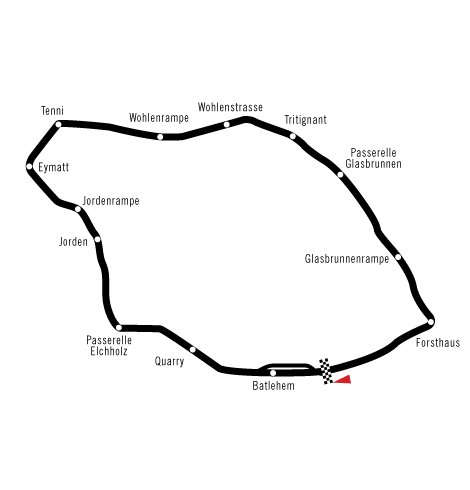
Circuit and race characteristics
The most famous venue for the Swiss Grand Prix was the Bremgarten circuit just outside the town of Bremgarten, near Bern. Bremgarten was a fast, sweeping road circuit woven through woods and farmland; it combined high speeds with limited run‑off areas, changing light conditions under tree cover and a mix of road surfaces. These features made the track challenging for drivers and unforgiving in wet weather, contributing to its reputation as one of the era's more dangerous yet iconic venues.
History and development
Grand Prix racing in Switzerland began in the 1930s and the event was included in the pre‑war European Championship calendar. After World War II the Swiss Grand Prix continued to attract top teams and drivers as part of the emerging Formula One scene. Over the decades the race reflected broader changes in motorsport, from hand‑built prewar machines to purpose‑built postwar single‑seaters.
Ban, relocation and later editions
Following the catastrophic 1955 24 Hours of Le Mans disaster, which prompted safety reviews across motorsport, Swiss authorities imposed strict limits on circuit racing. The domestic ban on spectator road racing effectively ended high‑level events inside Switzerland for many years. As a result, the Swiss Grand Prix name resurfaced on tracks outside the country: organizers staged the title at the Dijon‑Prenois circuit in France for non‑domestic events. One such running was a non‑championship meeting in the 1970s, and the name later appeared again on the World Championship calendar in the early 1980s. During the late 20th and early 21st centuries some restrictions were relaxed for specific demonstrations and for certain classes of competition, particularly events featuring alternative technologies.
Legacy and notable facts
- The Swiss Grand Prix originated as a major pre‑war European event and became part of the Formula One era.
- Bremgarten's tree‑lined, high‑speed layout made it distinct from purpose‑built modern circuits.
- After the mid‑1950s ban, the Swiss Grand Prix was one of the better‑known race names to be held abroad rather than on home soil.
- The race illustrates the mid‑20th‑century shift toward greater safety scrutiny and regulatory intervention in motorsport.
For further reading about the event's domestic venues, historical runnings and the circumstances that led to the relocation of Swiss‑named Grands Prix, consult contemporary race reports and archives on historic motorsport. More on the race
Results
| Circulation | Year | Route | Winner | Second | Third | ||
| I | 1934 | Bremgarten | NS State | NS State | Third French Republic | NS State | NS State |
| II | 1935 | Bremgarten | German Reich NS | Italy 1861 | German Reich NS | Italy 1861 | German Reich NS |
| III | 1936 | Bremgarten | German Reich NS | Italy 1861 | German Reich NS | German Reich NS | German Reich NS |
| IV | 1937 | Bremgarten | German Reich NS | German Reich NS | German Reich NS | German Reich NS | German Reich NS |
| V | 1938 | Bremgarten | German Reich NS | United Kingdom | German Reich NS | United Kingdom | United Kingdom |
| VI | 1939 | Bremgarten | German Reich NS | German Reich NS | German Reich NS | German Reich NS | German Reich NS |
| 1940 until 1946 | No Swiss Grand Prix | ||||||
| VII | 1947 | Bremgarten | France 1946 | Italy | Italy | France 1946 | France 1946 |
| VIII | 1948 | Bremgarten | Italy | France 1946 | Italy | France 1946 | France 1946 |
| IX | 1949 | Bremgarten | Italy | Italy | France 1946 | Italy | Italy |
| X | 1950 | Bremgarten | Italy | Italy | France 1946 | Argentina | Italy |
| XI | 1951 | Bremgarten | Argentina | Italy | Italy | Argentina | Argentina |
| XII | 1952 | Bremgarten | Italy | Switzerland | France 1946 | Italy | Italy |
| XIII | 1953 | Bremgarten | Italy | Italy | United Kingdom | Argentina | Italy |
| XIV | 1954 | Bremgarten | Argentina | Argentina | Germany | Argentina | Argentina |
| 1955 until 1974 | No Swiss Grand Prix | ||||||
| XV | 1975 | Dijon | Switzerland | France | Germany | France | France |
| 1976 until 1981 | No Swiss Grand Prix | ||||||
| XVI | 1982 | Dijon | Finland | France | Austria | France | France |
| since 1983 | No Swiss Grand Prix | ||||||




| Legend | ||
| Abbreviation | Class | Comment |
| F1 | Formula 1 | Formula 1 World Championship from 1950 |
| F2 | ||
| FL | Formula libre | Vehicle class usually advertised by the organizer |
| SW | Sports car | |
| TW | Touring car | |
| GP | Grand Prix cars | |
| ↓ Solid gray lines indicate when a new course was taken in history. ↓ | ||
| Entries with a bright red background were not rounds of the automobile or Formula 1 World Championship. | ||
| Entries with yellow background were heats for the European Championship. | ||
Questions and answers
Q: What was the Swiss Grand Prix?
A: The Swiss Grand Prix was a motor race of Switzerland, and in its later years it was a Formula One race.
Q: When did Grand Prix racing start in Switzerland?
A: Grand Prix racing started in Switzerland in 1934.
Q: Where was the Bremgarten circuit located?
A: The Bremgarten circuit was just outside the town of Bremgarten, near Bern.
Q: How long did the Swiss Grand Prix count toward the European Championship for?
A: The Swiss Grand Prix counted toward the European Championship from 1935 to 1939.
Q: Why did motor racing get banned by the Swiss government in 1958?
A: Motor racing got banned by the Swiss government in 1958 as an unsafe spectator sport, following the death of 80 people at the 1955 24 Hours of Le Mans race.
Q: Where were two more races held after motor racing got banned?
A: After motor racing got banned, two more races were held at Dijon-Prenois circuit, just across the border in France.
Q: Was there ever another Championship F1 race after 1975?
A: Yes, one Championship F1 race was held in 1982.
Related articles
Author
AlegsaOnline.com Swiss Grand Prix Leandro Alegsa
URL: https://en.alegsaonline.com/art/95547