
Battle of Philippi (42 BC): final clash of the Liberators and the Triumvirs
Two linked engagements in October 42 BC near Philippi in Macedonia where forces of Mark Antony and Octavian defeated Brutus and Cassius, ending organized senatorial resistance and reshaping Roman rule.
Overview
The Battle of Philippi was fought in October 42 BC near the city of Philippi in the Roman province of Macedonia. It was the decisive confrontation in the struggle between the leaders of the Second Triumvirate and the men who had assassinated Julius Caesar. The fighting followed the post‑Caesarean settlement by the ruling coalition and the attempt by the republican faction to regain political control. The conflict is usually situated as part of the larger Wars of the Second Triumvirate and is widely regarded as the last serious campaign of the senatorial pro‑republican party.
Image gallery
4 Images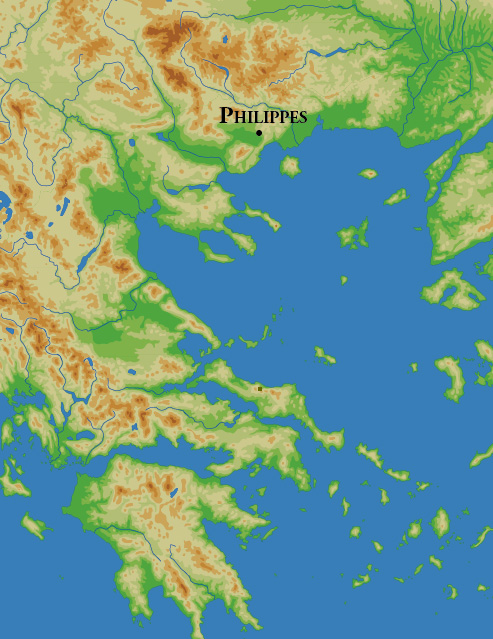


Forces, terrain, and disposition
On one side stood the triumviral commanders, principally Mark Antony and Octavian (later Augustus), here identified as Octavian in contemporary narratives. Opposing them were the leading conspirators Marcus Brutus and Gaius Cassius, often called the Liberatores. The armies met on the flat expanses west of Philippi—the open plain favored set‑piece engagements—and the campaign quickly developed into two linked encounters rather than a single pitched battle; historians therefore describe it as composed of two engagements across the plain.
The two engagements and immediate outcomes
In the first clash, Brutus confronted Octavian and initially gained ground, even entering parts of the young triumvir’s camp. Simultaneously to the south, Antony attacked and routed Cassius’s forces. A mistaken report that Brutus had been beaten led Cassius to take his own life—an act often noted in sources as a fatal blow to the republican cause (suicide). The loss of Cassius removed an experienced commander whom many contemporaries and later writers called the movement’s most capable leader (best commander), and it weakened republican morale.
Second engagement and political consequence
About two weeks after the first clash the armies met again. The second engagement decisively favoured Antony and Octavian; Brutus’s remaining legions were overwhelmed and, facing inevitable capture and disgrace, Brutus also committed suicide. With the principal resistance crushed, the victors consolidated power and the alliance of the two senior partners—known collectively as the triumvirate—asserted control over Rome’s political institutions and provinces. The result effectively ended organized armed opposition to the triumviral regime and cleared the path for the end of the Roman Republic as a functioning oligarchic system.
Significance and later developments
Philippi marked a turning point: it ended the immediate hopes of those who sought to restore the pre‑Caesarian republic by force, while elevating Antony and Octavian in prestige and resources. For Antony the victory was the apogee of his military career; for Octavian it was an essential step toward unrivalled authority. The alliance between them, however, would later fray into rivalry that culminated in a new civil war. Philippi’s lessons were studied by Roman commanders and later historians for its examples of leadership, logistics and the consequences of misinformation on the battlefield.
Legacy and remembrance
Archaeological remains and ancient accounts preserve details of troop dispositions and the campaign’s local impact; the site near modern Kavala has been the subject of study and tourism. Philippi remains widely cited in discussions of the transformation from republic to imperial monarchy, the nature of civil conflict, and the interplay of personal ambition and institutional change. For further reading consult contemporary sources and modern syntheses that examine the campaign, politics, and personalities that made Philippi a decisive moment in Roman history. Additional context: see sources on the wider civil war, the background of Caesar’s assassination (murder), and the biographies of its principal actors through the links provided above.
Questions and answers
Q: What was the Battle of Philippi?
A: The Battle of Philippi was the final battle in the Wars of the Second Triumvirate between the forces of Mark Antony and Octavian against the forces of Julius Caesar's assassins Brutus and Cassius in 42 BC, at Philippi in the Roman province of Macedonia.
Q: Why did the Second Triumvirate declare this civil war?
A: The Second Triumvirate declared this civil war to avenge Julius Caesar's murder.
Q: Where did the battle take place?
A: The battle took place at Philippi in the Roman province of Macedonia.
Q: Who was involved in the first engagement?
A: In the first engagement, Brutus faced Octavian, while Antony's forces were up against those of Cassius.
Q: Who won the first engagement?
A: At first, Brutus pushed back Octavian and entered his army's camp. But to the south, Cassius was defeated by Antony, and committed suicide after hearing a false report that Brutus had also failed, making the first engagement a draw.
Q: Who was deprived of their best commander after Cassius' suicide?
A: The Liberatores were deprived of their best commander after Cassius' suicide.
Q: Who won the second encounter?
A: The second encounter, on 23 October, finished off Brutus's forces, and he committed suicide in turn, leaving the triumvirate in control of the Roman Republic.
Related articles
Author
AlegsaOnline.com Battle of Philippi (42 BC): final clash of the Liberators and the Triumvirs Leandro Alegsa
URL: https://en.alegsaonline.com/art/9533