
Susanoo: Storms, the Sea, and a Central Deity of Shinto Myth
Susanoo is a major kami in Shinto associated with the sea, storms and chaotic forces. This article outlines his origins, myths, symbols, and cultural importance in Japanese tradition.
Overview
Susanoo-no-Mikoto is one of the principal deities (kami) of the Shinto tradition, most commonly connected with the sea, storms and turbulent natural phenomena. Written in Japanese as 須佐之男命, Susanoo appears throughout classical chronicles and folk tales as a powerful, unpredictable figure whose actions shape the natural and social order. Scholarly summaries often describe him as a liminal deity who both causes and averts disaster, depending on the tale and context. Readers looking for ritual or theological entries can consult more specialized sources such as shrine records and classical texts referenced elsewhere: primary kami lists and coastal shrine catalogues (sea-related shrines).
Image gallery
10 Images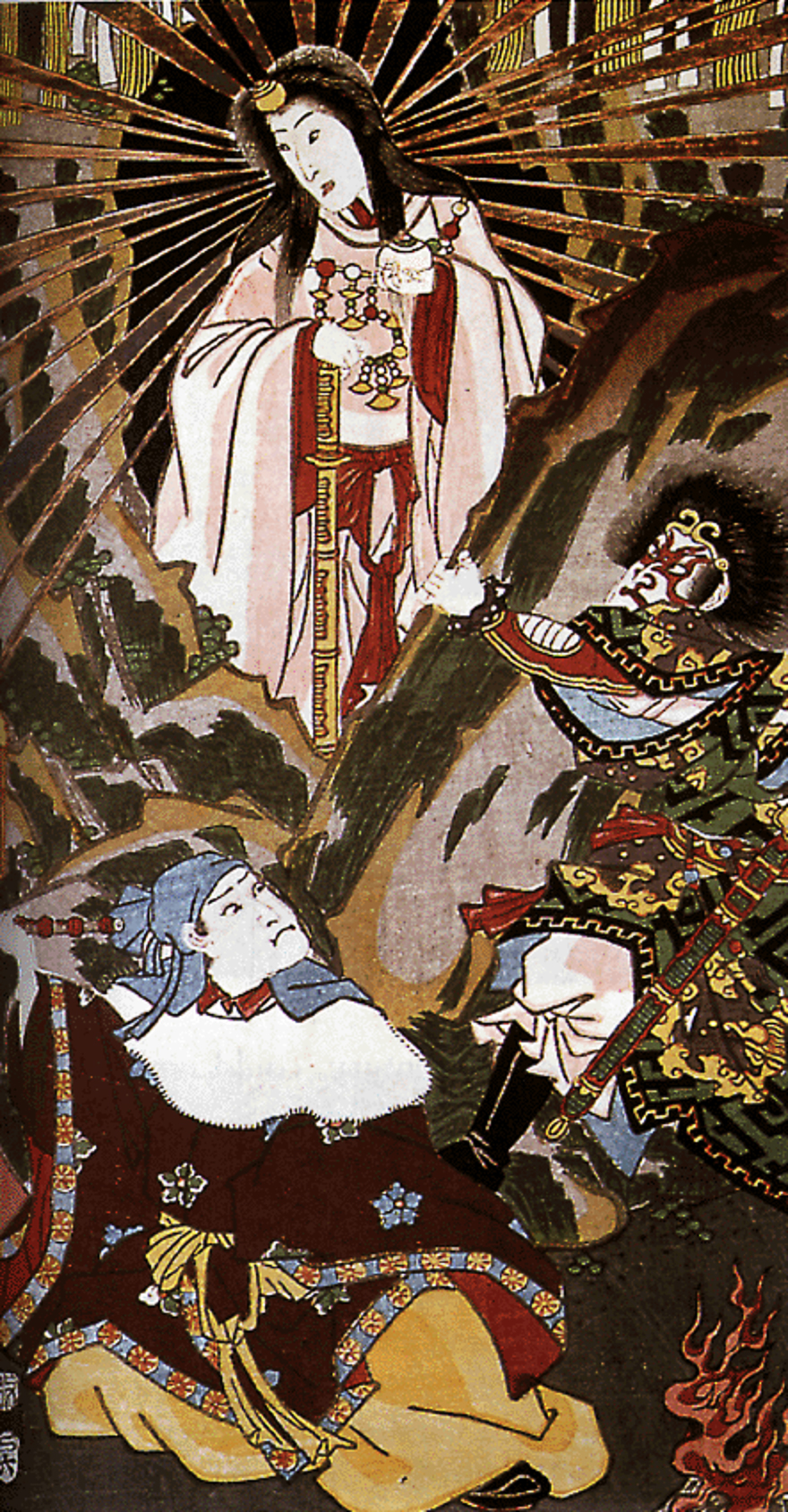


Origins and Family
The traditional genealogy has Susanoo as a child of the primordial pair Izanagi and Izanami. Classical accounts report that Susanoo, together with his siblings Amaterasu and Tsukuyomi, emerged during Izanagi's purification rites after leaving the land of Yomi. Different texts record the specific birth acts: Amaterasu from the left eye, Tsukuyomi from the right eye, and Susanoo from the nose — episodes cited in many retellings and annotated editions (texts) and commentaries.
Myths and Major Episodes
One well-known cycle concerns the rivalry between Susanoo and his sister the sun goddess. A ritual contest of fateful creations precedes a destructive outburst: fields trampled, a loom desecrated and servants harmed, prompting Amaterasu to retreat to the heavenly cave and plunge the world into darkness. This sequence is described in classical chronicles and is often used to explain ritual reconciliation between kami in later performance traditions; see annotated retellings and ritual descriptions (accounts) and (analyses). The exile that follows his punishment leads Susanoo to the province of Izumo, an important stage in his narrative arc and in regional shrine cults (Izumo traditions).
Yamata-no-Orochi and the Kusanagi Sword
In Izumo he encounters an elderly couple whose daughters have been prey to the colossal eight-headed serpent Yamata-no-Orochi. Agreeing to their plea, Susanoo devises a stratagem involving sake and ambush, then slays the monster. From the beast's tail he extracts a great sword, variously named Ame-no-Murakumo-no-Tsurugi and later Kusanagi-no-Tsurugi. That blade becomes one of the Three Imperial Regalia of Japan and is transferred through mythic genealogy to Ninigi and ultimately to imperial lineage narratives associated with Emperor Jimmu. The story is commonly cited in studies of royal legitimization and symbolic objects (regalia studies).
Symbols, Attributes and Worship
Common attributes attached to Susanoo include storms, wild sea-weather, swords and sake as ritual implements. He appears in ritual contexts both as a dangerous force to be placated and as a protector against monsters and disease. Shrines dedicated to him or linked with his myths often preserve variant rites and local narratives; for comparative shrine information see regional shrine lists (north) and (south). Typical symbols and associated items include:
- Sword: the blade from Orochi's tail, an emblem of martial power and legitimacy (sword lore).
- Sake: used in the Orochi trick and in many rituals where Susanoo is propitiated (ritual use).
- Storm imagery: winds, waves and sudden weather changes (see coastal rites (coastal)).
Cultural Role and Distinctions
Susanoo's ambivalent character—capable of both havoc and heroic service—makes him a versatile figure in folklore, performing arts and local cults. He contrasts with Amaterasu's solar, orderly aspect and with Tsukuyomi's nocturnal associations, creating a mythic triad often interpreted as balancing sun, moon and storm. Modern references to Susanoo appear in literature, theater and popular media, where his motifs are adapted but retain links to the classical corpus: see modern adaptations and critical essays (modern), theatrical treatments (Noh, Kabuki), and comparative studies (comparative mythology).
Further Reading and Notable Points
For readers seeking primary-source translations and academic commentary, editions and critical studies remain the best starting point; many university presses and museum catalogues compile annotated texts and shrine records (text collections). Susanoo's myths illuminate early Japanese ideas about purification, sovereignty and human–nature relations; they also show how myth can justify political authority, as with the transfer of sacred objects to mortal rulers (political ritual) and in the construction of regional identities in places like Izumo (regional identity).
Questions and answers
Q: Who is Susanoo?
A: Susanoo is the kami of the sea and storms in Shinto. He is the brother of Amaterasu, the goddess of the sun, and Tsukuyomi, the god of the moon. All three were created from Izanagi when he washed his face to cleanse himself from Yomi, the underworld.
Q: How did Susano'o and Amaterasu interact?
A: Susano'o and Amaterasu had a great rivalry between them. When Susano'o was about to leave Heaven forever because Izanagi ordered him to, he went to say goodbye to his sister. Amaterasu proposed him a challenge where each would turn an object of each other's into people. However, Susano'o destroyed her rice fields and killed one of her assistants in anger which caused Amaterasu to hide inside Ama-no-Iwato so that Sun was hidden for a long time. As punishment for this action, Susano'o was banished from Heaven.
Q: What happened when Susano'o arrived in Izumo?
A: When Susano'o arrived in Izumo, he met an old couple who told him that seven out of their eight daughters had been eaten by Yamata-no-Orochi and it was about to come for their eighth daughter Kushi-inada-hime as well. After they promised their daughter's hand in marriage to Susano’o if he saved her life, he agreed to kill Orochi with help from eight bowls of sake (one for each head). After killing Orochi with his sword Ame-no-Murakumo-no-Tsurugi ("Heaven's Cloud Gathering Sword"), later known as Kusanagi no Tsurugi ,he gave it as a reconciliation gift along with Yata no Kagami (a mirror) and magatama (sacred jewels) as proof of divine right over Earth (the three Imperial Regalia of Japan).
Q: What does Shinto refer to?
A: Shinto refers to an ancient Japanese religion which involves worshiping spirits or gods called "kami". It focuses on ritual practices such as purification ceremonies which are meant to bring good fortune or ward off evil spirits or bad luck. It also includes festivals dedicated towards honoring ancestors or deities associated with nature such as mountains or rivers.
Q: Where did Izanagi wash himself?
A: Izanagi washed himself at Yomi which is referred to as “the underworld” in Japanese mythology .It is described as a dark place filled with shadows where souls go after death before being reincarnated into another form .Yomi can be reached through crossing Sanzu River using bridges made out of feathers .
Q:What objects were given by Susanoo ? A:Susanoo gave Amaterasu Ame - no - Murakumo - no - Tsurugi ("Heaven's Cloud Gathering Sword"), later known as Kusanagi no Tsurugi ,along with Yata no Kagami (a mirror) and magatama (sacred jewels )as proofof divine right over Earth(the three Imperial RegaliaofJapan).
Related articles
Author
AlegsaOnline.com Susanoo: Storms, the Sea, and a Central Deity of Shinto Myth Leandro Alegsa
URL: https://en.alegsaonline.com/art/95276