
Battle of New Orleans (January 1815)
Final major engagement of the War of 1812 near New Orleans. A decisive American victory under Andrew Jackson that occurred after peace was negotiated in Europe, with significant political and military consequences.
Overview
The Battle of New Orleans was the last large land engagement of the War of 1812. Fought mainly on January 8, 1815, on the Plains of Chalmette a few miles downriver from New Orleans, it pitted a British expeditionary force against an American army commanded by General Andrew Jackson. Although a peace treaty had been signed in Europe shortly before the clash, slow trans-Atlantic communications meant the combatants were unaware and the battle went ahead.
Image gallery
10 Images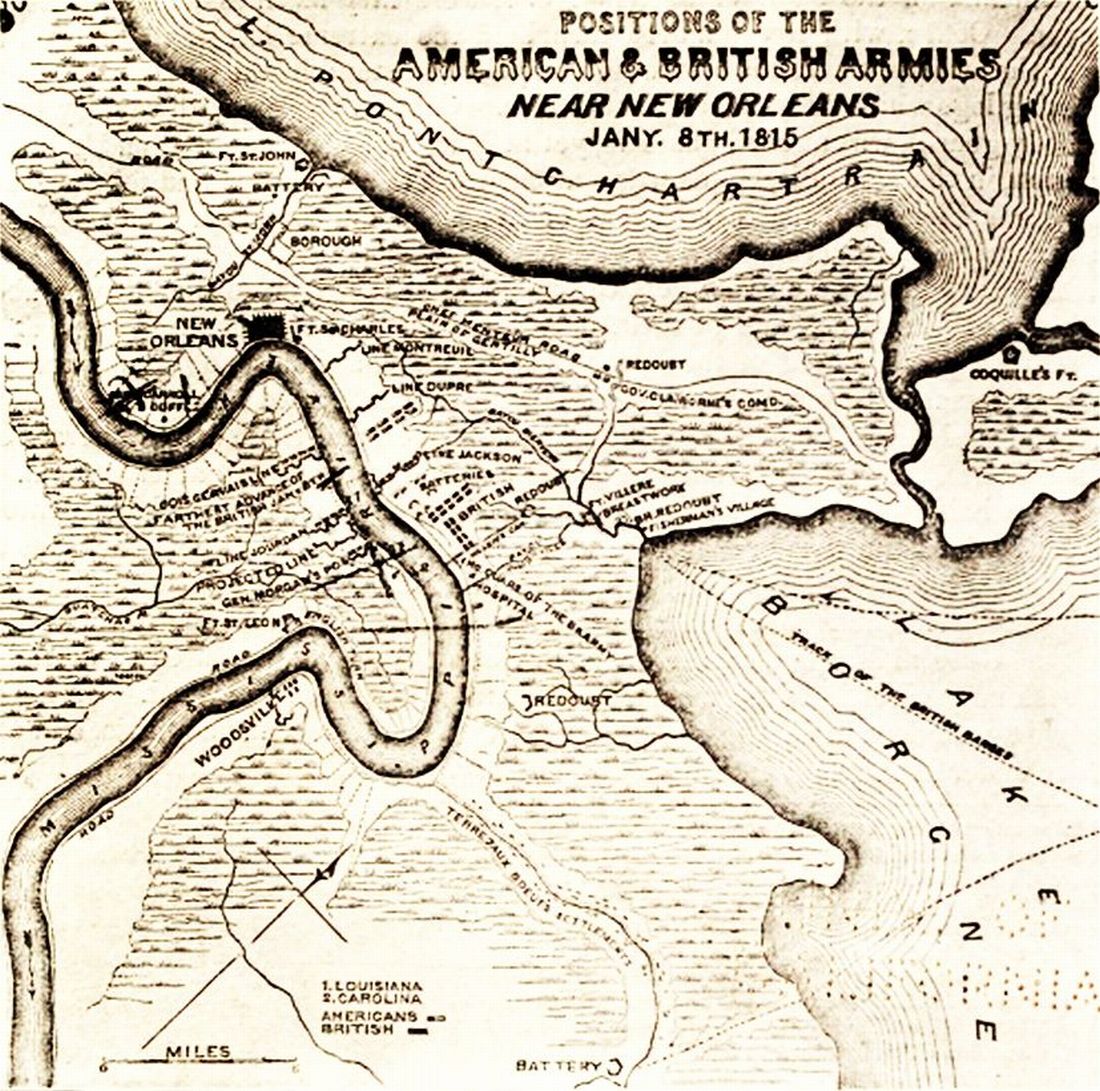


Forces, leaders and defenses
The British force, under a senior commander often identified as General Edward Pakenham, included several thousand infantry drawn from a larger expeditionary corps; many sources describe roughly 8,000 troops committed to the frontal assault from a total force in the area. The Americans were a mixed command of regulars, militia, local volunteers, free men of color, Native American allies and frontiersmen. Jackson and his officers prepared strong field works—earthworks and parapets constructed near a shallow canal and supported by artillery—that proved central to the defense.
Course of the engagement
Prior to the main attack there were a series of maneuver actions, skirmishes and naval operations as the British sought landing points and control of approaches to the city. On January 8 the British launched a planned frontal assault against the American line. The defenders, well-protected in prepared positions, inflicted heavy losses on the attacking columns. The British attack failed to break the line, and the assault ended in retreat; several senior British officers were killed or wounded during the fighting.
Aftermath and significance
Strategically the battle did not change the outcome of the wider war, because the Treaty of Ghent had already been agreed in December 1814 and eventually took effect when ratified by both sides. Nonetheless, the American victory had important political and cultural effects: it elevated the national stature of General Jackson, shaped public memory of the war in the United States, and temporarily safeguarded the Mississippi River approaches and the port city.
Notable facts and distinctions
- The engagement is often called the last major battle of the war even though it occurred after a peace settlement had been signed.
- Jackson's defensive preparations, use of locally raised forces and effective positioning were decisive.
- The battle demonstrated how slow communication in the age of sail could lead to warfare continuing after diplomatic agreements.
Further reading and context
To understand the battle in its wider diplomatic and military setting, examine accounts of the campaign and the separate naval and amphibious operations that preceded the land fight. Contemporary and later narratives focus on leadership, the diversity of American forces, and the role of terrain and fortification in the outcome. For summaries and primary-source references see general histories of the War of 1812, British operational records linked to commanders such as Pakenham and British troops referred to as infantry, and American leadership under Jackson. The national players include both the British and the Americans, and the event remains a widely studied episode in early 19th-century Atlantic warfare.
Questions and answers
Q: What was the Battle of New Orleans?
A: The Battle of New Orleans was the last battle fought in the War of 1812 between the British and the Americans.
Q: When did the Battle of New Orleans take place?
A: The main engagement of the Battle of New Orleans took place on January 8, 1815.
Q: How many infantry did the British have in the line during the Battle of New Orleans?
A: The British had 8,000 infantry in the line out of a total strength of 11,000.
Q: Who was in command of the British force during the Battle of New Orleans?
A: The British force was commanded by General Edward Pakenham.
Q: Who was in command of the American troops during the Battle of New Orleans?
A: The Americans were under the command of General Andrew Jackson.
Q: Where did the Battle of New Orleans take place?
A: The Battle of New Orleans took place at the Plains of Chalmette a few miles from New Orleans.
Q: Was the Battle of New Orleans a significant battle?
A: Yes, the Battle of New Orleans was a significant battle and is considered one of the most important battles in American history.
Related articles
Author
AlegsaOnline.com Battle of New Orleans (January 1815) Leandro Alegsa
URL: https://en.alegsaonline.com/art/9523