
Surrey — county in South East England
Surrey is a historic, mainly rural county immediately south-west of London, known for commuter towns, the Surrey Hills AONB, Guildford and links to H. G. Wells' War of the Worlds.
Not to be confused with Surrey, British Columbia. Surrey is a ceremonial and historic county in southern England, forming part of the commuter belt around London. It has long combined suburban and market towns with extensive woodland and rolling hills, and its population has exceeded one million in recent decades (a 2002 estimate gave about 1,059,000 residents).
Image gallery
10 Images





Geography and landscape
The county occupies a mix of lowland river valleys and higher chalk and sandstone ridges. The River Thames marks part of the northern boundary. Much of the central and southern county is characterised by the Surrey Hills, an Area of Outstanding Natural Beauty, with well-known high points such as Box Hill and Leith Hill. Woodland, heath and agricultural land remain important features, giving Surrey a noticeably rural character despite its proximity to the capital.
Towns, institutions and culture
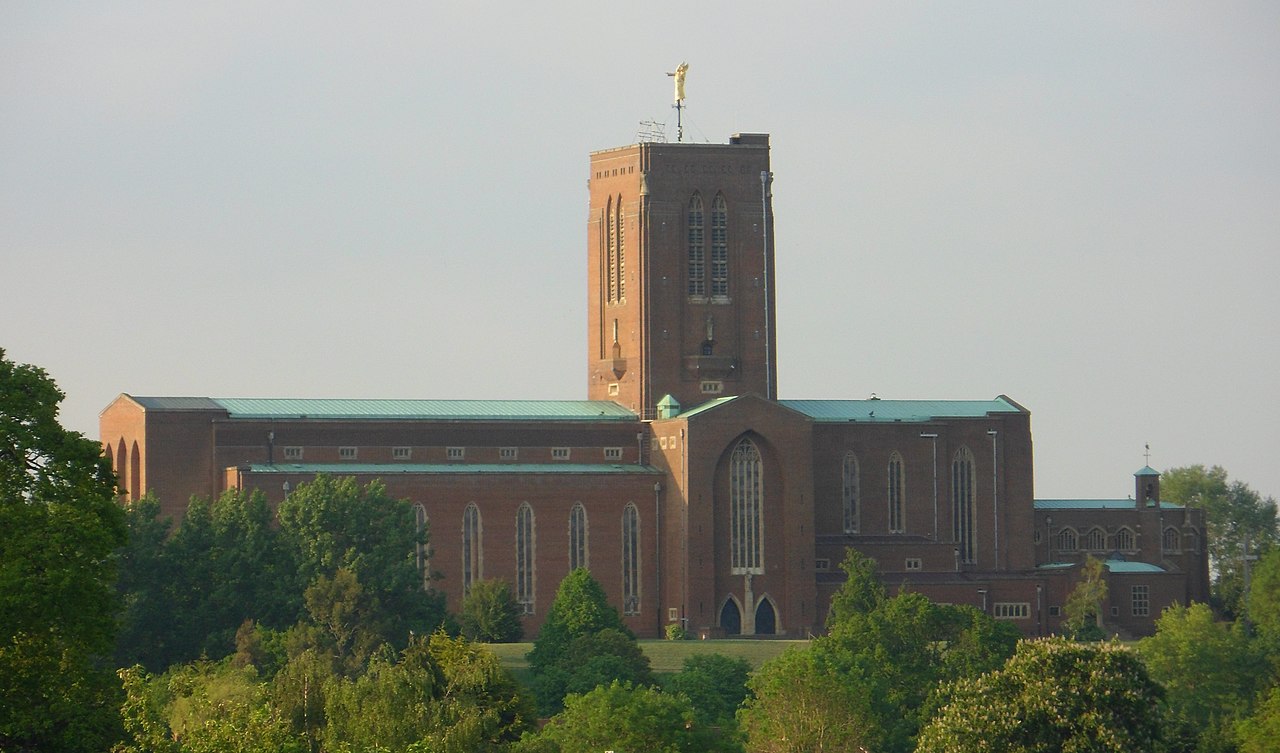
Guildford is Surrey's largest town and traditional administrative centre; it hosts the University of Surrey and a mix of commercial, cultural and retail activity. Other principal towns include Woking, Epsom, Staines and Farnham. Woking features in literature as the local setting used by H. G. Wells in his novel War of the Worlds, with specific scenes set in Woking and nearby Leatherhead.
Transport and economy
Surrey's economy is diverse: many residents commute into London while the county also supports light industry, professional services and research parks linked to the university. Good transport links are a defining feature. Major roads such as the M25 orbital motorway and routes including the M3 and M23 cross the county, and rail services provide frequent journeys into central London. Air travel is convenient with both Heathrow and Gatwick airports accessible from many parts of Surrey.
Notable facts and distinctions
- Surrey combines urban suburbs and protected countryside, which makes it a prominent example of London’s commuter hinterland.
- The Surrey Hills AONB is valued for recreation, conservation and scenic landscapes.
- Historical and literary associations — from market towns to Victorian novels — are a visible part of the county’s identity.
Surrey’s mix of transport connectivity, green spaces and historic towns gives it a distinctive role in the south-east of England: close to the capital, yet retaining large areas of protected landscape and local character.
Geography
Surrey is divided by the chalk ridge of the North Downs, which runs east-west. The ridge in turn is crossed by Surrey's main rivers, the Wey and the Mole, which are tributaries of the Thames. The Thames formed Surrey's northern boundary prior to state reorganisation. North of the Downs, Surrey is largely flat and forms part of the Thames basin. Geologically this area is defined by London Clay to the east, Bagshot Sand to the west and alluvial deposits along the rivers. South of the Downs and in the western part of the county are the Surrey Hills, composed of sandstone. Further east is the flat Low Weald landscape, which extends to the edge of the High Weald in the extreme south-east. The Downs and the southern area form part of a circular structure of geological deposits which also spreads across south Kent and large parts of Sussex. This structure is predominantly composed of Wealden Clay, Lower Greensand and the limestone of the Downs.
History
The name Surrey derives from the Saxon "Sūþrīge" or "Suthrige", the name for the "Southern Region" of the Kingdom of Middlesex ("Middle Saxony"). In fact, to this day Surrey lies south of the former County of Middlesex, i.e. today's Greater London.
Surrey was formerly divided into 14 hundreds. Until 1889, Surrey also included the boroughs of Lambeth, Southwark and Wandsworth, which are now part of London. In 1965 the boroughs Croydon, Kingston upon Thames, Merton, Richmond upon Thames and Sutton became parts of Greater London; in exchange Surrey received Spelthorne from Middlesex.
In the 1974 local government reform, London Gatwick Airport and the surrounding land were assigned to West Sussex. Horley and Charlwood were also to be added to West Sussex; however, this was reversed due to angry protests from the population.
Related articles
Author
AlegsaOnline.com Surrey — county in South East England Leandro Alegsa
URL: https://en.alegsaonline.com/art/95202